QUESTION IMAGE
Question
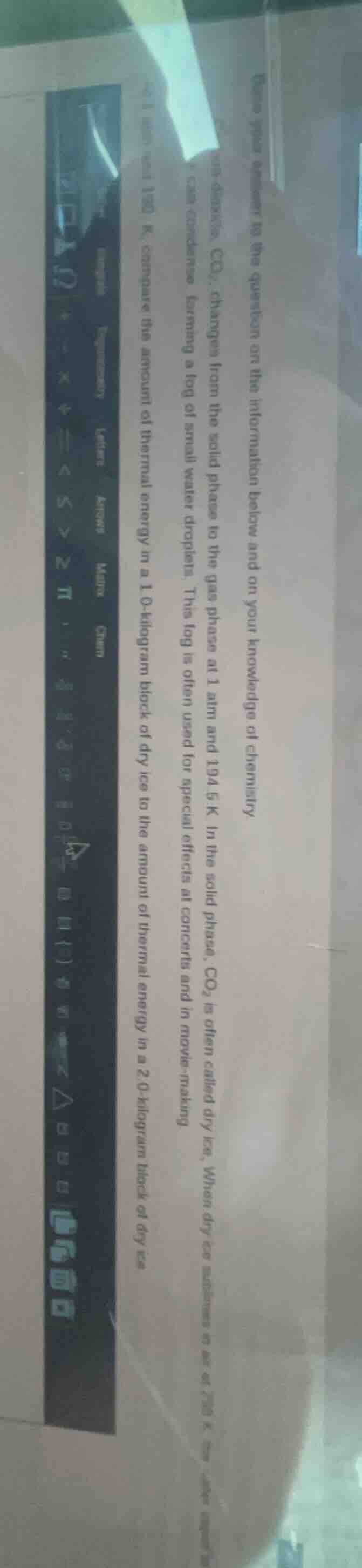
base your answer to the question on the information below and on your knowledge of chemistry
carbon dioxide, co₂, changes from the solid phase to the gas phase at 1 atm and 194.5 k. in the solid phase, co₂ is often called dry ice. when dry ice sublimes in air at 293 k, the water vapor in the air can condense, forming a fog of small water droplets. this fog is often used for special effects at concerts and in movie-making
at 190. k, compare the amount of thermal energy in a 1.0-kilogram block of dry ice to the amount of thermal energy in a 2.0-kilogram block of dry ice
Step1: Relate mass to thermal energy
Thermal energy (for same substance at same temp) is directly proportional to mass:
$E \propto m$
Step2: Compare the two blocks
Let $E_1$ = energy in 1.0 kg block, $E_2$ = energy in 2.0 kg block.
$\frac{E_2}{E_1} = \frac{2.0\ \text{kg}}{1.0\ \text{kg}} = 2$

Snap & solve any problem in the app
Get step-by-step solutions on Sovi AI
Photo-based solutions with guided steps
Explore more problems and detailed explanations
The amount of thermal energy in the 2.0-kilogram block of dry ice is twice the amount of thermal energy in the 1.0-kilogram block of dry ice (at the same temperature, 194.5 K).