QUESTION IMAGE
Question
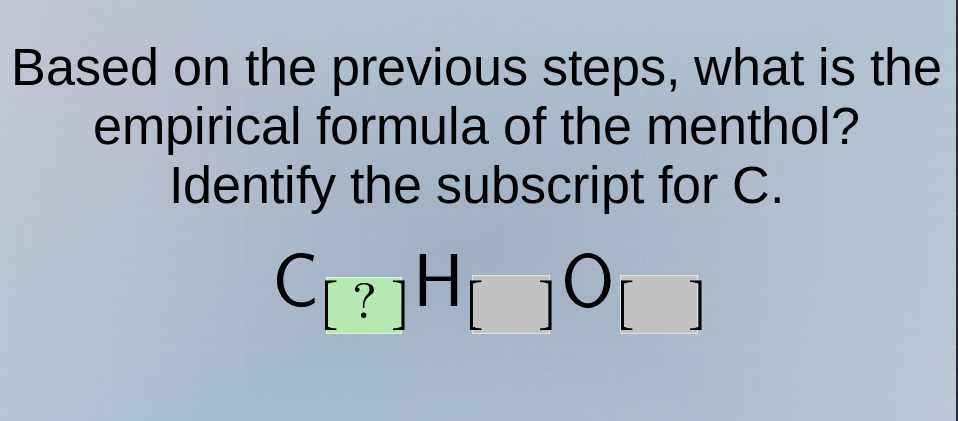
based on the previous steps, what is the empirical formula of the menthol? identify the subscript for c. c?ho
To determine the subscript for \( C \) in the empirical formula of menthol, we typically follow these steps (assuming previous steps involved determining moles of each element):
Step 1: Recall Empirical Formula Basics
The empirical formula gives the simplest whole - number ratio of atoms in a compound. For menthol (\( \text{C}_{10}\text{H}_{20}\text{O} \) molecular formula), to find the empirical formula, we divide the subscripts by their greatest common divisor (GCD).
Step 2: Find GCD of Subscripts
For \( \text{C}_{10}\text{H}_{20}\text{O} \), the subscripts are 10 (for C), 20 (for H), and 1 (for O). The GCD of 10, 20, and 1 is 1? Wait, no. Wait, actually, the molecular formula of menthol is \( \text{C}_{10}\text{H}_{20}\text{O} \), and to get the empirical formula, we check the ratios. The ratio of C:H:O in molecular formula is 10:20:1. The GCD of 10, 20, and 1 is 1? No, wait, 10 and 20 have a GCD of 10, but 1 and 10 have a GCD of 1. Wait, no, actually, the empirical formula of menthol is \( \text{C}_{10}\text{H}_{20}\text{O} \) is not correct. Wait, no, let's think again. Wait, menthol has a molecular formula of \( \text{C}_{10}\text{H}_{20}\text{O} \), and when we simplify the ratios: 10:20:1. The GCD of 10, 20, and 1 is 1? No, 10 and 20 can be divided by 10, but 1 can't be divided by 10. Wait, no, maybe I made a mistake. Wait, actually, the empirical formula of menthol is \( \text{C}_{10}\text{H}_{20}\text{O} \) is the same as the molecular formula? No, that can't be. Wait, no, let's check the molar masses. The molar mass of menthol is about 156 g/mol. Let's calculate the molar mass of \( \text{C}_{10}\text{H}_{20}\text{O} \): \( (10\times12.01)+(20\times1.008)+16.00 = 120.1+20.16 + 16.00=156.26\space g/mol \), which matches the molar mass of menthol. So the molecular formula and empirical formula are the same here because the ratio 10:20:1 cannot be simplified further (since 1 and 10/20 have no common divisor greater than 1). Wait, but 10 and 20 have a GCD of 10, but 1 and 10 have a GCD of 1. So when we divide 10 by 10, 20 by 10, and 1 by 10, we get non - whole numbers for O. So we can't simplify the ratio further. So the empirical formula is \( \text{C}_{10}\text{H}_{20}\text{O} \), so the subscript for C is 10.

Snap & solve any problem in the app
Get step-by-step solutions on Sovi AI
Photo-based solutions with guided steps
Explore more problems and detailed explanations
10