QUESTION IMAGE
Question
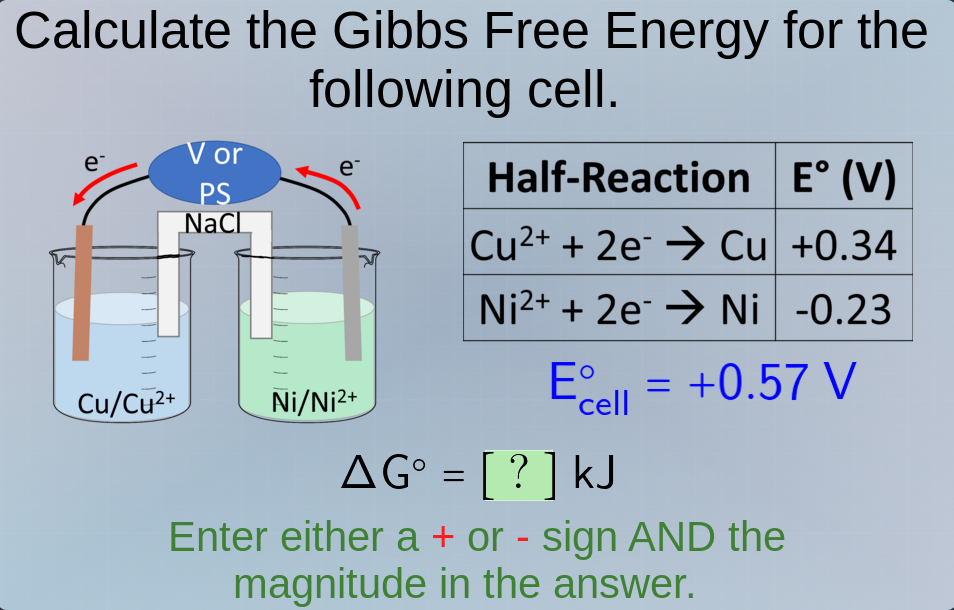
calculate the gibbs free energy for the following cell.
half-reaction | e° (v)
cu²⁺ + 2e⁻ → cu | +0.34
ni²⁺ + 2e⁻ → ni | -0.23
e°cell = +0.57 v
δg° = ? kj
enter either a + or - sign and the magnitude in the answer.
Step1: Recall the formula for Gibbs Free Energy
The formula relating Gibbs Free Energy change ($\Delta G^\circ$) and cell potential ($E^\circ_{cell}$) is $\Delta G^\circ = -nFE^\circ_{cell}$, where $n$ is the number of moles of electrons transferred, $F$ is Faraday's constant ($F = 96485\ \text{C/mol e}^-$ or approximately $96500\ \text{C/mol e}^-$), and $E^\circ_{cell}$ is the standard cell potential.
Step2: Determine the value of $n$
From the half - reactions, both $Cu^{2+}+2e^-
ightarrow Cu$ and $Ni^{2+}+2e^-
ightarrow Ni$ involve the transfer of 2 moles of electrons. So, $n = 2\ \text{mol e}^-$.
Step3: Substitute the values into the formula
We know that $n = 2\ \text{mol e}^-$, $F=96485\ \text{C/mol e}^-$, and $E^\circ_{cell}= + 0.57\ \text{V}$ (since $1\ \text{V}=1\ \text{J/C}$).
First, calculate $\Delta G^\circ$ in joules:
$\Delta G^\circ=-nFE^\circ_{cell}=-2\ \text{mol e}^-\times96485\ \text{C/mol e}^-\times0.57\ \text{V}$
$\Delta G^\circ=-2\times96485\times0.57\ \text{J}$
Calculate $2\times96485\times0.57$:
$2\times96485 = 192970$
$192970\times0.57=192970\times(0.5 + 0.07)=192970\times0.5+192970\times0.07=96485+13507.9 = 109992.9$
So, $\Delta G^\circ=- 109992.9\ \text{J}$
Step4: Convert joules to kilojoules
To convert from joules to kilojoules, divide by 1000.
$\Delta G^\circ=\frac{- 109992.9\ \text{J}}{1000}=-109.9929\ \text{kJ}\approx - 110\ \text{kJ}$ (or using $F = 96500\ \text{C/mol e}^-$ for approximation:
$\Delta G^\circ=-2\times96500\times0.57=-2\times96500\times0.57=-2\times54905=-109810\ \text{J}=-109.81\ \text{kJ}\approx - 110\ \text{kJ}$)

Snap & solve any problem in the app
Get step-by-step solutions on Sovi AI
Photo-based solutions with guided steps
Explore more problems and detailed explanations
-110