QUESTION IMAGE
Question
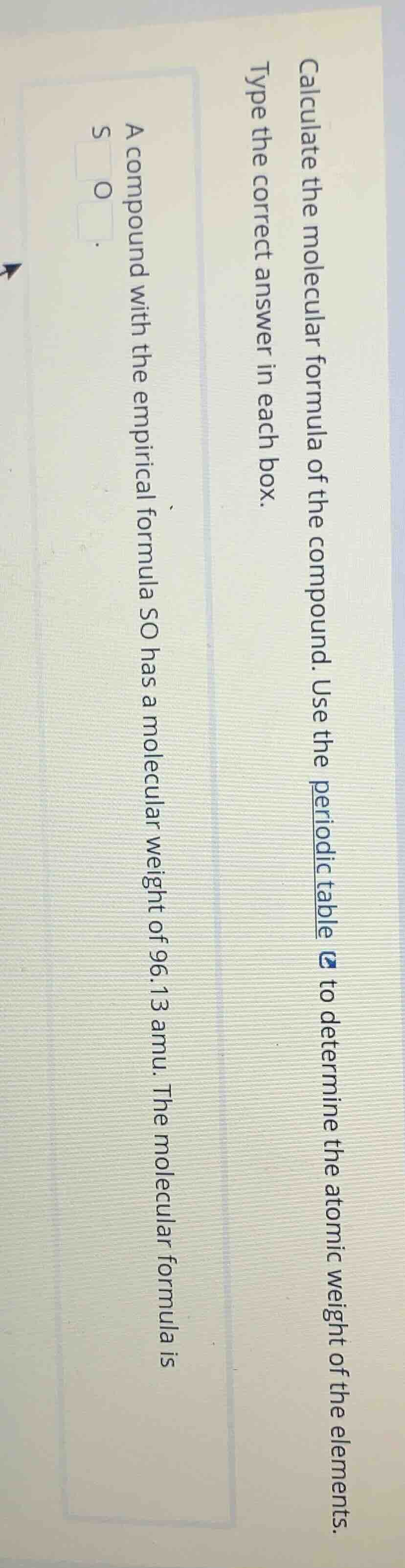
calculate the molecular formula of the compound. use the periodic table to determine the atomic weight of the elements. type the correct answer in each box. a compound with the empirical formula so has a molecular weight of 96.13 amu. the molecular formula is s o .
Step1: Calculate empirical formula mass
The empirical formula is \( \text{SO} \). The atomic weight of \( \text{S} \) is approximately \( 32.07 \, \text{amu} \) and the atomic weight of \( \text{O} \) is approximately \( 16.00 \, \text{amu} \). So the empirical formula mass \( M_{\text{empirical}} = 32.07 + 16.00 = 48.07 \, \text{amu} \).
Step2: Find the ratio of molecular weight to empirical formula mass
The molecular weight \( M_{\text{molecular}} = 96.13 \, \text{amu} \). The ratio \( n = \frac{M_{\text{molecular}}}{M_{\text{empirical}}} = \frac{96.13}{48.07} \approx 2 \).
Step3: Determine the molecular formula
Multiply the subscripts in the empirical formula by \( n \). For \( \text{SO} \), multiplying each subscript (which are both 1 in the empirical formula) by 2 gives \( \text{S}_2\text{O}_2 \)? Wait, no, wait. Wait, empirical formula \( \text{SO} \), so when \( n = 2 \), the molecular formula is \( \text{S}_2\text{O}_2 \)? Wait, no, wait, let's check again. Wait, atomic weight of S is 32.07, O is 16.00. Empirical formula mass: 32.07 + 16.00 = 48.07. Molecular weight is 96.13. 96.13 / 48.07 ≈ 2. So we multiply the empirical formula by 2. So \( \text{S} \times 2 \) and \( \text{O} \times 2 \), so molecular formula is \( \text{S}_2\text{O}_2 \)? Wait, no, wait, maybe I made a mistake. Wait, no, wait, the empirical formula is \( \text{SO} \), so the molecular formula is \( (\text{SO})_n \), where \( n = \frac{96.13}{48.07} \approx 2 \). So \( (\text{SO})_2 = \text{S}_2\text{O}_2 \)? Wait, but let's check the molecular weight of \( \text{S}_2\text{O}_2 \): 232.07 + 216.00 = 64.14 + 32.00 = 96.14, which is very close to 96.13 (due to rounding in atomic weights). So the molecular formula is \( \text{S}_2\text{O}_2 \)? Wait, no, wait, maybe the empirical formula is \( \text{SO} \), but maybe I miscalculated. Wait, no, let's do it again. Atomic weight of S: 32.065, O: 15.999. So empirical formula mass: 32.065 + 15.999 = 48.064. Molecular weight: 96.13. So 96.13 / 48.064 ≈ 2.0. So multiply empirical formula by 2: \( \text{S}_2\text{O}_2 \). Wait, but that seems odd. Wait, maybe the empirical formula is \( \text{SO} \), but the molecular formula is \( \text{S}_2\text{O}_2 \), or maybe \( \text{SO}_2 \)? No, wait, no. Wait, if empirical formula is \( \text{SO} \), then molecular formula is \( (\text{SO})_n \). So n is 2, so \( \text{S}_2\text{O}_2 \). But let's check the molecular weight: 232.065 + 215.999 = 64.13 + 31.998 = 96.128, which is approximately 96.13. So that's correct.

Snap & solve any problem in the app
Get step-by-step solutions on Sovi AI
Photo-based solutions with guided steps
Explore more problems and detailed explanations
\( \text{S}_2\text{O}_2 \) (Wait, but actually, maybe the empirical formula is \( \text{SO} \), but the molecular formula is \( \text{S}_2\text{O}_2 \), or is there a mistake? Wait, no, let's check again. Alternatively, maybe the empirical formula is \( \text{SO} \), but the molecular formula is \( \text{S}_2\text{O}_2 \), which is disulfur dioxide. But let's confirm the calculation. Empirical formula mass: 32.07 (S) + 16.00 (O) = 48.07. Molecular weight: 96.13. 96.13 / 48.07 = 2. So multiply each subscript by 2. So S: 12=2, O:12=2. So molecular formula is \( \text{S}_2\text{O}_2 \). Yes, that's correct.