QUESTION IMAGE
Question
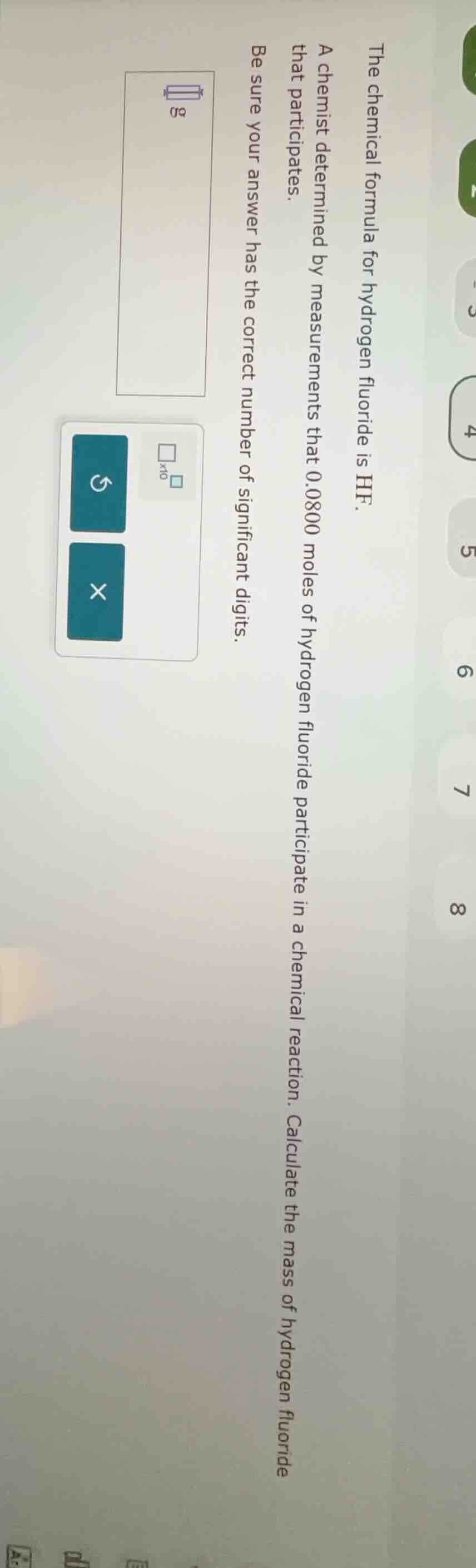
the chemical formula for hydrogen fluoride is hf. a chemist determined by measurements that 0.0800 moles of hydrogen fluoride participate in a chemical reaction. calculate the mass of hydrogen fluoride that participates. be sure your answer has the correct number of significant digits.
Step1: Find molar mass of HF
Molar mass of H (hydrogen) is \(1.008\space g/mol\), molar mass of F (fluorine) is \(19.00\space g/mol\). So molar mass of HF (\(M\)) is \(1.008 + 19.00 = 20.008\space g/mol\).
Step2: Use mass = moles × molar mass
Given moles (\(n\)) = \(0.0800\space mol\), so mass (\(m\)) = \(n\times M = 0.0800\space mol\times20.008\space g/mol\).
Calculate \(0.0800\times20.008 = 1.60064\space g\). With significant digits (0.0800 has 3 significant digits, 20.008 is precise), the result is \(1.60\space g\) (or more accurately \(1.60064\) rounded to 3 significant digits is \(1.60\), but let's check calculation again: \(0.0800\times20.008 = 1.60064\), and since 0.0800 has 3 significant figures, the answer should have 3. Wait, 0.0800 is 3 significant digits? Wait, 0.0800: the leading zeros are not significant, the 8, 0, 0 are significant, so 3 significant digits. So \(0.0800\times20.008 = 1.60064\), which rounds to \(1.60\space g\) (or maybe the molar mass is taken as 20.01 for simplicity, then \(0.0800\times20.01 = 1.6008\approx1.60\space g\)).

Snap & solve any problem in the app
Get step-by-step solutions on Sovi AI
Photo-based solutions with guided steps
Explore more problems and detailed explanations
\(1.60\space g\) (or more precisely \(1.60064\space g\) which can be rounded to \(1.60\space g\) considering significant digits)