QUESTION IMAGE
Question
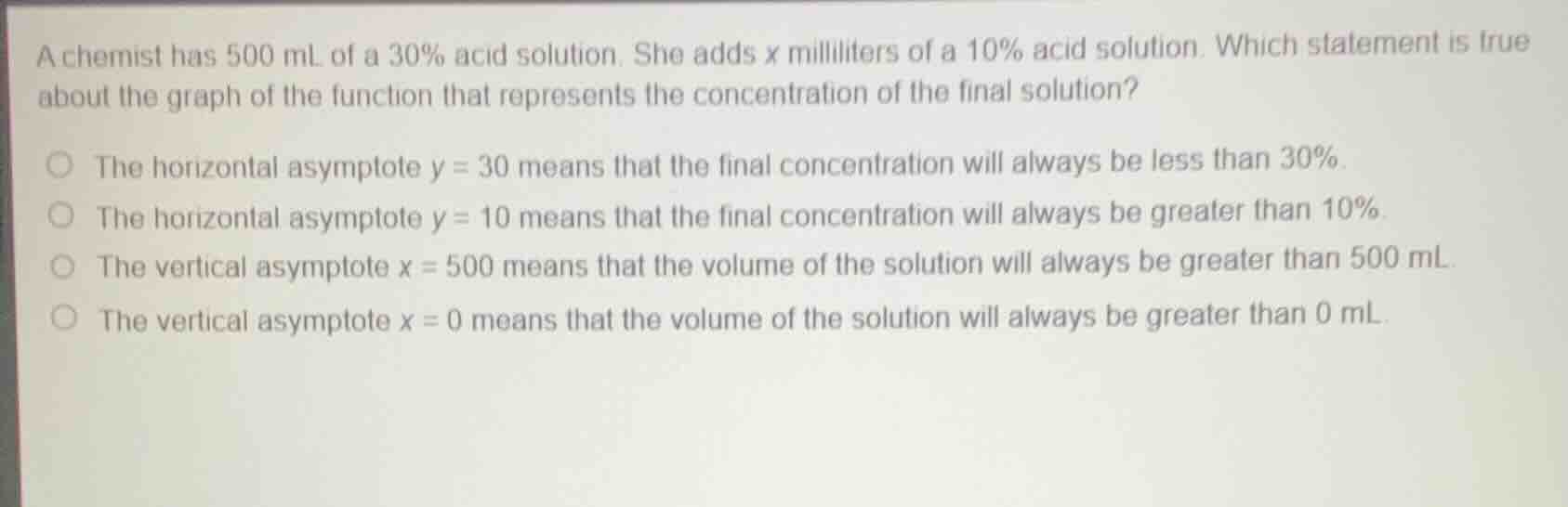
a chemist has 500 ml of a 30% acid solution. she adds x milliliters of a 10% acid solution. which statement is true about the graph of the function that represents the concentration of the final solution?
the horizontal asymptote y = 30 means that the final concentration will always be less than 30%.
the horizontal asymptote y = 10 means that the final concentration will always be greater than 10%.
the vertical asymptote x = 500 means that the volume of the solution will always be greater than 500 ml.
the vertical asymptote x = 0 means that the volume of the solution will always be greater than 0 ml.
Step1: Define concentration function
First, calculate the total amount of acid and total volume.
Total acid: $0.30 \times 500 + 0.10x = 150 + 0.10x$
Total volume: $500 + x$
Concentration function: $y = \frac{150 + 0.10x}{500 + x}$
Step2: Find horizontal asymptote
For rational functions, horizontal asymptote is determined by leading coefficients.
$\lim_{x \to \infty} \frac{0.10x + 150}{x + 500} = 0.10$ or $10\%$
Step3: Analyze asymptote meaning
Since we add a 10% solution to a 30% solution, the final concentration will always be between 10% and 30%, so it is always greater than 10%.
Step4: Eliminate incorrect options
- Horizontal asymptote is $y=10$, not $y=30$, so first option is wrong.
- The function has no vertical asymptote in the valid domain ($x \geq 0$), so third and fourth options are wrong.

Snap & solve any problem in the app
Get step-by-step solutions on Sovi AI
Photo-based solutions with guided steps
Explore more problems and detailed explanations
The horizontal asymptote $y = 10$ means that the final concentration will always be greater than 10%.