QUESTION IMAGE
Question
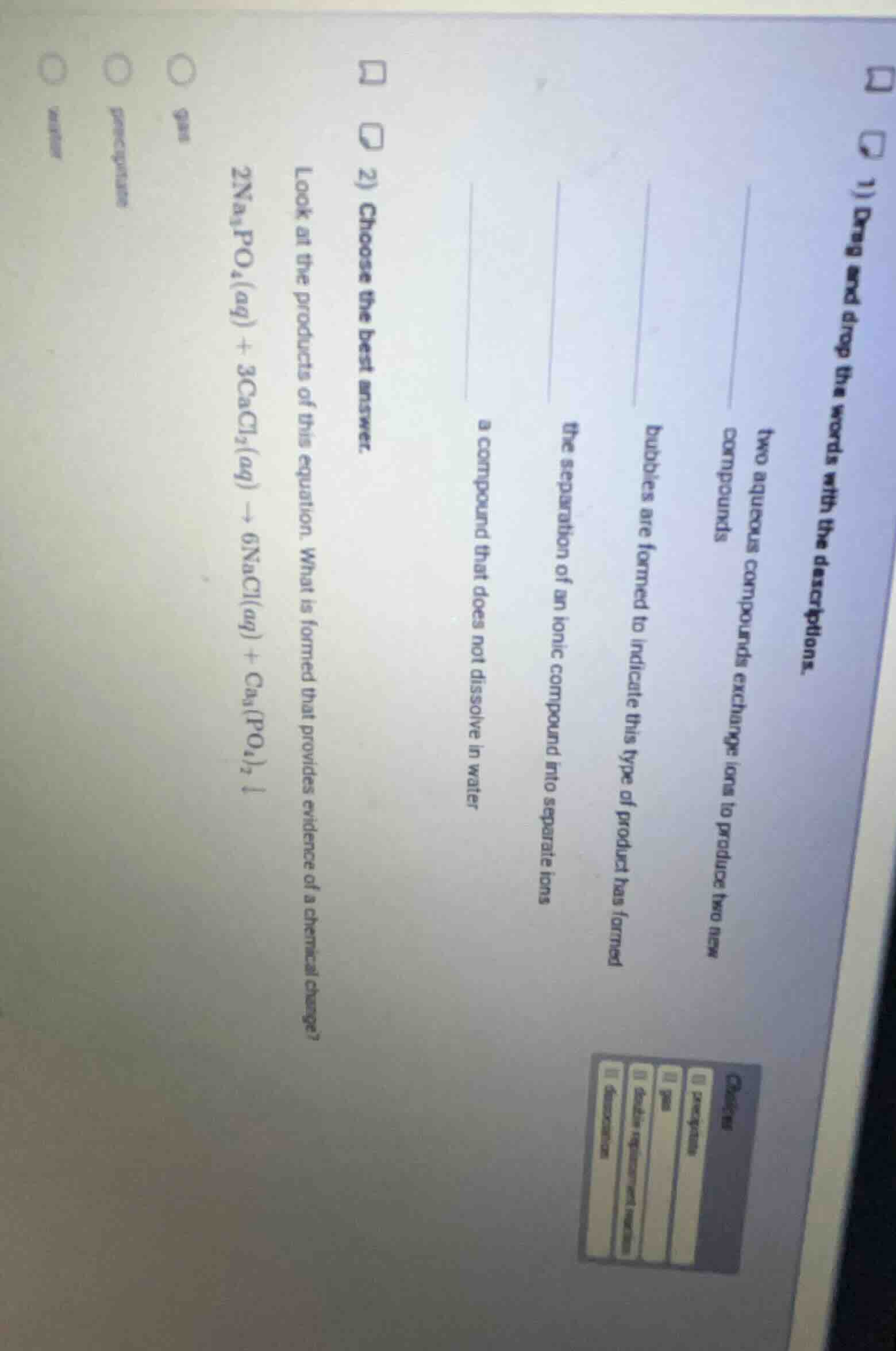
- choose the best answer. look at the products of this equation. what is formed that provides evidence of a chemical change? \\(2\text{na}_3\text{po}_4(aq) + 3\text{cacl}_2(aq) \
ightarrow 6\text{nacl}(aq) + \text{ca}_3(\text{po}_4)_2\downarrow\\) \
a compound that does not dissolve in water \
the separation of an ionic compound into separate ions \
bubbles are formed to indicate this type of product has formed \
two aqueous compounds exchange ions to produce two new compounds
Step1: Match term to double replacement
Identify the reaction description for double replacement: two aqueous compounds exchange ions to form new compounds.
Step2: Match term to gas
Identify the description for gas: bubbles indicate this product formed.
Step3: Match term to dissociation
Identify the description for dissociation: ionic compound separates into ions.
Step4: Match term to precipitate
Identify the description for precipitate: compound does not dissolve in water.
Step5: Identify chemical change evidence
Look for the product with the precipitate symbol ($\downarrow$) in the reaction: $\text{Ca}_3(\text{PO}_4)_2 \downarrow$, which is a precipitate.

Snap & solve any problem in the app
Get step-by-step solutions on Sovi AI
Photo-based solutions with guided steps
Explore more problems and detailed explanations
Part 1 (Drag-and-Drop Matches):
- double replacement reaction: two aqueous compounds exchange ions to produce two new compounds
- gas: bubbles are formed to indicate this type of product has formed
- dissociation: the separation of an ionic compound into separate ions
- precipitate: a compound that does not dissolve in water
Part 2 (Multiple Choice):
precipitate