QUESTION IMAGE
Question
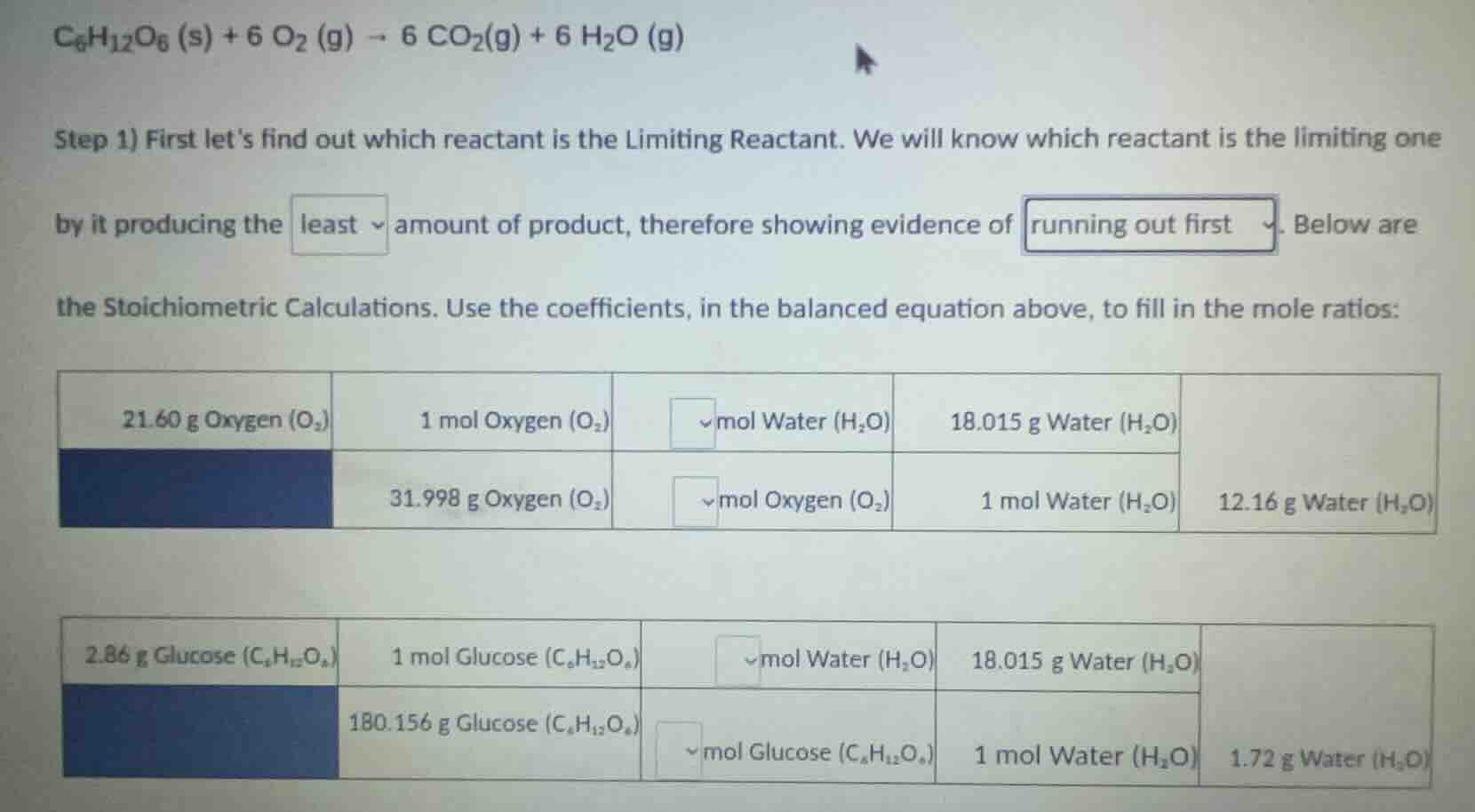
c₆h₁₂o₆ (s) + 6 o₂ (g) → 6 co₂(g) + 6 h₂o (g)
step 1) first lets find out which reactant is the limiting reactant. we will know which reactant is the limiting one by it producing the least amount of product, therefore showing evidence of running out first. below are the stoichiometric calculations. use the coefficients, in the balanced equation above, to fill in the mole ratios:
21.60 g oxygen (o₂) \t1 mol oxygen (o₂) \t□ mol water (h₂o) \t18.015 g water (h₂o)
\t\t31.998 g oxygen (o₂) \t□ mol oxygen (o₂) \t1 mol water (h₂o) \t12.16 g water (h₂o)
2.86 g glucose (c₆h₁₂o₆) \t1 mol glucose (c₆h₁₂o₆) \t□ mol water (h₂o) \t18.015 g water (h₂o)
\t\t180.156 g glucose (c₆h₁₂o₆) \t□ mol glucose (c₆h₁₂o₆) \t1 mol water (h₂o) \t1.72 g water (h₂o)
To determine the mole ratios for the reaction \( \ce{C6H12O6 (s) + 6 O2 (g) -> 6 CO2(g) + 6 H2O (g)} \), we use the coefficients from the balanced equation.
For the \( \ce{O2} \) to \( \ce{H2O} \) ratio:
From the balanced equation, 6 moles of \( \ce{O2} \) produce 6 moles of \( \ce{H2O} \). Thus, the mole ratio of \( \ce{H2O} \) to \( \ce{O2} \) is \( \frac{6\ \text{mol}\ \ce{H2O}}{6\ \text{mol}\ \ce{O2}} = \frac{1\ \text{mol}\ \ce{H2O}}{1\ \text{mol}\ \ce{O2}} \)? Wait, no—wait, the coefficients are 6 \( \ce{O2} \) and 6 \( \ce{H2O} \), so the ratio \( \ce{H2O} : \ce{O2} \) is \( 6:6 = 1:1 \)? Wait, no, let’s re-express:
The balanced equation is \( \ce{C6H12O6 + 6 O2 -> 6 CO2 + 6 H2O} \). So:
- Moles of \( \ce{H2O} \) per mole of \( \ce{O2} \): \( \frac{6\ \text{mol}\ \ce{H2O}}{6\ \text{mol}\ \ce{O2}} = 1\ \text{mol}\ \ce{H2O} / 1\ \text{mol}\ \ce{O2} \)? Wait, no—actually, the ratio of \( \ce{H2O} \) to \( \ce{O2} \) is \( 6:6 = 1:1 \). Wait, but let’s check the first table:
In the first table (for \( \ce{O2} \) to \( \ce{H2O} \)):
- Top row (converting \( \ce{O2} \) to \( \ce{H2O} \)): The mole ratio of \( \ce{H2O} \) to \( \ce{O2} \) is \( \frac{6\ \text{mol}\ \ce{H2O}}{6\ \text{mol}\ \ce{O2}} = 1\ \text{mol}\ \ce{H2O} / 1\ \text{mol}\ \ce{O2} \)? Wait, no—wait, the coefficient of \( \ce{O2} \) is 6, and \( \ce{H2O} \) is 6. So:
For the \( \ce{O2} \) → \( \ce{H2O} \) conversion:
The mole ratio is \( \frac{6\ \text{mol}\ \ce{H2O}}{6\ \text{mol}\ \ce{O2}} = 1\ \text{mol}\ \ce{H2O} / 1\ \text{mol}\ \ce{O2} \)? Wait, no, that can’t be. Wait, no—let’s do it properly.
Wait, the first table is calculating grams of \( \ce{O2} \) to grams of \( \ce{H2O} \). Let’s track the units:
\( 21.60\ \text{g}\ \ce{O2} \times \frac{1\ \text{mol}\ \ce{O2}}{31.998\ \text{g}\ \ce{O2}} \times \frac{x\ \text{mol}\ \ce{H2O}}{y\ \text{mol}\ \ce{O2}} \times \frac{18.015\ \text{g}\ \ce{H2O}}{1\ \text{mol}\ \ce{H2O}} = 12.16\ \text{g}\ \ce{H2O} \).
From the balanced equation, 6 moles \( \ce{O2} \) produce 6 moles \( \ce{H2O} \), so \( x = 6 \), \( y = 6 \) (since \( \frac{6\ \text{mol}\ \ce{H2O}}{6\ \text{mol}\ \ce{O2}} = 1 \), but wait, no—wait, the ratio is \( \frac{6\ \text{mol}\ \ce{H2O}}{6\ \text{mol}\ \ce{O2}} = 1\ \text{mol}\ \ce{H2O} / 1\ \text{mol}\ \ce{O2} \)? Wait, that simplifies to 1:1. But let’s check the calculation:
\( 21.60\ \text{g}\ \ce{O2} \times \frac{1\ \text{mol}\ \ce{O2}}{31.998\ \text{g}\ \ce{O2}} \times \frac{6\ \text{mol}\ \ce{H2O}}{6\ \text{mol}\ \ce{O2}} \times \frac{18.015\ \text{g}\ \ce{H2O}}{1\ \text{mol}\ \ce{H2O}} \)
Simplify \( \frac{6}{6} = 1 \), so:
\( 21.60 \times \frac{1}{31.998} \times 1 \times 18.015 \approx 21.60 \times 0.03125 \times 18.015 \approx 0.675 \times 18.015 \approx 12.16\ \text{g}\ \ce{H2O} \) (matches the table). So the mole ratio \( \ce{H2O} : \ce{O2} \) is \( 6:6 = 1:1 \)? Wait, no—wait, the coefficients are 6 \( \ce{O2} \) and 6 \( \ce{H2O} \), so the ratio is \( 6\ \text{mol}\ \ce{H2O} / 6\ \text{mol}\ \ce{O2} = 1\ \text{mol}\ \ce{H2O} / 1\ \text{mol}\ \ce{O2} \). So the top box (moles \( \ce{H2O} \) per mole \( \ce{O2} \)) is \( 6/6 = 1 \)? Wait, no—wait, the first table’s top row is:
\( 21.60\ \text{g}\ \ce{O2} \times \frac{1\ \text{mol}\ \ce{O2}}{31.998\ \text{g}\ \ce{O2}} \times \frac{[\text{mol}\ \ce{H2O}]}{[\text{mol}\ \ce{O2}]} \times \frac{18.015\ \text{g}\ \ce{H2O}}{1\ \text{mol}\ \ce{H2O}} \)
So the middle term (mole ratio) is \( \frac{6\ \text{mol}\ \ce{H2O}}{6\ \text{mol}\ \ce{O2}} = 1 \)? Wait, no—wait, the balanced equation is \( 6\ \ce{O2} \) → \( 6\ \ce{H2O} \), so the r…

Snap & solve any problem in the app
Get step-by-step solutions on Sovi AI
Photo-based solutions with guided steps
Explore more problems and detailed explanations
To determine the mole ratios for the reaction \( \ce{C6H12O6 (s) + 6 O2 (g) -> 6 CO2(g) + 6 H2O (g)} \), we use the coefficients from the balanced equation.
For the \( \ce{O2} \) to \( \ce{H2O} \) ratio:
From the balanced equation, 6 moles of \( \ce{O2} \) produce 6 moles of \( \ce{H2O} \). Thus, the mole ratio of \( \ce{H2O} \) to \( \ce{O2} \) is \( \frac{6\ \text{mol}\ \ce{H2O}}{6\ \text{mol}\ \ce{O2}} = \frac{1\ \text{mol}\ \ce{H2O}}{1\ \text{mol}\ \ce{O2}} \)? Wait, no—wait, the coefficients are 6 \( \ce{O2} \) and 6 \( \ce{H2O} \), so the ratio \( \ce{H2O} : \ce{O2} \) is \( 6:6 = 1:1 \)? Wait, no, let’s re-express:
The balanced equation is \( \ce{C6H12O6 + 6 O2 -> 6 CO2 + 6 H2O} \). So:
- Moles of \( \ce{H2O} \) per mole of \( \ce{O2} \): \( \frac{6\ \text{mol}\ \ce{H2O}}{6\ \text{mol}\ \ce{O2}} = 1\ \text{mol}\ \ce{H2O} / 1\ \text{mol}\ \ce{O2} \)? Wait, no—actually, the ratio of \( \ce{H2O} \) to \( \ce{O2} \) is \( 6:6 = 1:1 \). Wait, but let’s check the first table:
In the first table (for \( \ce{O2} \) to \( \ce{H2O} \)):
- Top row (converting \( \ce{O2} \) to \( \ce{H2O} \)): The mole ratio of \( \ce{H2O} \) to \( \ce{O2} \) is \( \frac{6\ \text{mol}\ \ce{H2O}}{6\ \text{mol}\ \ce{O2}} = 1\ \text{mol}\ \ce{H2O} / 1\ \text{mol}\ \ce{O2} \)? Wait, no—wait, the coefficient of \( \ce{O2} \) is 6, and \( \ce{H2O} \) is 6. So:
For the \( \ce{O2} \) → \( \ce{H2O} \) conversion:
The mole ratio is \( \frac{6\ \text{mol}\ \ce{H2O}}{6\ \text{mol}\ \ce{O2}} = 1\ \text{mol}\ \ce{H2O} / 1\ \text{mol}\ \ce{O2} \)? Wait, no, that can’t be. Wait, no—let’s do it properly.
Wait, the first table is calculating grams of \( \ce{O2} \) to grams of \( \ce{H2O} \). Let’s track the units:
\( 21.60\ \text{g}\ \ce{O2} \times \frac{1\ \text{mol}\ \ce{O2}}{31.998\ \text{g}\ \ce{O2}} \times \frac{x\ \text{mol}\ \ce{H2O}}{y\ \text{mol}\ \ce{O2}} \times \frac{18.015\ \text{g}\ \ce{H2O}}{1\ \text{mol}\ \ce{H2O}} = 12.16\ \text{g}\ \ce{H2O} \).
From the balanced equation, 6 moles \( \ce{O2} \) produce 6 moles \( \ce{H2O} \), so \( x = 6 \), \( y = 6 \) (since \( \frac{6\ \text{mol}\ \ce{H2O}}{6\ \text{mol}\ \ce{O2}} = 1 \), but wait, no—wait, the ratio is \( \frac{6\ \text{mol}\ \ce{H2O}}{6\ \text{mol}\ \ce{O2}} = 1\ \text{mol}\ \ce{H2O} / 1\ \text{mol}\ \ce{O2} \)? Wait, that simplifies to 1:1. But let’s check the calculation:
\( 21.60\ \text{g}\ \ce{O2} \times \frac{1\ \text{mol}\ \ce{O2}}{31.998\ \text{g}\ \ce{O2}} \times \frac{6\ \text{mol}\ \ce{H2O}}{6\ \text{mol}\ \ce{O2}} \times \frac{18.015\ \text{g}\ \ce{H2O}}{1\ \text{mol}\ \ce{H2O}} \)
Simplify \( \frac{6}{6} = 1 \), so:
\( 21.60 \times \frac{1}{31.998} \times 1 \times 18.015 \approx 21.60 \times 0.03125 \times 18.015 \approx 0.675 \times 18.015 \approx 12.16\ \text{g}\ \ce{H2O} \) (matches the table). So the mole ratio \( \ce{H2O} : \ce{O2} \) is \( 6:6 = 1:1 \)? Wait, no—wait, the coefficients are 6 \( \ce{O2} \) and 6 \( \ce{H2O} \), so the ratio is \( 6\ \text{mol}\ \ce{H2O} / 6\ \text{mol}\ \ce{O2} = 1\ \text{mol}\ \ce{H2O} / 1\ \text{mol}\ \ce{O2} \). So the top box (moles \( \ce{H2O} \) per mole \( \ce{O2} \)) is \( 6/6 = 1 \)? Wait, no—wait, the first table’s top row is:
\( 21.60\ \text{g}\ \ce{O2} \times \frac{1\ \text{mol}\ \ce{O2}}{31.998\ \text{g}\ \ce{O2}} \times \frac{[\text{mol}\ \ce{H2O}]}{[\text{mol}\ \ce{O2}]} \times \frac{18.015\ \text{g}\ \ce{H2O}}{1\ \text{mol}\ \ce{H2O}} \)
So the middle term (mole ratio) is \( \frac{6\ \text{mol}\ \ce{H2O}}{6\ \text{mol}\ \ce{O2}} = 1 \)? Wait, no—wait, the balanced equation is \( 6\ \ce{O2} \) → \( 6\ \ce{H2O} \), so the ratio is \( 6\ \text{mol}\ \ce{H2O} / 6\ \text{mol}\ \ce{O2} = 1 \). So the top box (moles \( \ce{H2O} \)) is 6? Wait, no, I think I messed up. Let’s re-express:
The balanced equation: \( 1\ \ce{C6H12O6} + 6\ \ce{O2} → 6\ \ce{CO2} + 6\ \ce{H2O} \).
So:
- Moles of \( \ce{H2O} \) produced from \( \ce{O2} \): For every 6 moles \( \ce{O2} \), 6 moles \( \ce{H2O} \) are produced. So the mole ratio \( \ce{H2O} : \ce{O2} \) is \( 6:6 = 1:1 \). Wait, but that would mean 1 mole \( \ce{O2} \) produces 1 mole \( \ce{H2O} \). But let’s check the calculation:
\( 21.60\ \text{g}\ \ce{O2} \times \frac{1\ \text{mol}\ \ce{O2}}{32.00\ \text{g}\ \ce{O2}} \approx 0.675\ \text{mol}\ \ce{O2} \).
Then, moles of \( \ce{H2O} \) from \( \ce{O2} \): \( 0.675\ \text{mol}\ \ce{O2} \times \frac{6\ \text{mol}\ \ce{H2O}}{6\ \text{mol}\ \ce{O2}} = 0.675\ \text{mol}\ \ce{H2O} \).
Mass of \( \ce{H2O} \): \( 0.675\ \text{mol} \times 18.015\ \text{g/mol} \approx 12.16\ \text{g} \) (matches the table). So the mole ratio \( \ce{H2O} : \ce{O2} \) is \( 6:6 = 1:1 \), so the top box (moles \( \ce{H2O} \)) is 6? Wait, no—wait, the ratio is \( \frac{6\ \text{mol}\ \ce{H2O}}{6\ \text{mol}\ \ce{O2}} \), so when filling the box for “mol Water (H₂O)” over “mol Oxygen (O₂)”, it’s \( \frac{6\ \text{mol}\ \ce{H2O}}{6\ \text{mol}\ \ce{O2}} \), which simplifies to \( 1 \)? Wait, no, the coefficients are 6 for \( \ce{O2} \) and 6 for \( \ce{H2O} \), so the ratio is \( 6:6 \), so the top box (moles \( \ce{H2O} \)) is 6, and the bottom box (moles \( \ce{O2} \)) is 6? Wait, the table has two boxes: one for “mol Water (H₂O)” and one for “mol Oxygen (O₂)”. So the ratio is \( \frac{6\ \text{mol}\ \ce{H2O}}{6\ \text{mol}\ \ce{O2}} \), so the top box (numerator, moles \( \ce{H2O} \)) is 6, and the bottom box (denominator, moles \( \ce{O2} \)) is 6.
For the \( \ce{C6H12O6} \) to \( \ce{H2O} \) ratio:
From the balanced equation, 1 mole of \( \ce{C6H12O6} \) produces 6 moles of \( \ce{H2O} \). So the mole ratio of \( \ce{H2O} \) to \( \ce{C6H12O6} \) is \( \frac{6\ \text{mol}\ \ce{H2O}}{1\ \text{mol}\ \ce{C6H12O6}} \).
Let’s verify with the table:
\( 2.86\ \text{g}\ \ce{C6H12O6} \times \frac{1\ \text{mol}\ \ce{C6H12O6}}{180.156\ \text{g}\ \ce{C6H12O6}} \approx 0.01587\ \text{mol}\ \ce{C6H12O6} \).
Moles of \( \ce{H2O} \) from \( \ce{C6H12O6} \): \( 0.01587\ \text{mol}\ \ce{C6H12O6} \times \frac{6\ \text{mol}\ \ce{H2O}}{1\ \text{mol}\ \ce{C6H12O6}} \approx 0.0952\ \text{mol}\ \ce{H2O} \). Wait, but the table says 1.72 g \( \ce{H2O} \). Wait, \( 0.0952\ \text{mol} \times 18.015\ \text{g/mol} \approx 1.715\ \text{g} \), which matches 1.72 g. So the mole ratio \( \ce{H2O} : \ce{C6H12O6} \) is \( 6:1 \). Thus, the top box (moles \( \ce{H2O} \)) is 6, and the bottom box (moles \( \ce{C6H12O6} \)) is 1.
Filling the boxes:
- For the \( \ce{O2} \) to \( \ce{H2O} \) ratio:
- Top box (mol \( \ce{H2O} \)): \( 6 \)
- Bottom box (mol \( \ce{O2} \)): \( 6 \)
- For the \( \ce{C6H12O6} \) to \( \ce{H2O} \) ratio:
- Top box (mol \( \ce{H2O} \)): \( 6 \)
- Bottom box (mol \( \ce{C6H12O6} \)): \( 1 \)
Final Answers:
- For \( \ce{O2} \) → \( \ce{H2O} \):
- Mol \( \ce{H2O} \): \( \boldsymbol{6} \)
- Mol \( \ce{O2} \): \( \boldsymbol{6} \)
- For \( \ce{C6H12O6} \) → \( \ce{H2O} \):
- Mol \( \ce{H2O} \): \( \boldsymbol{6} \)
- Mol \( \ce{C6H12O6} \): \( \boldsymbol{1} \)