QUESTION IMAGE
Question
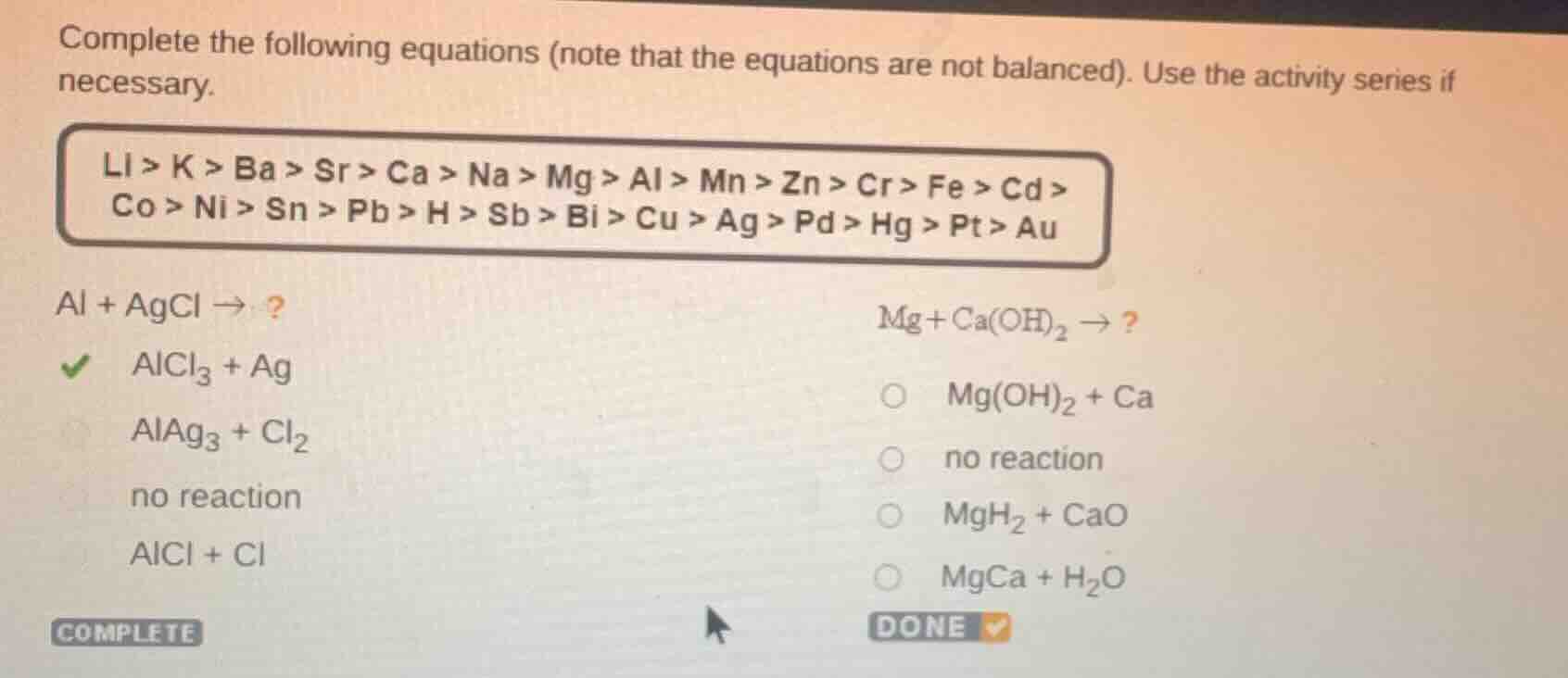
complete the following equations (note that the equations are not balanced). use the activity series if necessary.
li > k > ba > sr > ca > na > mg > al > mn > zn > cr > fe > cd >
co > ni > sn > pb > h > sb > bi > cu > ag > pd > hg > pt > au
al + agcl → ?
\talcl₃ + ag
\talag₃ + cl₂
\tno reaction
\talcl + cl
mg + ca(oh)₂ → ?
\tmg(oh)₂ + ca
\tno reaction
\tmgh₂ + cao
\tmgca + h₂o
For the reaction \( \text{Mg} + \text{Ca(OH)}_2
ightarrow \)?
Step 1: Check Activity Series
From the given activity series, we compare the reactivity of Mg and Ca. The series is \( \text{Li} > \text{K} > \text{Ba} > \text{Sr} > \text{Ca} > \text{Na} > \text{Mg} > \dots \). So, Ca is more reactive than Mg (since Ca comes before Mg in the series, meaning higher reactivity).
Step 2: Determine Reaction Possibility
In a single - displacement reaction, a more reactive metal displaces a less reactive metal from its compound. Here, Mg is less reactive than Ca. So, Mg cannot displace Ca from \( \text{Ca(OH)}_2 \). Therefore, there is no reaction.

Snap & solve any problem in the app
Get step-by-step solutions on Sovi AI
Photo-based solutions with guided steps
Explore more problems and detailed explanations
no reaction (the option: no reaction)