QUESTION IMAGE
Question
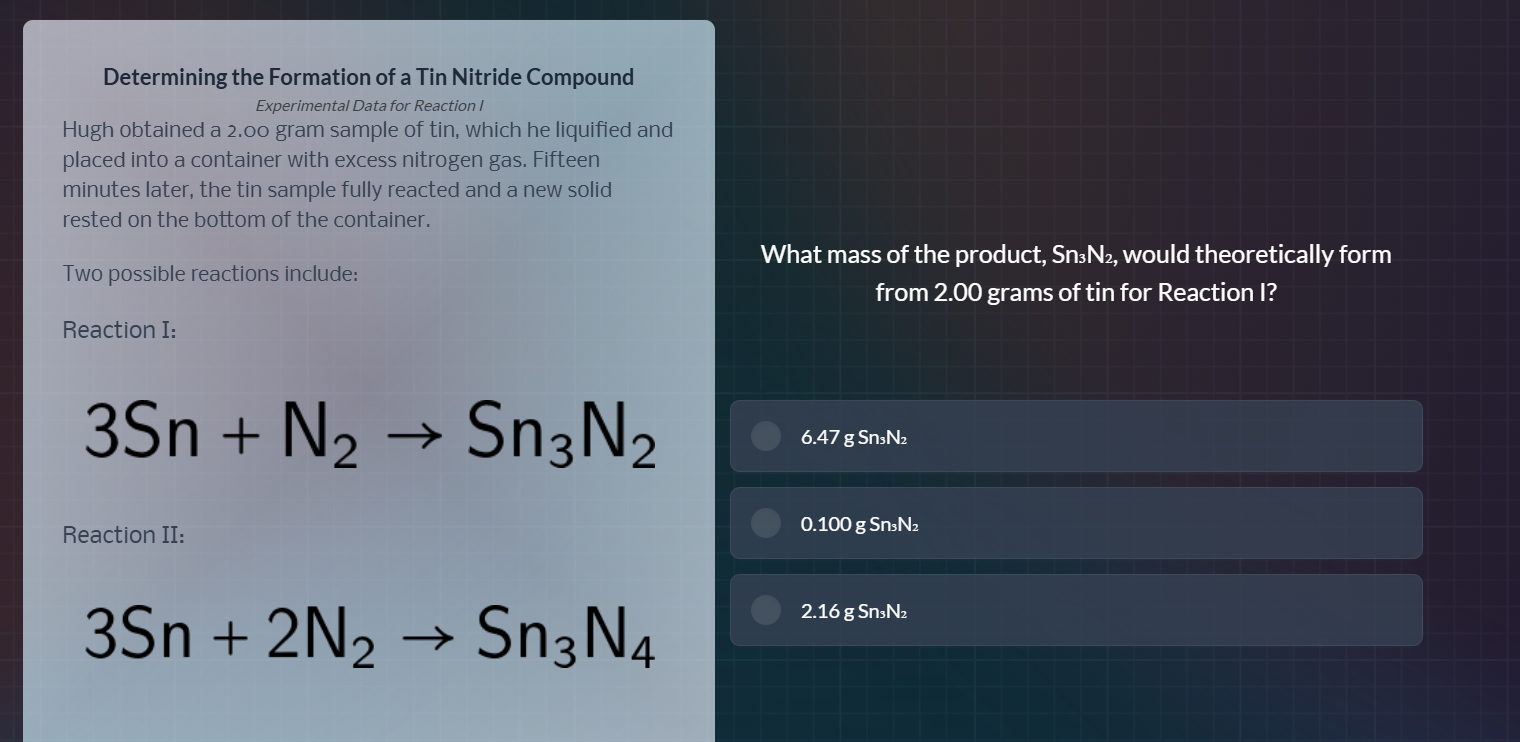
determining the formation of a tin nitride compound
experimental data for reaction i
hugh obtained a 2.00 gram sample of tin, which he liquified and placed into a container with excess nitrogen gas. fifteen minutes later, the tin sample fully reacted and a new solid rested on the bottom of the container.
two possible reactions include:
reaction i:
$3\text{sn} + \text{n}_2 \
ightarrow \text{sn}_3\text{n}_2$
reaction ii:
$3\text{sn} + 2\text{n}_2 \
ightarrow \text{sn}_3\text{n}_4$
what mass of the product, $\text{sn}_3\text{n}_2$, would theoretically form from 2.00 grams of tin for reaction i?
- $6.47\\ \text{g}\\ \text{sn}_3\text{n}_2$
- $0.100\\ \text{g}\\ \text{sn}_3\text{n}_2$
- $2.16\\ \text{g}\\ \text{sn}_3\text{n}_2$
Step1: Calculate moles of Sn
Molar mass of Sn is 118.71 g/mol. Moles of Sn = $\frac{2.00\ g}{118.71\ g/mol}$ ≈ 0.01685 mol.
Step2: Relate moles of Sn to Sn₃N₂
From reaction I: 3 mol Sn produces 1 mol Sn₃N₂. Moles of Sn₃N₂ = $\frac{0.01685\ mol}{3}$ ≈ 0.005617 mol.
Step3: Calculate mass of Sn₃N₂
Molar mass of Sn₃N₂: 3×118.71 + 2×14.01 = 356.13 + 28.02 = 384.15 g/mol. Mass = 0.005617 mol × 384.15 g/mol ≈ 2.16 g.

Snap & solve any problem in the app
Get step-by-step solutions on Sovi AI
Photo-based solutions with guided steps
Explore more problems and detailed explanations
2.16 g Sn₃N₂ (corresponding to the option "2.16 g Sn₃N₂")