QUESTION IMAGE
Question
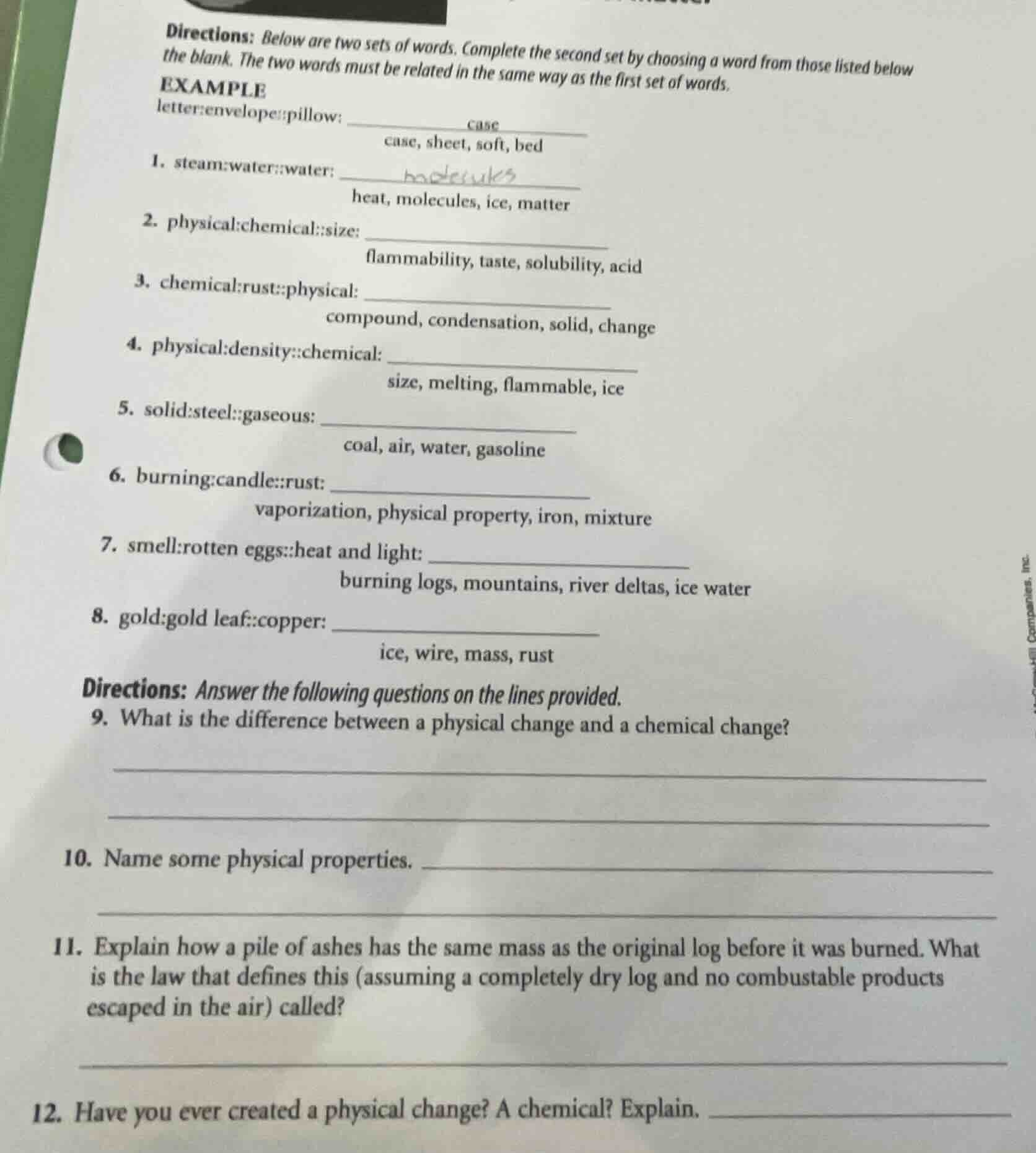
directions: below are two sets of words. complete the second set by choosing a word from those listed below the blank. the two words must be related in the same way as the first set of words.exampleletter:envelope::pillow: ____ case __case, sheet, soft, bed1. steam:water::water: __heat, molecules, ice, matter2. physical:chemical::size: __flammability, taste, solubility, acid3. chemical:rust::physical: __compound, condensation, solid, change4. physical:density::chemical: __size, melting, flammable, ice5. solid:steel::gaseous: __coal, air, water, gasoline6. burning:candle::rust: __vaporization, physical property, iron, mixture7. smell:rotten eggs::heat and light: __burning logs, mountains, river deltas, ice water8. gold:gold leaf::copper: ____ice, wire, mass, rustdirections: answer the following questions on the lines provided.9. what is the difference between a physical change and a chemical change?10. name some physical properties.11. explain how a pile of ashes has the same mass as the original log before it was burned. what is the law that defines this called?12. have you ever created a physical change? a chemical? explain.
- steam:water::water:ice: Steam is gaseous water, water is liquid; water (liquid) relates to ice (solid form of water).
- physical:chemical::size:solubility: Physical and chemical are broad property types; size is a physical property, solubility is a chemical property.
- chemical:rust::physical:condensation: Rust is an example of a chemical change; condensation is an example of a physical change.
- physical:density::chemical:flammable: Density is a specific physical property; flammable describes a specific chemical property.
- solid:steel::gaseous:air: Steel is an example of a solid; air is an example of a gaseous substance.
- burning:candle::rust:iron: Burning is a process that happens to a candle; rusting is a process that happens to iron.
- smell:rotten eggs::heat and light:burning logs: The smell of rotten eggs is a sign of that substance; heat and light are signs of burning logs.
- gold:gold leaf::copper:wire: Gold leaf is a form/use of gold; copper wire is a form/use of copper.
- A physical change alters a substance's form/appearance without creating a new substance, while a chemical change produces a new substance with different properties.
- Physical properties are observable/measurable without changing the substance's identity.
- The mass is conserved because all matter from the log is converted into ash and other combustion products (trapped here). This follows the law of conservation of mass.
- Physical changes alter form without new substances; chemical changes create new substances.

Snap & solve any problem in the app
Get step-by-step solutions on Sovi AI
Photo-based solutions with guided steps
Explore more problems and detailed explanations
- ice
- solubility
- condensation
- flammable
- air
- iron
- burning logs
- wire
- A physical change only changes a substance's physical form (no new substance is formed), while a chemical change produces an entirely new substance with different chemical properties.
- Examples include color, density, hardness, melting point, and size.
- All the matter from the original log is converted into ash and other combustion products (none escaped, per the scenario), so total mass stays the same. This is defined by the Law of Conservation of Mass.
- Example: Physical change - Melting ice (it changes from solid to liquid but is still water). Chemical change - Baking a cake (ingredients react to form a new, non-reversible substance).