QUESTION IMAGE
Question
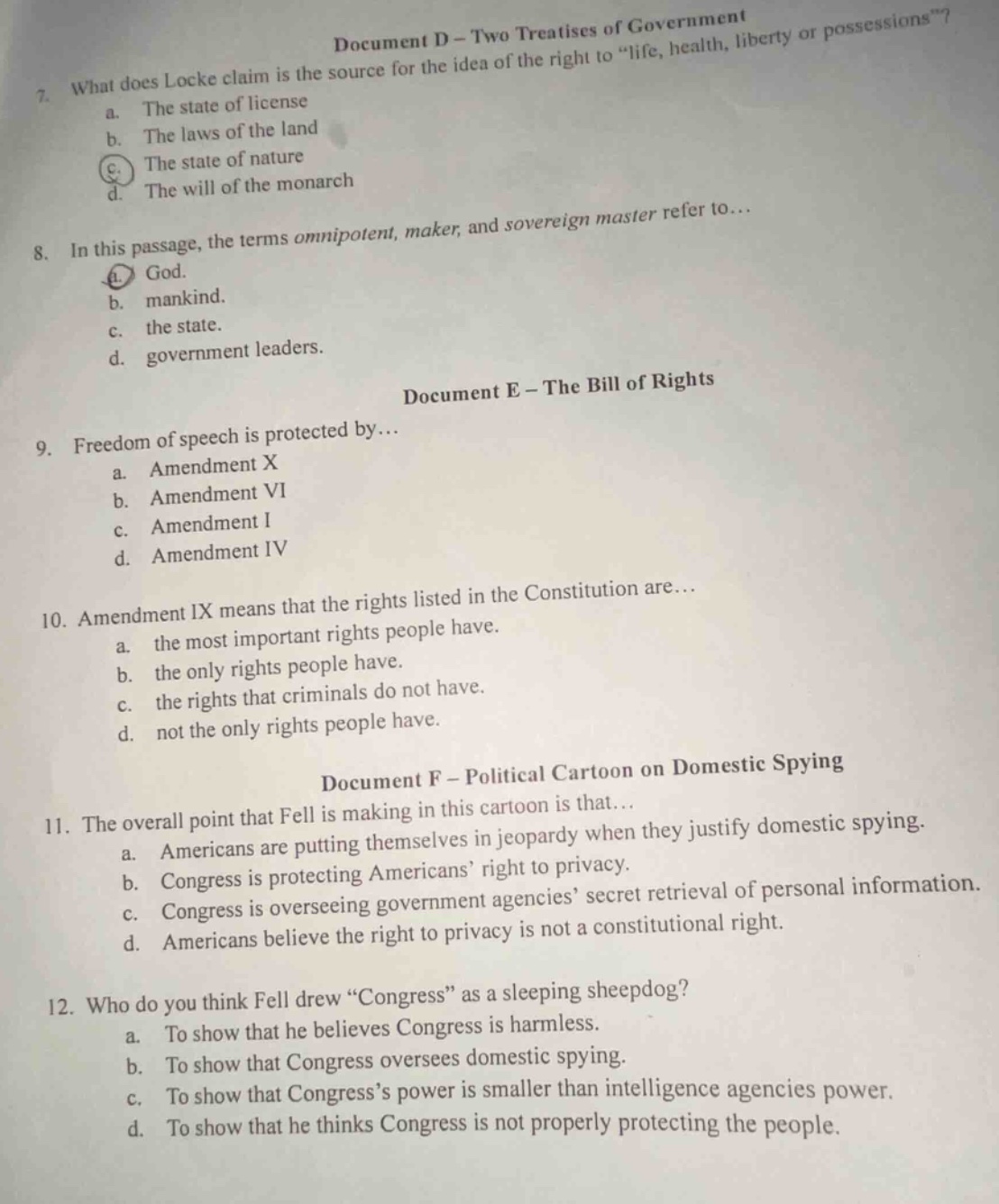
document d – two treatises of government
- what does locke claim is the source for the idea of the right to \life, health, liberty or possessions\?
a. the state of license
b. the laws of the land
c. the state of nature
d. the will of the monarch
- in this passage, the terms omnipotent, maker, and sovereign master refer to…
a. god.
b. mankind.
c. the state.
d. government leaders.
document e – the bill of rights
- freedom of speech is protected by…
a. amendment x
b. amendment vi
c. amendment i
d. amendment iv
- amendment ix means that the rights listed in the constitution are…
a. the most important rights people have.
b. the only rights people have.
c. the rights that criminals do not have.
d. not the only rights people have.
document f – political cartoon on domestic spying
- the overall point that fell is making in this cartoon is that…
a. americans are putting themselves in jeopardy when they justify domestic spying.
b. congress is protecting americans’ right to privacy.
c. congress is overseeing government agencies’ secret retrieval of personal information.
d. americans believe the right to privacy is not a constitutional right.
- who do you think fell drew “congress” as a sleeping sheepdog?
a. to show that he believes congress is harmless.
b. to show that congress oversees domestic spying.
c. to show that congress’s power is smaller than intelligence agencies power.
d. to show that he thinks congress is not properly protecting the people.
Question 7
Locke's Two Treatises of Government states that the right to "life, health, liberty or possessions" (property) comes from the state of nature, where individuals have natural rights before government. The state of license is a state of chaos, laws of the land are created by government (not the source of natural rights), and the will of the monarch is not Locke's view (he opposed divine - right monarchy).
In Locke's Two Treatises of Government, the terms “omnipotent, maker, and sovereign master” are used to refer to God, as Locke's political philosophy has a theological basis where God is the creator and sovereign. Mankind, the state, or government leaders do not fit these descriptions in this context.
The Bill of Rights' Amendment I protects freedom of speech, along with freedom of religion, press, assembly, and petition. Amendment X deals with reserved powers, Amendment VI with criminal trials, and Amendment IV with search and seizure.

Snap & solve any problem in the app
Get step-by-step solutions on Sovi AI
Photo-based solutions with guided steps
Explore more problems and detailed explanations
c. The state of nature