QUESTION IMAGE
Question
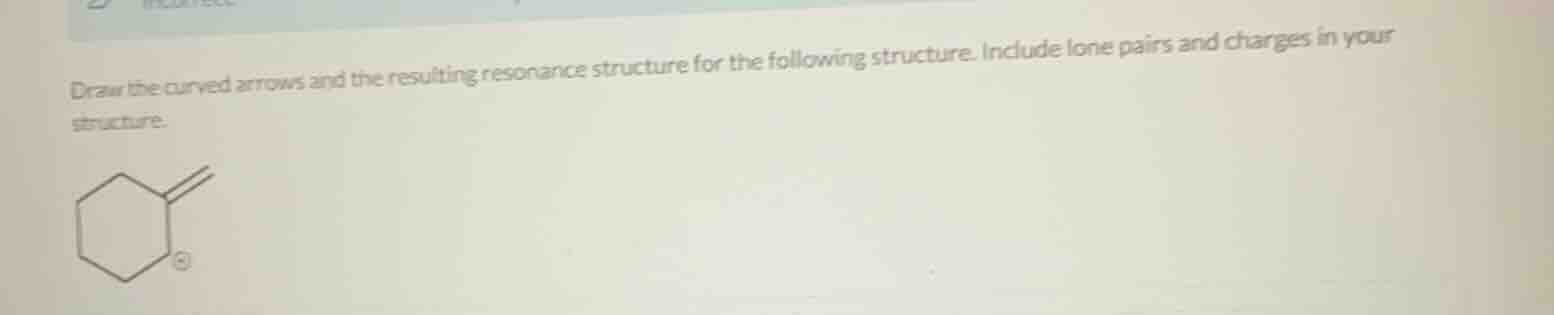
draw the curved arrows and the resulting resonance structure for the following structure. include lone pairs and charges in your structure.
Step1: Identify Resonance Movement
The given structure has a cyclohexane ring with a double bond and a positive charge on a carbon. The double bond's π electrons can move to form a new double bond, and the positive charge can shift. The curved arrow starts from the double bond (π electrons) and moves to the adjacent carbon with the positive charge.
Step2: Draw Resulting Structure
After the electron movement, the double bond shifts, and the positive charge moves to the carbon that was part of the original double bond. The new structure has the double bond in the ring, and the positive charge on the carbon adjacent to the original double - bonded carbon. The lone pairs (if any) are already considered, and the charge is properly placed.
(Note: Since this is a drawing - related problem, the key is to show the electron movement with curved arrows and the resulting resonance structure. The curved arrow should be drawn from the double bond towards the positively charged carbon, and the resulting resonance structure will have the double bond shifted and the positive charge at the appropriate carbon. Here is a textual description of the resonance structure: The cyclohexane ring now has a double bond between the carbon that was positively charged and its adjacent carbon, and the positive charge is now on the carbon that was part of the original double bond. Lone pairs are not present on any atoms in this case as the atoms are carbon (valence electrons for carbon in the ring: each carbon has 4 valence electrons, and in the ring, they are involved in single or double bonds, with the positively charged carbon having 3 valence electrons involved in bonding, so no lone pairs to show except if there were heteroatoms, which there aren't here).)

Snap & solve any problem in the app
Get step-by-step solutions on Sovi AI
Photo-based solutions with guided steps
Explore more problems and detailed explanations
(The curved arrow is drawn from the double - bond electrons towards the positively charged carbon. The resulting resonance structure has the double bond shifted in the cyclohexane ring, with the positive charge on the carbon that was part of the original double bond. A visual representation would be:
Original structure: Cyclohexane ring with a double bond (between C1 and C2) and positive charge on C3.
Curved arrow: From the double bond (C1 - C2 π electrons) to C3.
Resulting structure: Cyclohexane ring with a double bond between C2 and C3, and positive charge on C1.
(Note: Since we can't draw here, this textual description is provided. In a proper chemical drawing, the curved arrow and the resonance structure would be drawn with the correct bond and charge placements.))