QUESTION IMAGE
Question
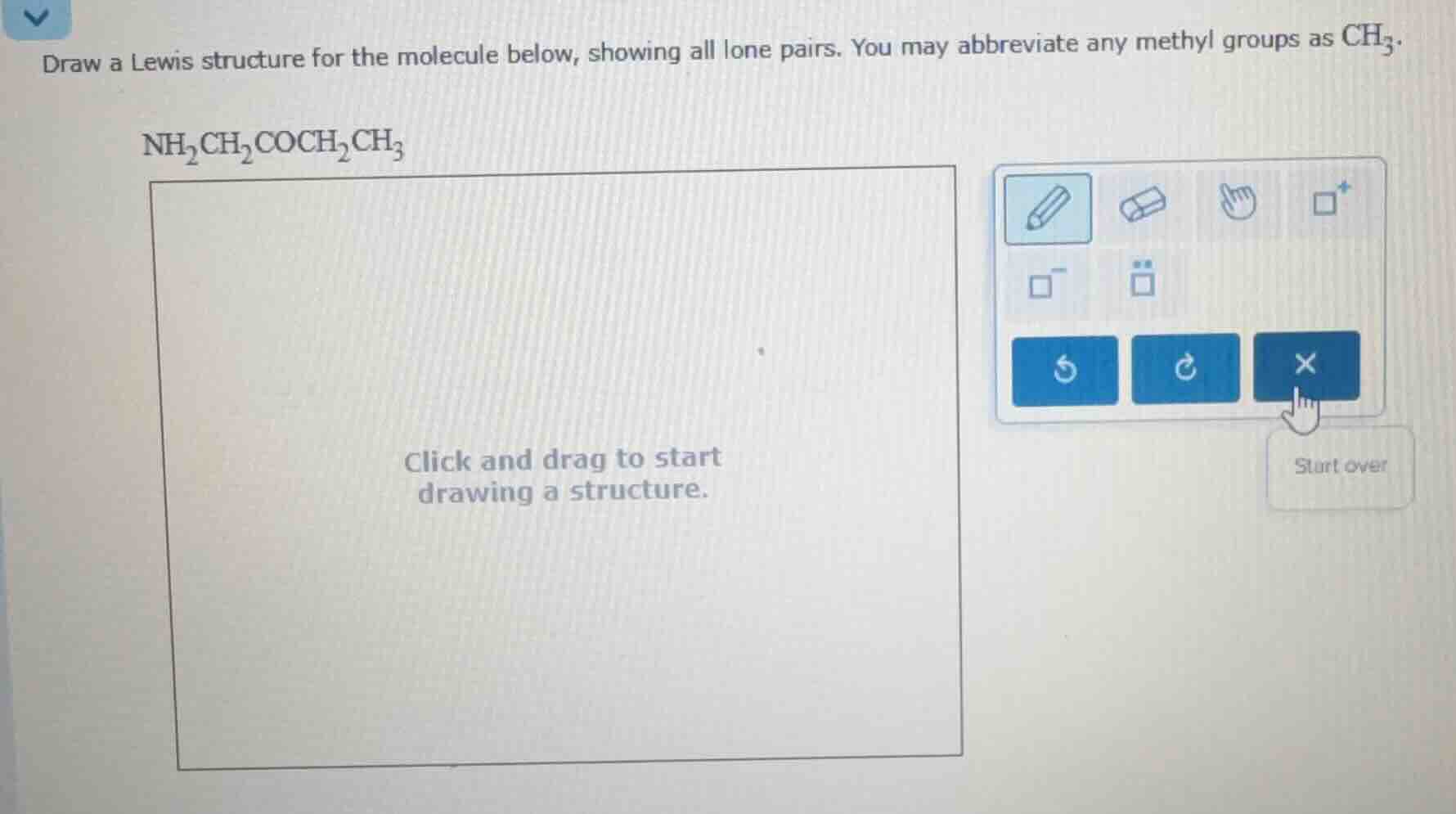
draw a lewis structure for the molecule below, showing all lone pairs. you may abbreviate any methyl groups as \\(\ce{ch_3}\\). \\(\ce{nh_2ch_2coch_2ch_3}\\) click and drag to start drawing a structure.
Step1: Identify Atoms and Bonds
The molecule is \( \text{NH}_2\text{CH}_2\text{COCH}_2\text{CH}_3 \) (which is glycine ethyl ester). Let's break down the atoms: \( \text{N} \), \( \text{H} \) (2 on N), \( \text{C} \) (first \( \text{CH}_2 \)), \( \text{C} \) (carbonyl \( \text{C} \)), \( \text{O} \) (carbonyl \( \text{O} \)), \( \text{C} \) (next \( \text{CH}_2 \)), \( \text{C} \) ( \( \text{CH}_3 \) ).
- Nitrogen (\( \text{N} \)): Valence electrons = 5. It is bonded to 2 \( \text{H} \) and 1 \( \text{C} \), so it has 1 lone pair (since \( 5 - (2 + 1) = 2 \) electrons, 1 lone pair of 2 electrons? Wait, no: \( \text{N} \) in \( \text{NH}_2 \) has 2 single bonds to \( \text{H} \) and 1 single bond to \( \text{C} \), so total bonds: 3, so lone pairs: \( 5 - 3 = 2 \) (1 lone pair of 2 electrons? Wait, lone pairs are pairs, so \( 5 - 3 = 2 \) electrons, which is 1 lone pair? No, 2 electrons is 1 lone pair (a pair is 2 electrons). Wait, \( \text{N} \) has 5 valence electrons. Bonds: 3 (2 to H, 1 to C), so non - bonding electrons: \( 5 - 3 = 2 \), which is 1 lone pair (since a lone pair is 2 electrons).
- Carbonyl Carbon (\( \text{C} \)): Double bonded to \( \text{O} \) (carbonyl) and single bonded to \( \text{CH}_2 \) (left) and \( \text{O} \) (ester)? Wait, no, the structure is \( \text{NH}_2 - \text{CH}_2 - \text{C}(= \text{O}) - \text{O} - \text{CH}_2 - \text{CH}_3 \)? Wait, no, the formula is \( \text{NH}_2\text{CH}_2\text{COCH}_2\text{CH}_3 \), which is \( \text{NH}_2 - \text{CH}_2 - \text{C}(= \text{O}) - \text{CH}_2 - \text{CH}_3 \)? Wait, that would be a ketone, but the correct structure for \( \text{NH}_2\text{CH}_2\text{COCH}_2\text{CH}_3 \) is actually \( \text{NH}_2 - \text{CH}_2 - \text{C}(= \text{O}) - \text{CH}_2 - \text{CH}_3 \) (a ketone - like but with an amino group). Wait, no, the correct functional groups: \( \text{NH}_2 \) (amino), \( \text{CH}_2 \), \( \text{CO} \) (carbonyl), \( \text{CH}_2 \), \( \text{CH}_3 \).
- Carbonyl Oxygen (\( \text{O} \)): Valence electrons = 6. It is double bonded to \( \text{C} \), so it has 2 lone pairs (since \( 6 - 2 = 4 \) electrons, 2 lone pairs of 2 electrons each).
- The other carbons (\( \text{CH}_2 \), \( \text{CH}_3 \)): \( \text{CH}_2 \) carbons are bonded to 4 atoms (single bonds), so no lone pairs. \( \text{CH}_3 \) carbon is bonded to 3 H and 1 C, no lone pairs.
- Hydrogens: All bonded with single bonds, no lone pairs.
Step2: Draw the Skeleton
- Start with the \( \text{NH}_2 \) group: Draw \( \text{N} \) with 2 single bonds to \( \text{H} \) and 1 single bond to \( \text{C} \) (of \( \text{CH}_2 \)). Add 1 lone pair on \( \text{N} \).
- Then the \( \text{CH}_2 \) group: The \( \text{C} \) from \( \text{CH}_2 \) is bonded to \( \text{N} \) (from \( \text{NH}_2 \)) and to the carbonyl \( \text{C} \) with a single bond. The \( \text{CH}_2 \) has 2 single bonds to \( \text{H} \) (not shown in abbreviation, but in Lewis structure, we can show or abbreviate as \( \text{CH}_2 \)).
- Carbonyl group (\( \text{C}= \text{O} \)): The carbonyl \( \text{C} \) is double bonded to \( \text{O} \) and single bonded to the \( \text{CH}_2 \) (from \( \text{NH}_2\text{CH}_2 \)) and to the next \( \text{CH}_2 \) (of \( \text{CH}_2\text{CH}_3 \))? Wait, no, the formula is \( \text{NH}_2\text{CH}_2\text{COCH}_2\text{CH}_3 \), which is \( \text{NH}_2 - \text{CH}_2 - \text{C}(= \text{O}) - \text{CH}_2 - \text{CH}_3 \) (a ketone). Wait, but that would be a ketone with an amino group. Let's correct: the correct structure is \( \text{NH}_2 - \text{CH}_2 - \text{C}(= \text{O}) - \text{O} -…

Snap & solve any problem in the app
Get step-by-step solutions on Sovi AI
Photo-based solutions with guided steps
Explore more problems and detailed explanations
The Lewis structure has:
- Nitrogen (\( \text{N} \)) with 1 lone pair (2 electrons).
- Carbonyl oxygen (\( \text{O} \)) with 2 lone pairs (4 electrons).
- The carbon - hydrogen and carbon - carbon bonds are single bonds, and the carbon - oxygen bond is a double bond. The structure can be drawn as \( \text{H}_2\ddot{\text{N}} - \text{CH}_2 - \text{C}(=\ddot{\text{O}}) - \text{CH}_2 - \text{CH}_3 \) (with appropriate single bonds between the carbon atoms and hydrogen atoms attached to the carbon atoms as needed, and the lone pairs shown on \( \text{N} \) and \( \text{O} \)).