QUESTION IMAGE
Question
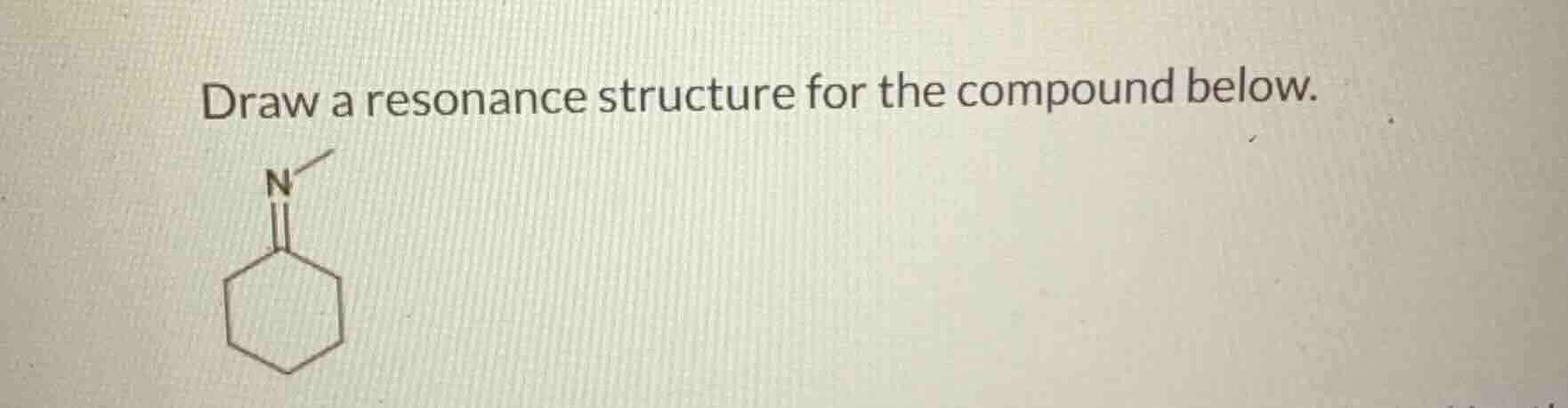
draw a resonance structure for the compound below.
To draw the resonance structure of the given compound (a cyclic ketone - like structure with a \( \text{C}=\text{N} \) bond where N is also bonded to a methyl group), we consider the movement of electrons in the \( \text{C}=\text{N} \) bond and the ring. Resonance in such structures involves the delocalization of \( \pi \) electrons or lone pairs. Here, the nitrogen has a lone pair, and we can move the \( \pi \) electrons of the \( \text{C}=\text{N} \) double bond. The original structure has a cyclohexane ring with a \( \text{C}=\text{N}(\text{CH}_3) \) group. For the resonance structure, we can transfer the double - bond electrons (from \( \text{C}=\text{N} \)) such that the nitrogen gains a negative charge (by accepting the \( \pi \) electrons) and the carbon (on the ring) gains a positive charge, or we can consider the delocalization of the lone pair on N into the double bond. The correct resonance structure would show the movement of the \( \pi \) bond electrons. The original structure is \( \ce{CH3 - N = C - (cyclohexane ring)} \). In the resonance structure, we can have the lone pair on N move to form a double bond, and the \( \pi \) electrons of the \( \text{C}=\text{N} \) bond move to the carbon, but more accurately, for a structure with a \( \text{C}=\text{N} \) bond (imino group on a cyclohexane), the resonance structure will involve the delocalization of the \( \pi \) electrons. The resonance structure can be represented as a cyclohexane ring with a carbon having a positive charge and nitrogen having a negative charge (after the movement of \( \pi \) electrons from \( \text{C}=\text{N} \) to N, giving N a lone pair and a negative charge, and the carbon a positive charge) or vice - versa depending on the electron distribution. The standard way is to show the electron movement: the double bond between C and N can shift, with N acquiring a lone pair (and a negative charge) and C (on the ring) acquiring a positive charge, while maintaining the single bond between N and \( \ce{CH3} \).

Snap & solve any problem in the app
Get step-by-step solutions on Sovi AI
Photo-based solutions with guided steps
Explore more problems and detailed explanations
The resonance structure can be drawn as follows: The cyclohexane ring with a carbon atom (adjacent to the \( \text{C}-\text{N} \) bond) having a \( + \) charge, the nitrogen atom (bonded to \( \ce{CH3} \)) having a \( - \) charge, and the bond between C and N being a single bond (while the lone pair on N is now involved in a way that creates this charge separation). Structurally, it is represented as \( \ce{CH3 - \overset{-}{N} - \overset{+}{C} - (cyclohexane ring)} \) (with the cyclohexane ring structure intact, and the charges on N and C as described). If we were to draw it with the ring:
      CH3
       |
       N⁻
       |
  +C - (cyclohexane ring)
(where the cyclohexane ring is drawn as a regular hexagon, and the \( + \) is on the carbon adjacent to N, and \( - \) is on N bonded to \( \ce{CH3} \), with a single bond between C and N now, and the double - bond electrons have moved to N to form a lone pair).