QUESTION IMAGE
Question
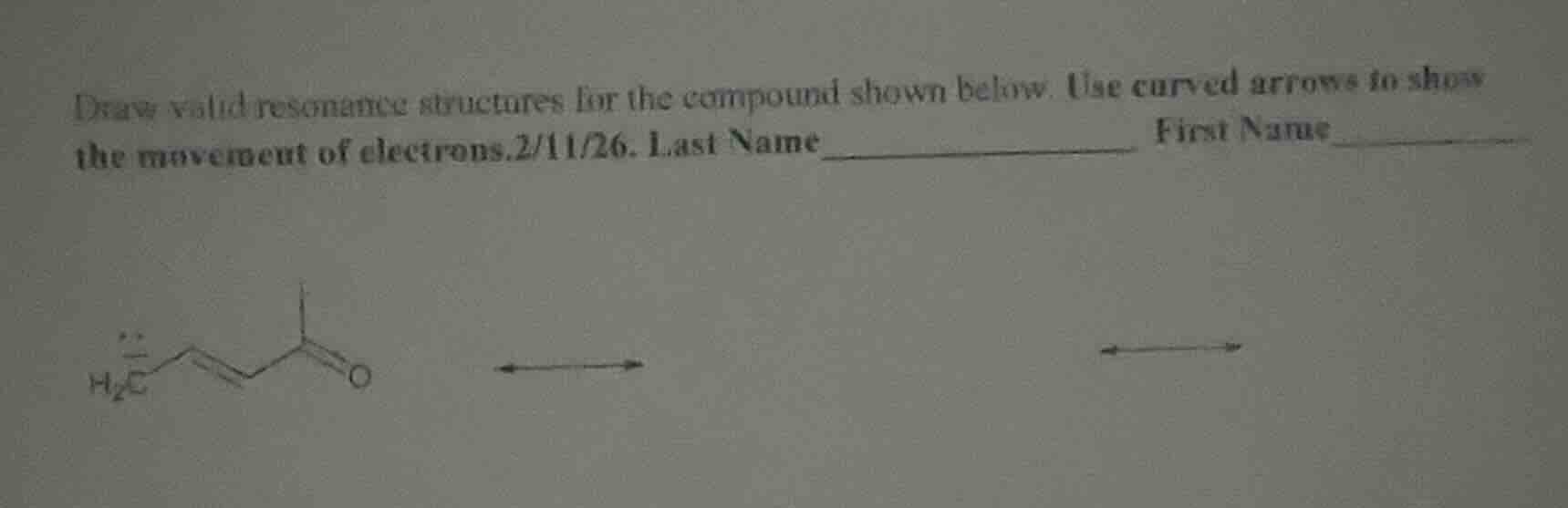
draw valid resonance structures for the compound shown below. use curved arrows to show the movement of electrons.2/11/26. last name__________________ first name_____________
Step1: First resonance electron shift
Move lone pair on terminal $\ce{CH2^-}$ to form double bond, shift adjacent double bond towards carbonyl group.
$\ce{H2\overset{-}{C}-CH=CH-CHO <-> H2C=CH-\overset{-}{C}H-CHO}$ (with curved arrow from $\ce{CH2^-}$ lone pair to adjacent C-C, and from C=C double bond to next C)
Step2: Second resonance electron shift
Move lone pair on middle $\ce{CH^-}$ to form double bond, shift carbonyl double bond to oxygen.
$\ce{H2C=CH-\overset{-}{C}H-CHO <-> H2C=CH-CH=\overset{-}{O}}$ (with curved arrow from $\ce{CH^-}$ lone pair to adjacent C-C, and from C=O double bond to O)

Snap & solve any problem in the app
Get step-by-step solutions on Sovi AI
Photo-based solutions with guided steps
Explore more problems and detailed explanations
- First resonance structure: $\ce{H2C=CH-\overset{-}{C}H-CHO}$
- Second resonance structure: $\ce{H2C=CH-CH=\overset{-}{O}}$
(With curved arrows showing electron flow: from the negatively charged carbon's lone pair to form a new double bond, and the adjacent double bond shifting towards the carbonyl/next carbon, then finally the carbonyl double bond shifting to the oxygen.)