QUESTION IMAGE
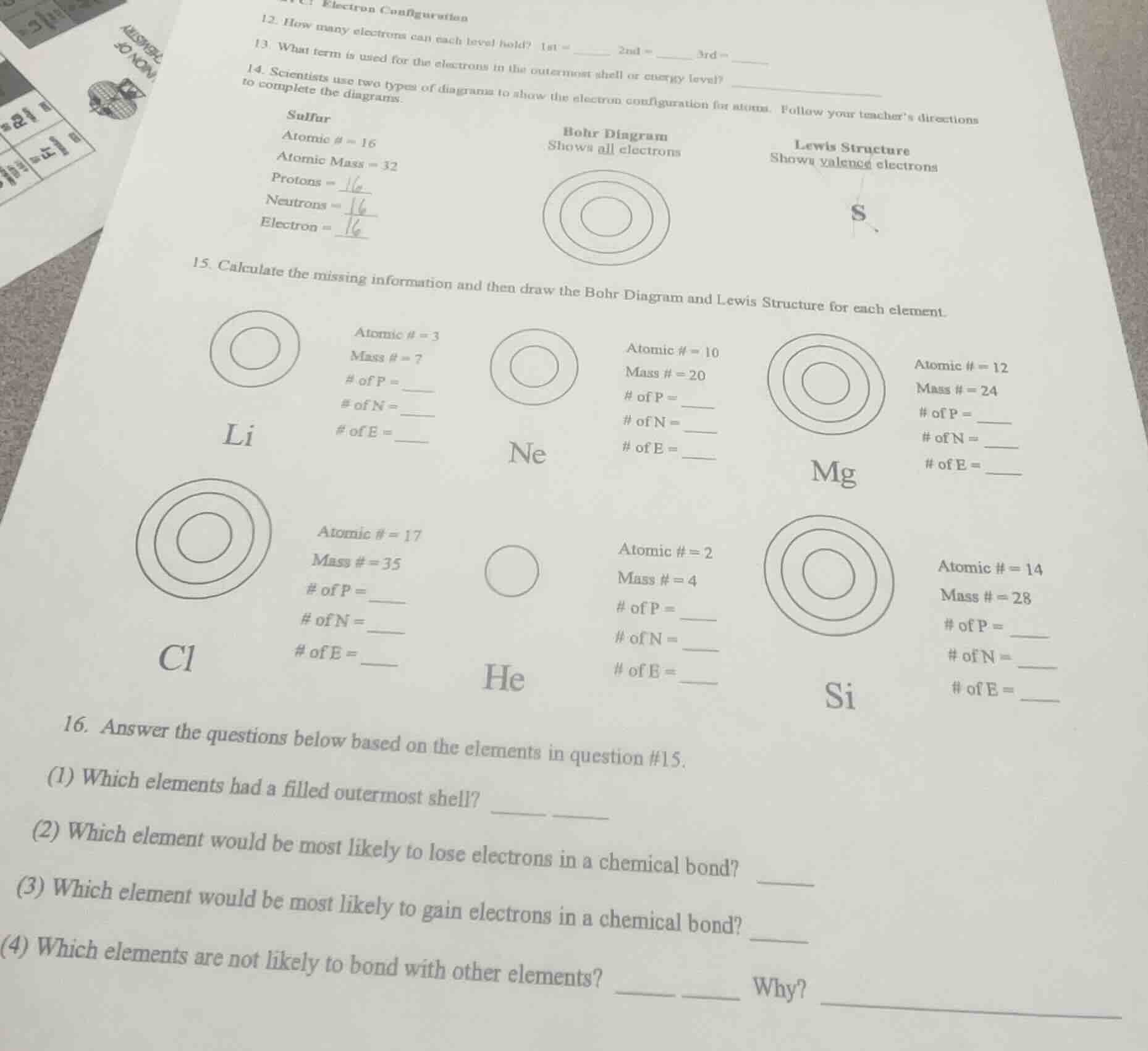
Question
electron configuration
- how many electrons can each level hold? 1st = __ 2nd = 3rd = __
- what term is used for the electrons in the outermost shell or energy level? ____
- scientists use two types of diagrams to show the electron configuration for atoms. follow your teacher’s directions to complete the diagrams.
sulfur
atomic # = 16
atomic mass = 32
protons =
neutrons =
electron =
bohr diagram
shows all electrons
lewis structure
shows valence electrons
- calculate the missing information and then draw the bohr diagram and lewis structure for each element.
li
atomic # = 3
mass # = 7
of p = ____
of n = ____
of e = ____
ne
atomic # = 10
mass # = 20
of p = ____
of n = ____
of e = ____
mg
atomic # = 12
mass # = 24
of p = ____
of n = ____
of e = ____
cl
atomic # = 17
mass # = 35
of p = ____
of n = ____
of e = ____
he
atomic # = 2
mass # = 4
of p = ____
of n = ____
of e = ____
si
atomic # = 14
mass # = 28
of p = ____
of n = ____
of e = ____
- answer the questions below based on the elements in question #15.
(1) which elements had a filled outermost shell? __ __
(2) which element would be most likely to lose electrons in a chemical bond? ____
(3) which element would be most likely to gain electrons in a chemical bond? ____
(4) which elements are not likely to bond with other elements? __ why? __
Step1: Solve Q12: Electron capacity per level
Recall electron level formula: $2n^2$
1st level ($n=1$): $2(1)^2 = 2$
2nd level ($n=2$): $2(2)^2 = 8$
3rd level ($n=3$): $2(3)^2 = 18$
Step2: Solve Q13: Define outer shell electrons
The term for outermost shell electrons is valence electrons.
Step3: Solve Q15: Calculate subatomic particles
Use rules:
- Protons ($P$) = Atomic Number
- Neutrons ($N$) = Mass Number - Atomic Number
- Electrons ($E$) = Atomic Number (neutral atoms)
Lithium (Li):
$P = 3$, $N = 7-3=4$, $E=3$
Neon (Ne):
$P=10$, $N=20-10=10$, $E=10$
Magnesium (Mg):
$P=12$, $N=24-12=12$, $E=12$
Chlorine (Cl):
$P=17$, $N=35-17=18$, $E=17$
Helium (He):
$P=2$, $N=4-2=2$, $E=2$
Silicon (Si):
$P=14$, $N=28-14=14$, $E=14$
Step4: Solve Q16: Chemical behavior questions
- Filled outer shell: Noble gases (He, Ne)
- Most likely to lose electrons: Group 1/2 metal (Li)
- Most likely to gain electrons: Group 17 nonmetal (Cl)
- Non-bonding elements: Noble gases (He, Ne), they have full valence shells.

Snap & solve any problem in the app
Get step-by-step solutions on Sovi AI
Photo-based solutions with guided steps
Explore more problems and detailed explanations
- 1st = 2, 2nd = 8, 3rd = 18
- Valence electrons
15.
- Li: # of P = 3, # of N = 4, # of E = 3
- Ne: # of P = 10, # of N = 10, # of E = 10
- Mg: # of P = 12, # of N = 12, # of E = 12
- Cl: # of P = 17, # of N = 18, # of E = 17
- He: # of P = 2, # of N = 2, # of E = 2
- Si: # of P = 14, # of N = 14, # of E = 14
16.
(1) He, Ne
(2) Li
(3) Cl
(4) He, Ne; They have a full, stable valence electron shell.
---
Diagram Notes (for Q14 and Q15):
- Sulfur Bohr Diagram: 2 electrons in 1st shell, 8 in 2nd, 6 in 3rd
- Sulfur Lewis Structure: Symbol S with 6 dots around it
- Li Bohr Diagram: 2 electrons in 1st shell, 1 in 2nd; Lewis Structure: Li with 1 dot
- Ne Bohr Diagram: 2 electrons in 1st shell, 8 in 2nd; Lewis Structure: Ne with 8 dots
- Mg Bohr Diagram: 2 electrons in 1st shell, 8 in 2nd, 2 in 3rd; Lewis Structure: Mg with 2 dots
- Cl Bohr Diagram: 2 electrons in 1st shell, 8 in 2nd, 7 in 3rd; Lewis Structure: Cl with 7 dots
- He Bohr Diagram: 2 electrons in 1st shell; Lewis Structure: He with 2 dots
- Si Bohr Diagram: 2 electrons in 1st shell, 8 in 2nd, 4 in 3rd; Lewis Structure: Si with 4 dots