QUESTION IMAGE
Question
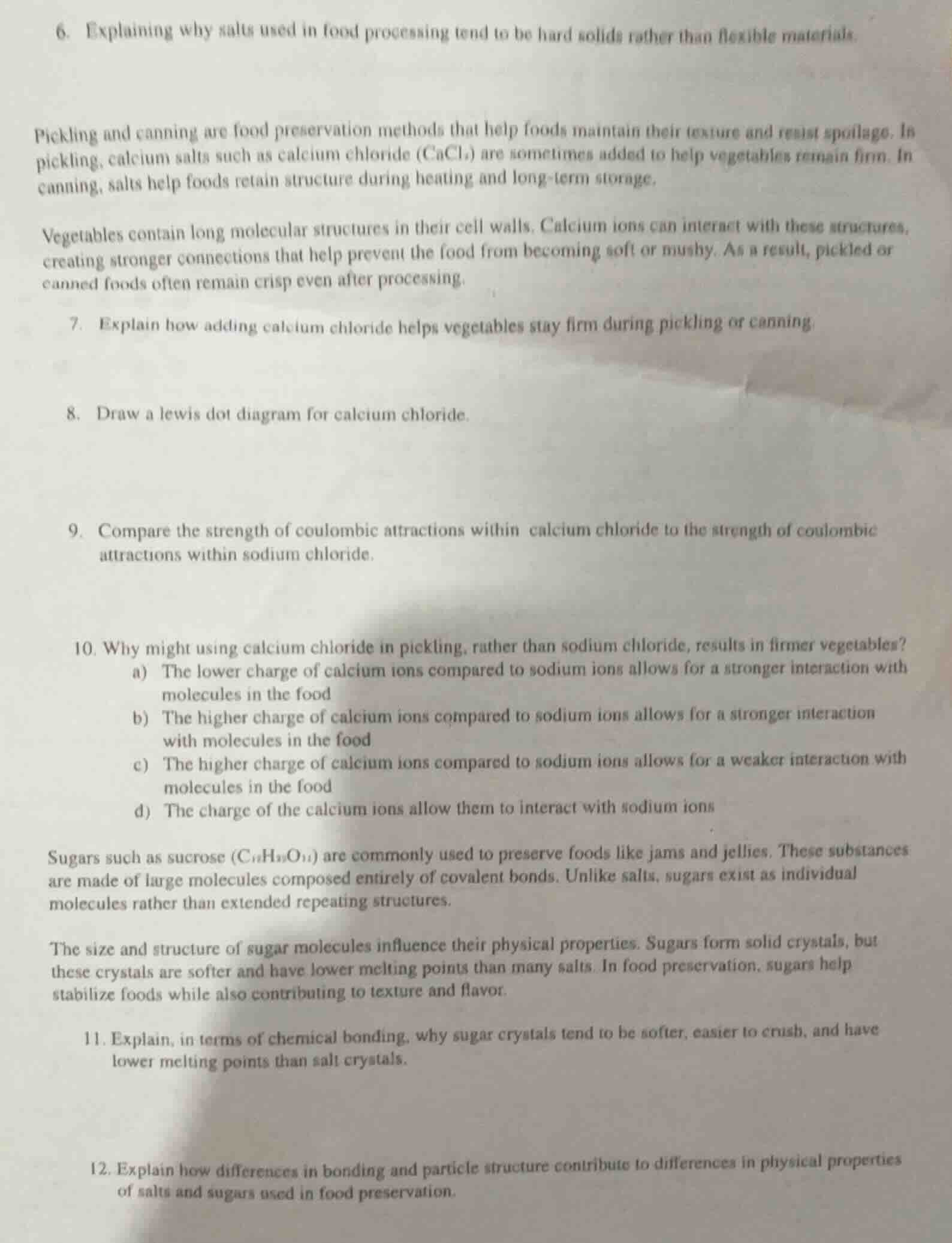
- explaining why salts used in food processing tend to be hard solids rather than flexible materials.
pickling and canning are food preservation methods that help foods maintain their texture and resist spoilage. in pickling, calcium salts such as calcium chloride (cacl₂) are sometimes added to help vegetables remain firm. in canning, salts help foods retain structure during heating and long - term storage.
vegetables contain long molecular structures in their cell walls. calcium ions can interact with these structures, creating stronger connections that help prevent the food from becoming soft or mushy. as a result, pickled or canned foods often remain crisp even after processing.
- explain how adding calcium chloride helps vegetables stay firm during pickling or canning.
- draw a lewis dot diagram for calcium chloride.
- compare the strength of coulombic attractions within calcium chloride to the strength of coulombic attractions within sodium chloride.
- why might using calcium chloride in pickling, rather than sodium chloride, results in firmer vegetables?
a) the lower charge of calcium ions compared to sodium ions allows for a stronger interaction with molecules in the food
b) the higher charge of calcium ions compared to sodium ions allows for a stronger interaction with molecules in the food
c) the higher charge of calcium ions compared to sodium ions allows for a weaker interaction with molecules in the food
d) the charge of the calcium ions allow them to interact with sodium ions
sugars such as sucrose (c₁₂h₂₂o₁₁) are commonly used to preserve foods like jams and jellies. these substances are made of large molecules composed entirely of covalent bonds. unlike salts, sugars exist as individual molecules rather than extended repeating structures.
the size and structure of sugar molecules influence their physical properties. sugars form solid crystals, but these crystals are softer and have lower melting points than many salts. in food preservation, sugars help stabilize foods while also contributing to texture and flavor.
- explain, in terms of chemical bonding, why sugar crystals tend to be softer, easier to crush, and have lower melting points than salt crystals.
- explain how differences in bonding and particle structure contribute to differences in physical properties of salts and sugars used in food preservation.
Question 6
Salts like calcium chloride are ionic compounds with a repeating lattice structure of positively and negatively charged ions. Strong coulombic attractions between these oppositely charged ions hold the lattice tightly together, creating a rigid, hard solid structure instead of flexible materials.
Vegetable cell walls have long molecular structures (like pectin). Calcium ions ($Ca^{2+}$) from calcium chloride interact with negatively charged sites on these cell wall molecules, forming stronger cross-links between them. These cross-links reinforce the cell wall structure, preventing it from breaking down during processing and keeping vegetables firm.
Calcium chloride is an ionic compound. Calcium (Group 2) has 2 valence electrons, and chlorine (Group 17) has 7 valence electrons. Calcium transfers its 2 valence electrons to two separate chlorine atoms, forming $Ca^{2+}$ and two $Cl^-$ ions. Lewis dot diagrams for ionic compounds show the ions with full valence shells, in brackets with their charges.

Snap & solve any problem in the app
Get step-by-step solutions on Sovi AI
Photo-based solutions with guided steps
Explore more problems and detailed explanations
Salts used in food processing are ionic compounds with a tightly bound ionic lattice held by strong coulombic attractions between oppositely charged ions. This strong, ordered ionic structure results in hard, rigid solids rather than flexible materials.
---