QUESTION IMAGE
Question
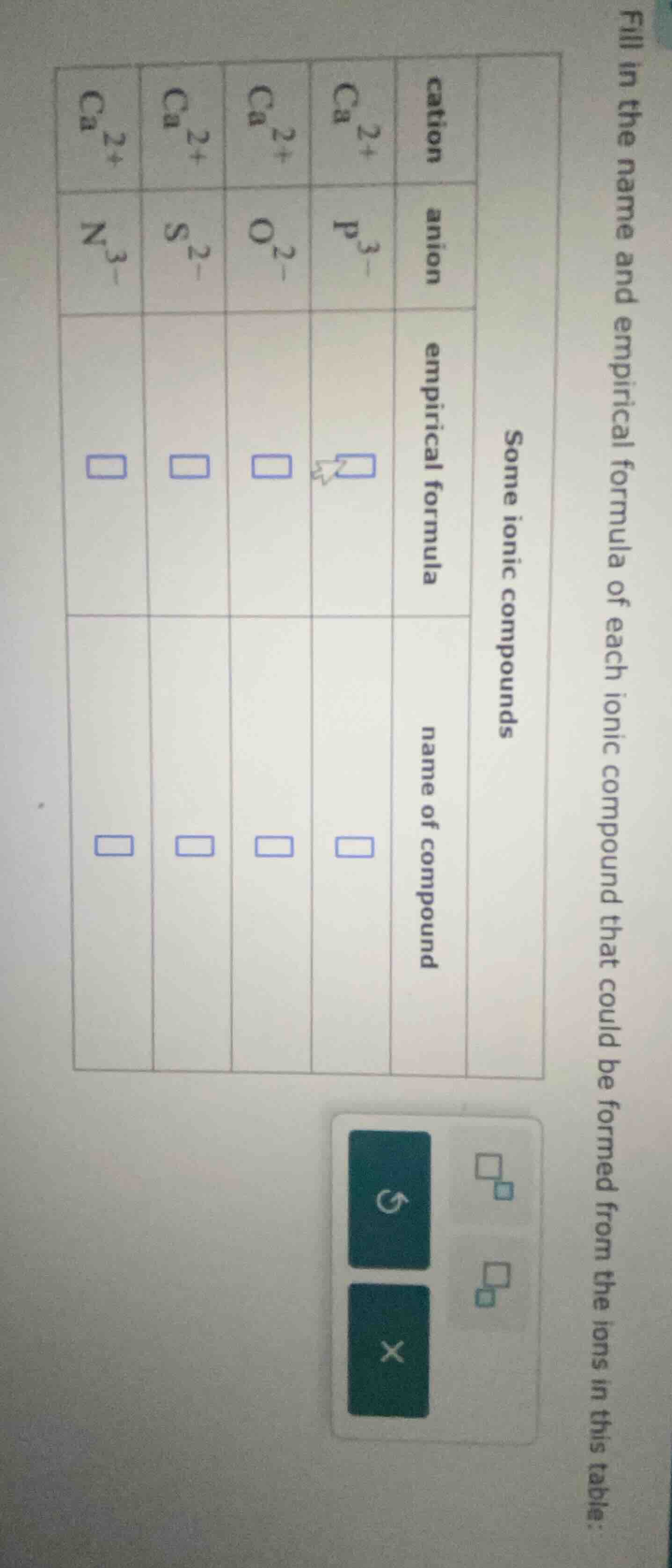
fill in the name and empirical formula of each ionic compound that could be formed from the ions in this table: some ionic compounds cation anion empirical formula name of compound ca²⁺ p³⁻ □ □ ca²⁺ o²⁻ □ □ ca²⁺ s²⁻ □ □ ca²⁺ n³⁻ □ □
To determine the empirical formula of an ionic compound, we need to balance the charges of the cation and anion. The general rule is that the total positive charge from the cations must equal the total negative charge from the anions.
For \( \boldsymbol{\text{Ca}^{2+}} \) and \( \boldsymbol{\text{P}^{3-}} \):
Step 1: Find the least common multiple (LCM) of the absolute values of the charges.
The charge of \( \text{Ca}^{2+} \) is \( +2 \) and the charge of \( \text{P}^{3-} \) is \( -3 \). The absolute values are \( 2 \) and \( 3 \). The LCM of \( 2 \) and \( 3 \) is \( 6 \).
Step 2: Determine the number of each ion needed.
To get a total positive charge of \( 6 \), we need \( \frac{6}{2} = 3 \) \( \text{Ca}^{2+} \) ions. To get a total negative charge of \( 6 \), we need \( \frac{6}{3} = 2 \) \( \text{P}^{3-} \) ions.
Step 3: Write the empirical formula.
The empirical formula is \( \text{Ca}_3\text{P}_2 \).
Step 4: Name the compound.
The cation is calcium (\( \text{Ca}^{2+} \)) and the anion is phosphide (\( \text{P}^{3-} \)). So the name of the compound is calcium phosphide.
For \( \boldsymbol{\text{Ca}^{2+}} \) and \( \boldsymbol{\text{O}^{2-}} \):
Step 1: Find the least common multiple (LCM) of the absolute values of the charges.
The charge of \( \text{Ca}^{2+} \) is \( +2 \) and the charge of \( \text{O}^{2-} \) is \( -2 \). The absolute values are \( 2 \) and \( 2 \). The LCM of \( 2 \) and \( 2 \) is \( 2 \).
Step 2: Determine the number of each ion needed.
To get a total positive charge of \( 2 \), we need \( \frac{2}{2} = 1 \) \( \text{Ca}^{2+} \) ion. To get a total negative charge of \( 2 \), we need \( \frac{2}{2} = 1 \) \( \text{O}^{2-} \) ion.
Step 3: Write the empirical formula.
The empirical formula is \( \text{CaO} \).
Step 4: Name the compound.
The cation is calcium (\( \text{Ca}^{2+} \)) and the anion is oxide (\( \text{O}^{2-} \)). So the name of the compound is calcium oxide.
For \( \boldsymbol{\text{Ca}^{2+}} \) and \( \boldsymbol{\text{S}^{2-}} \):
Step 1: Find the least common multiple (LCM) of the absolute values of the charges.
The charge of \( \text{Ca}^{2+} \) is \( +2 \) and the charge of \( \text{S}^{2-} \) is \( -2 \). The absolute values are \( 2 \) and \( 2 \). The LCM of \( 2 \) and \( 2 \) is \( 2 \).
Step 2: Determine the number of each ion needed.
To get a total positive charge of \( 2 \), we need \( \frac{2}{2} = 1 \) \( \text{Ca}^{2+} \) ion. To get a total negative charge of \( 2 \), we need \( \frac{2}{2} = 1 \) \( \text{S}^{2-} \) ion.
Step 3: Write the empirical formula.
The empirical formula is \( \text{CaS} \).
Step 4: Name the compound.
The cation is calcium (\( \text{Ca}^{2+} \)) and the anion is sulfide (\( \text{S}^{2-} \)). So the name of the compound is calcium sulfide.
For \( \boldsymbol{\text{Ca}^{2+}} \) and \( \boldsymbol{\text{N}^{3-}} \):
Step 1: Find the least common multiple (LCM) of the absolute values of the charges.
The charge of \( \text{Ca}^{2+} \) is \( +2 \) and the charge of \( \text{N}^{3-} \) is \( -3 \). The absolute values are \( 2 \) and \( 3 \). The LCM of \( 2 \) and \( 3 \) is \( 6 \).
Step 2: Determine the number of each ion needed.
To get a total positive charge of \( 6 \), we need \( \frac{6}{2} = 3 \) \( \text{Ca}^{2+} \) ions. To get a total negative charge of \( 6 \), we need \( \frac{6}{3} = 2 \) \( \text{N}^{3-} \) ions.
Step 3: Write the empirical formula.
The empirical formula is \( \text{Ca}_3\text{N}_2 \).
Step 4: Name the compound.
The cation is calcium (\( \text{Ca}^{2+…

Snap & solve any problem in the app
Get step-by-step solutions on Sovi AI
Photo-based solutions with guided steps
Explore more problems and detailed explanations
| cation | anion | empirical formula | name of compound |
|---|---|---|---|
| \( \text{Ca}^{2+} \) | \( \text{O}^{2-} \) | \( \text{CaO} \) | calcium oxide |
| \( \text{Ca}^{2+} \) | \( \text{S}^{2-} \) | \( \text{CaS} \) | calcium sulfide |
| \( \text{Ca}^{2+} \) | \( \text{N}^{3-} \) | \( \text{Ca}_3\text{N}_2 \) | calcium nitride |