QUESTION IMAGE
Question
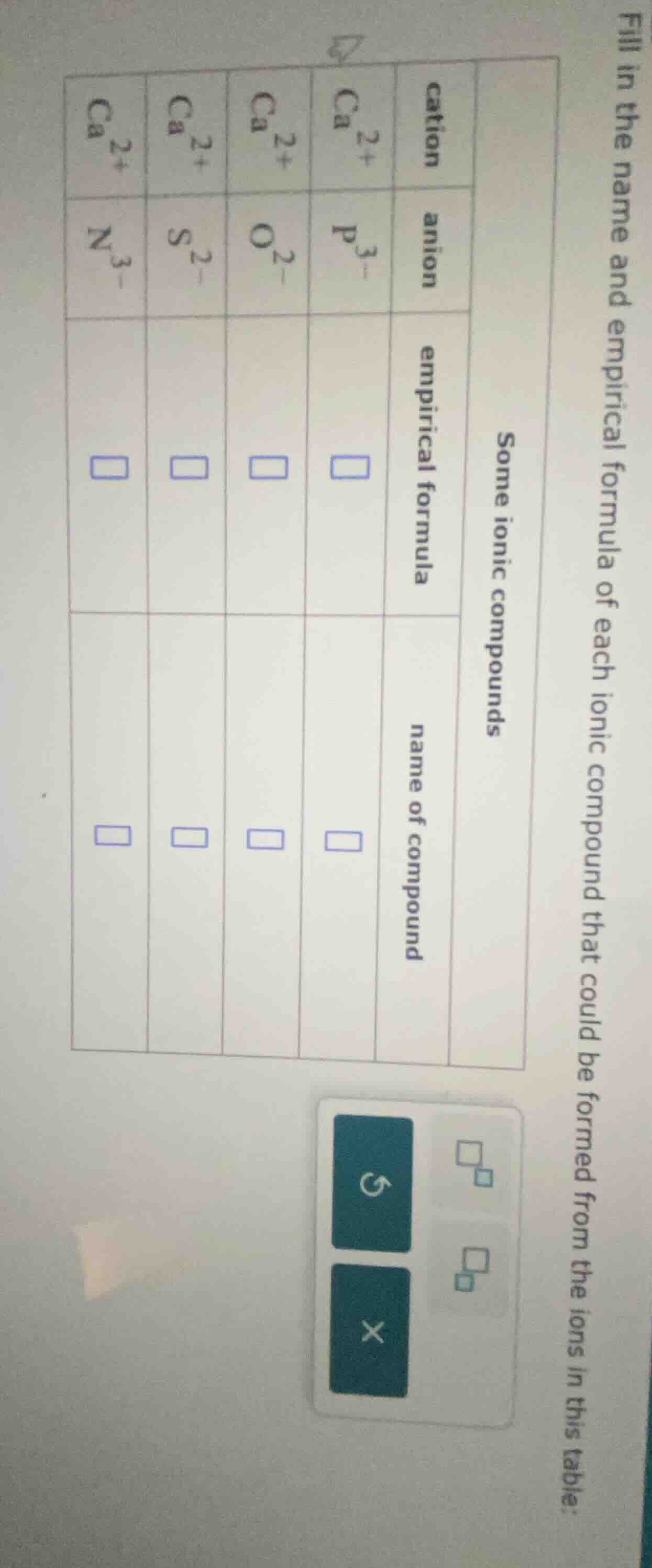
fill in the name and empirical formula of each ionic compound that could be formed from the ions in this table.
some ionic compounds
cation | anion | empirical formula | name of compound
$\ce{ca^{2+}}$ | $\ce{p^{3-}}$ | $\square$ | $\square$
$\ce{ca^{2+}}$ | $\ce{o^{2-}}$ | $\square$ | $\square$
$\ce{ca^{2+}}$ | $\ce{s^{2-}}$ | $\square$ | $\square$
$\ce{ca^{2+}}$ | $\ce{n^{3-}}$ | $\square$ | $\square$
To solve for the empirical formulas and names of the ionic compounds formed from $\ce{Ca^{2+}}$ and the given anions, we use the criss - cross method (where the magnitude of the charge of one ion becomes the subscript of the other ion) to balance the charges.
For $\ce{Ca^{2+}}$ and $\ce{P^{3-}}$:
Step 1: Balance the charges
The charge of $\ce{Ca^{2+}}$ is $+ 2$ and the charge of $\ce{P^{3-}}$ is $-3$. To balance the charges, we need 3 $\ce{Ca^{2+}}$ ions (since $3\times( + 2)=+6$) and 2 $\ce{P^{3-}}$ ions (since $2\times(- 3)=-6$). So the empirical formula is $\ce{Ca_{3}P_{2}}$.
Step 2: Name the compound
The cation is calcium ($\ce{Ca^{2+}}$) and the anion is phosphide ($\ce{P^{3-}}$). So the name of the compound is calcium phosphide.
For $\ce{Ca^{2+}}$ and $\ce{O^{2-}}$:
Step 1: Balance the charges
The charge of $\ce{Ca^{2+}}$ is $+2$ and the charge of $\ce{O^{2-}}$ is $-2$. The least common multiple of 2 and 2 is 2. So we need 1 $\ce{Ca^{2+}}$ ion and 1 $\ce{O^{2-}}$ ion. The empirical formula is $\ce{CaO}$.
Step 2: Name the compound
The cation is calcium ($\ce{Ca^{2+}}$) and the anion is oxide ($\ce{O^{2-}}$). So the name of the compound is calcium oxide.
For $\ce{Ca^{2+}}$ and $\ce{S^{2-}}$:
Step 1: Balance the charges
The charge of $\ce{Ca^{2+}}$ is $+2$ and the charge of $\ce{S^{2-}}$ is $-2$. The least common multiple of 2 and 2 is 2. So we need 1 $\ce{Ca^{2+}}$ ion and 1 $\ce{S^{2-}}$ ion. The empirical formula is $\ce{CaS}$.
Step 2: Name the compound
The cation is calcium ($\ce{Ca^{2+}}$) and the anion is sulfide ($\ce{S^{2-}}$). So the name of the compound is calcium sulfide.
For $\ce{Ca^{2+}}$ and $\ce{N^{3-}}$:
Step 1: Balance the charges
The charge of $\ce{Ca^{2+}}$ is $+2$ and the charge of $\ce{N^{3-}}$ is $-3$. To balance the charges, we need 3 $\ce{Ca^{2+}}$ ions (since $3\times( + 2)=+6$) and 2 $\ce{N^{3-}}$ ions (since $2\times(-3)=-6$). So the empirical formula is $\ce{Ca_{3}N_{2}}$.
Step 2: Name the compound
The cation is calcium ($\ce{Ca^{2+}}$) and the anion is nitride ($\ce{N^{3-}}$). So the name of the compound is calcium nitride.
Filling in the table:
| cation | anion | empirical formula | name of compound |
|---|---|---|---|
| $\ce{Ca^{2+}}$ | $\ce{O^{2-}}$ | $\ce{CaO}$ | calcium oxide |
| $\ce{Ca^{2+}}$ | $\ce{S^{2-}}$ | $\ce{CaS}$ | calcium sulfide |
| $\ce{Ca^{2+}}$ | $\ce{N^{3-}}$ | $\ce{Ca_{3}N_{2}}$ | calcium nitride |

Snap & solve any problem in the app
Get step-by-step solutions on Sovi AI
Photo-based solutions with guided steps
Explore more problems and detailed explanations
To solve for the empirical formulas and names of the ionic compounds formed from $\ce{Ca^{2+}}$ and the given anions, we use the criss - cross method (where the magnitude of the charge of one ion becomes the subscript of the other ion) to balance the charges.
For $\ce{Ca^{2+}}$ and $\ce{P^{3-}}$:
Step 1: Balance the charges
The charge of $\ce{Ca^{2+}}$ is $+ 2$ and the charge of $\ce{P^{3-}}$ is $-3$. To balance the charges, we need 3 $\ce{Ca^{2+}}$ ions (since $3\times( + 2)=+6$) and 2 $\ce{P^{3-}}$ ions (since $2\times(- 3)=-6$). So the empirical formula is $\ce{Ca_{3}P_{2}}$.
Step 2: Name the compound
The cation is calcium ($\ce{Ca^{2+}}$) and the anion is phosphide ($\ce{P^{3-}}$). So the name of the compound is calcium phosphide.
For $\ce{Ca^{2+}}$ and $\ce{O^{2-}}$:
Step 1: Balance the charges
The charge of $\ce{Ca^{2+}}$ is $+2$ and the charge of $\ce{O^{2-}}$ is $-2$. The least common multiple of 2 and 2 is 2. So we need 1 $\ce{Ca^{2+}}$ ion and 1 $\ce{O^{2-}}$ ion. The empirical formula is $\ce{CaO}$.
Step 2: Name the compound
The cation is calcium ($\ce{Ca^{2+}}$) and the anion is oxide ($\ce{O^{2-}}$). So the name of the compound is calcium oxide.
For $\ce{Ca^{2+}}$ and $\ce{S^{2-}}$:
Step 1: Balance the charges
The charge of $\ce{Ca^{2+}}$ is $+2$ and the charge of $\ce{S^{2-}}$ is $-2$. The least common multiple of 2 and 2 is 2. So we need 1 $\ce{Ca^{2+}}$ ion and 1 $\ce{S^{2-}}$ ion. The empirical formula is $\ce{CaS}$.
Step 2: Name the compound
The cation is calcium ($\ce{Ca^{2+}}$) and the anion is sulfide ($\ce{S^{2-}}$). So the name of the compound is calcium sulfide.
For $\ce{Ca^{2+}}$ and $\ce{N^{3-}}$:
Step 1: Balance the charges
The charge of $\ce{Ca^{2+}}$ is $+2$ and the charge of $\ce{N^{3-}}$ is $-3$. To balance the charges, we need 3 $\ce{Ca^{2+}}$ ions (since $3\times( + 2)=+6$) and 2 $\ce{N^{3-}}$ ions (since $2\times(-3)=-6$). So the empirical formula is $\ce{Ca_{3}N_{2}}$.
Step 2: Name the compound
The cation is calcium ($\ce{Ca^{2+}}$) and the anion is nitride ($\ce{N^{3-}}$). So the name of the compound is calcium nitride.
Filling in the table:
| cation | anion | empirical formula | name of compound |
|---|---|---|---|
| $\ce{Ca^{2+}}$ | $\ce{O^{2-}}$ | $\ce{CaO}$ | calcium oxide |
| $\ce{Ca^{2+}}$ | $\ce{S^{2-}}$ | $\ce{CaS}$ | calcium sulfide |
| $\ce{Ca^{2+}}$ | $\ce{N^{3-}}$ | $\ce{Ca_{3}N_{2}}$ | calcium nitride |