QUESTION IMAGE
Question
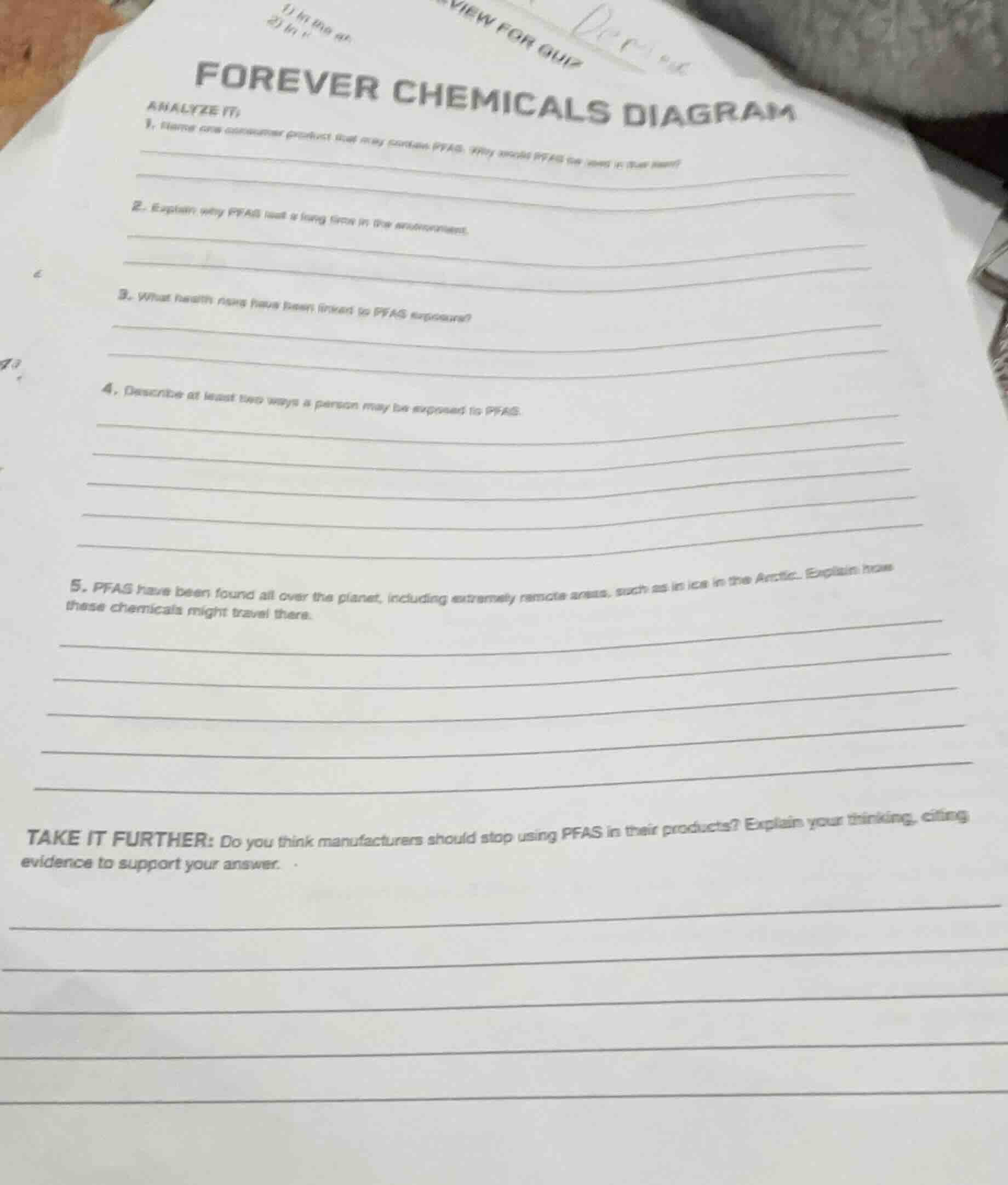
forever chemicals diagram
analyze it:
- name one consumer product that may contain pfas. why would pfas be used in that item?
- explain why pfas last a long time in the environment.
- what health risks have been linked to pfas exposure?
- describe at least two ways a person may be exposed to pfas.
- pfas have been found all over the planet, including extremely remote areas, such as in ice in the arctic. explain how these chemicals might travel there.
take it further: do you think manufacturers should stop using pfas in their products? explain your thinking, citing evidence to support your answer.
Brief Explanations
- Non-stick cookware (like Teflon) is a common consumer product with PFAS. PFAS are used here because their strong carbon-fluorine bonds create a heat-resistant, non-stick surface that repels food and resists scratching.
- PFAS have extremely strong carbon-fluorine (C-F) bonds that do not break down easily in natural environmental conditions (like sunlight, water, or microbial activity). This chemical stability lets them persist for decades or longer.
- Peer-reviewed studies and public health research link PFAS exposure to increased risk of kidney and testicular cancer, reduced immune function (especially in children), elevated cholesterol levels, and developmental issues in fetuses/infants.
- People can be exposed to PFAS by drinking contaminated water (from industrial runoff or landfill leachate) and by ingesting food that has absorbed PFAS from soil, water, or packaging materials.
- PFAS can travel long distances via atmospheric transport: they evaporate from contaminated surfaces into the air, are carried globally by wind currents, and then deposit onto remote areas like Arctic ice through precipitation (rain, snow) or dry particle fall.
- Manufacturers should stop using PFAS. Evidence includes their persistent environmental accumulation (leading to global contamination even in remote regions), well-documented links to serious human health risks (cancer, immune dysfunction), and the availability of safer alternative materials that can provide similar non-stick, water-repellent properties without the toxic and long-lasting effects of PFAS.

Snap & solve any problem in the app
Get step-by-step solutions on Sovi AI
Photo-based solutions with guided steps
Explore more problems and detailed explanations
- One consumer product is non-stick cookware (e.g., Teflon-coated pans). PFAS are used to create a heat-stable, non-stick surface that repels food and resists damage.
- PFAS persist long-term because their strong carbon-fluorine bonds do not break down easily in natural environmental processes.
- Health risks linked to PFAS exposure include increased risk of kidney and testicular cancer, reduced immune response, elevated cholesterol, and adverse developmental effects in children.
- Two exposure routes are: 1) Drinking water contaminated by industrial or landfill runoff containing PFAS; 2) Eating food that has absorbed PFAS from contaminated soil, water, or PFAS-containing packaging.
- PFAS travel to remote areas via atmospheric transport: they evaporate into the air from contaminated sites, are carried globally by wind, and then deposit onto Arctic ice through snow, rain, or dry particle deposition.
- Yes, manufacturers should stop using PFAS. Their extreme environmental persistence leads to global, irreversible contamination, and extensive research confirms they cause serious, chronic health issues in humans (such as cancer and immune system impairment). Safer functional alternatives exist for most applications where PFAS are currently used.