QUESTION IMAGE
Question
goal:
use your research from your questions to build a paragraph (jan 28).
- one thing you need to know to better understand your
- sub question one
make sure to use transition words to connect your ideas
no red or blue lines
paragraph one
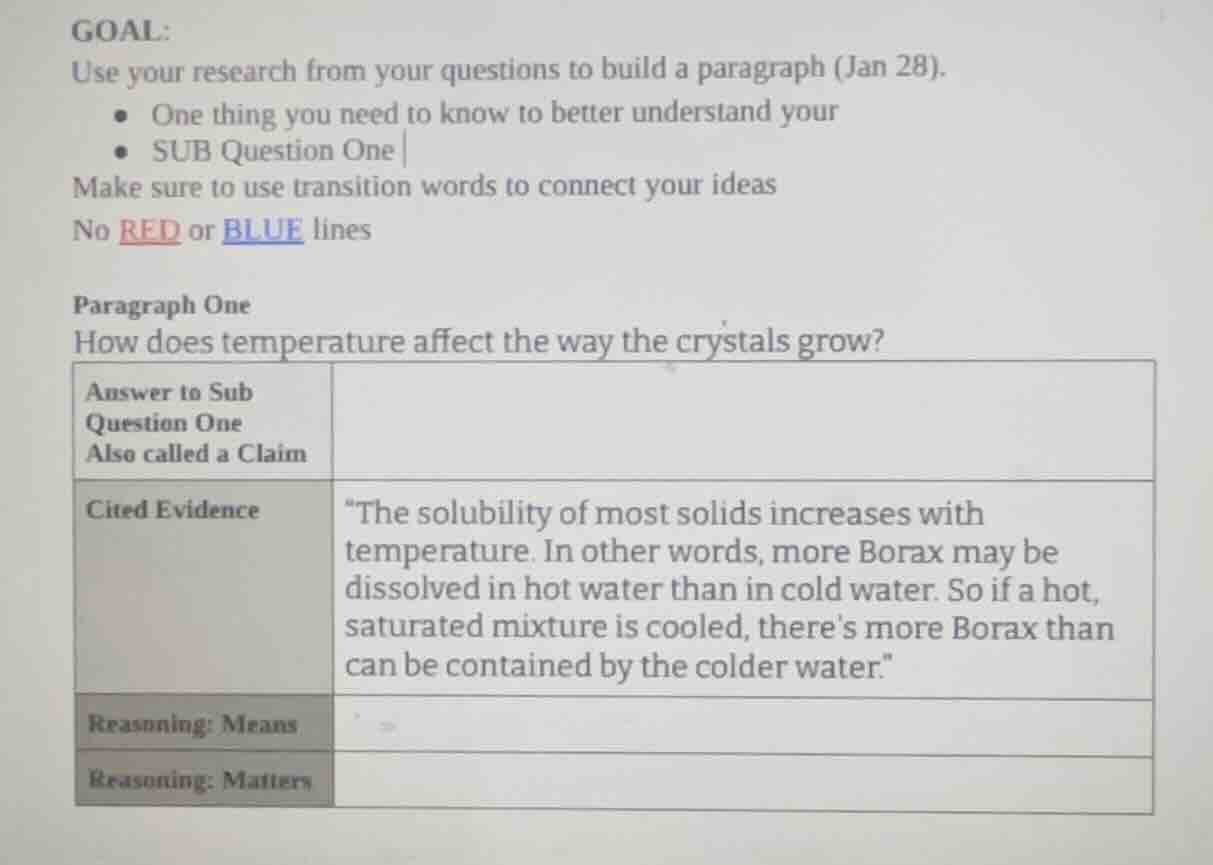
how does temperature affect the way the crystals grow?
| answer to sub question one also called a claim | |
| cited evidence | \the solubility of most solids increases with temperature. in other words, more borax may be dissolved in hot water than in cold water. so if a hot, saturated mixture is cooled, there’s more borax than can be contained by the colder water.\ |
| reasoning: means | |
| reasoning: matters |
Step1: Draft the claim (answer sub-question)
Temperature directly impacts crystal growth rate and size.
Step2: Link claim to evidence
First, the cited evidence notes that $\text{solubility of solids} \uparrow \text{with temperature}$, so hot water holds more borax. When cooled, excess borax precipitates.
Step3: Add "Means" reasoning
This means higher temps let more solute dissolve; cooling triggers rapid nucleation.
Step4: Add "Matters" reasoning
Matters because slower cooling (lower temp change) forms larger, more defined crystals, while fast cooling creates small, clustered ones.
Step5: Combine with transitions
Use transitions like "First", "This means", "Furthermore" to connect ideas into a paragraph.

Snap & solve any problem in the app
Get step-by-step solutions on Sovi AI
Photo-based solutions with guided steps
Explore more problems and detailed explanations
Temperature directly impacts the rate and size of crystal growth. First, the solubility of most solids increases with temperature, so hot water can hold far more borax than cold water; when this hot, saturated mixture cools, the water can no longer contain all the dissolved borax. This means that the rate of cooling (a factor tied to temperature) dictates how crystals form: rapid cooling from a high temperature causes quick nucleation, leading to many small, tightly clustered crystals. Furthermore, this matters because controlled temperature changes allow for intentional crystal growth—slower cooling over a lower temperature range produces larger, more well-formed crystals, while sudden, drastic temperature drops result in fine, irregular crystal structures.