QUESTION IMAGE
Question
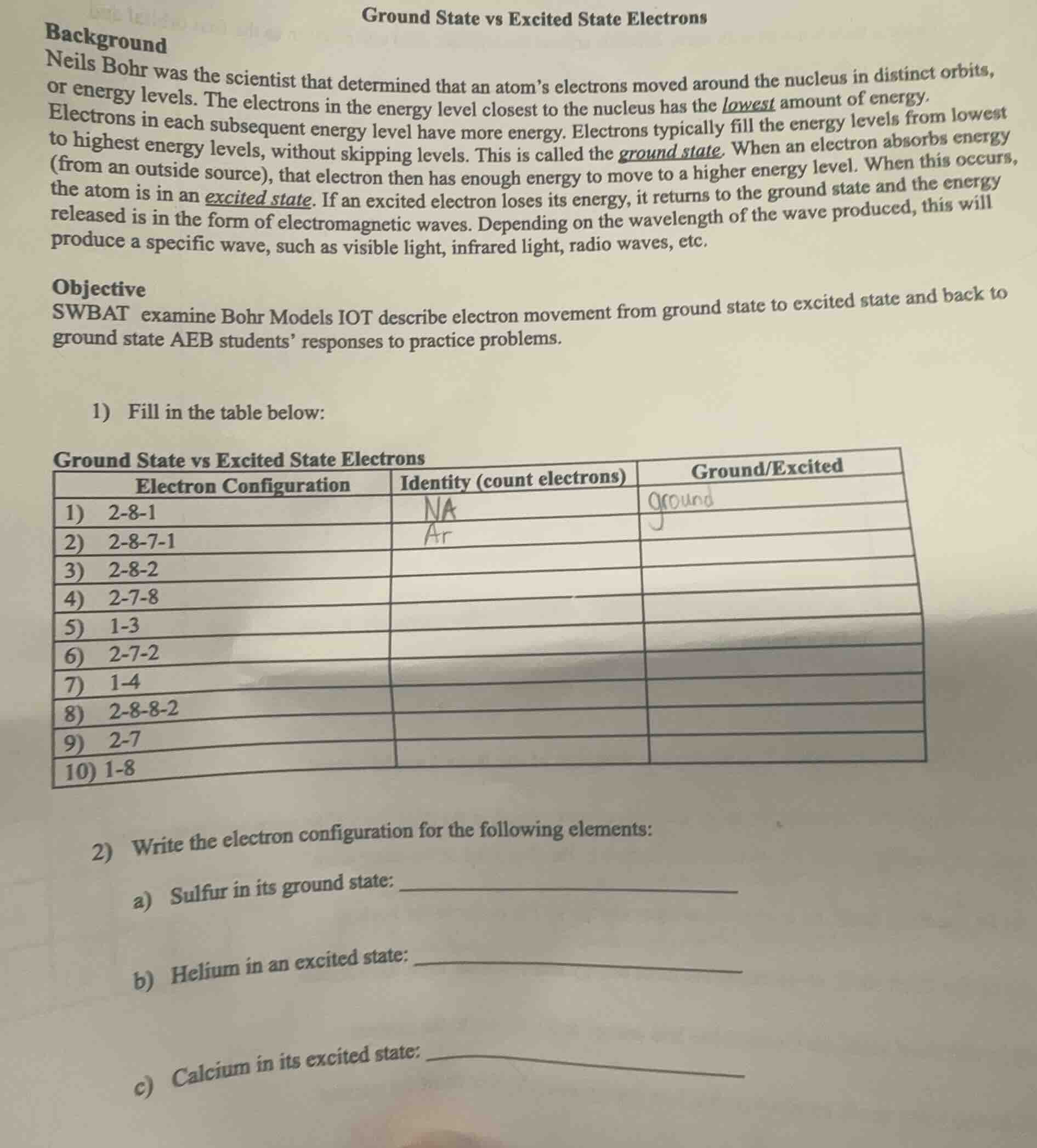
ground state vs excited state electrons
background
neils bohr was the scientist that determined that an atom’s electrons moved around the nucleus in distinct orbits, or energy levels. the electrons in the energy level closest to the nucleus has the lowest amount of energy. electrons in each subsequent energy level have more energy. electrons typically fill the energy levels from lowest to highest energy levels, without skipping levels. this is called the ground state. when an electron absorbs energy (from an outside source), that electron then has enough energy to move to a higher energy level. when this occurs, the atom is in an excited state. if an excited electron loses its energy, it returns to the ground state and the energy released is in the form of electromagnetic waves. depending on the wavelength of the wave produced, this will produce a specific wave, such as visible light, infrared light, radio waves, etc.
objective
swbat examine bohr models iot describe electron movement from ground state to excited state and back to ground state aeb students’ responses to practice problems.
- fill in the table below:
ground state vs excited state electrons
| electron configuration | identity (count electrons) | ground/excited |
|---|---|---|
| 2) 2 - 8 - 7 - 1 | ar | |
| 3) 2 - 8 - 2 | ||
| 4) 2 - 7 - 8 | ||
| 5) 1 - 3 | ||
| 6) 2 - 7 - 2 | ||
| 7) 1 - 4 | ||
| 8) 2 - 8 - 8 - 2 | ||
| 9) 2 - 7 | ||
| 10) 1 - 8 |
- write the electron configuration for the following elements:
a) sulfur in its ground state:
b) helium in an excited state:
c) calcium in its excited state:
Step1: Count total electrons
For each configuration, sum the numbers to get total electrons (equal to atomic number for neutral atoms).
Step2: Identify element
Match total electrons to atomic number of elements.
Step3: Classify ground/excited
Ground state: electrons fill levels from lowest to highest, no lower level is partially filled while higher is occupied. Excited state: electron jumps to higher level, leaving lower level incomplete.
Step4: Write ground config
For ground state, fill levels in order (2, 8, 8, 18...).
Step5: Write excited config
For excited state, move one electron from a filled lower level to a higher empty level.
---
1) Table Completion:
| Electron Configuration | Identity (count electrons) | Ground/Excited |
|---|---|---|
| 2) 2-8-7-1 | Ar (18 electrons) | Excited |
| 3) 2-8-2 | Mg (12 electrons) | Ground |
| 4) 2-7-8 | Cl (17 electrons) | Excited |
| 5) 1-3 | Be (4 electrons) | Excited |
| 6) 2-7-2 | Na (11 electrons) | Excited |
| 7) 1-4 | B (5 electrons) | Excited |
| 8) 2-8-8-2 | Ca (20 electrons) | Ground |
| 9) 2-7 | F (9 electrons) | Ground |
| 10) 1-8 | F (9 electrons) | Excited |
2) Electron Configurations:
a) Sulfur (atomic number 16) ground state: fill levels in order: $2+8+6=16$, so $\boldsymbol{2-8-6}$
b) Helium (atomic number 2) excited state: move 1 electron from first level to second: $\boldsymbol{1-1}$
c) Calcium (atomic number 20) excited state: move 1 electron from third level to fourth: $\boldsymbol{2-8-7-3}$ (other valid excited configurations are also acceptable, e.g., 2-7-8-3)

Snap & solve any problem in the app
Get step-by-step solutions on Sovi AI
Photo-based solutions with guided steps
Explore more problems and detailed explanations
1) Completed Table:
| Electron Configuration | Identity (count electrons) | Ground/Excited |
|---|---|---|
| 2) 2-8-7-1 | Ar | Excited |
| 3) 2-8-2 | Mg | Ground |
| 4) 2-7-8 | Cl | Excited |
| 5) 1-3 | Be | Excited |
| 6) 2-7-2 | Na | Excited |
| 7) 1-4 | B | Excited |
| 8) 2-8-8-2 | Ca | Ground |
| 9) 2-7 | F | Ground |
| 10) 1-8 | F | Excited |
2) Configurations:
a) $\boldsymbol{2-8-6}$
b) $\boldsymbol{1-1}$
c) $\boldsymbol{2-8-7-3}$ (or other valid excited state)