QUESTION IMAGE
Question
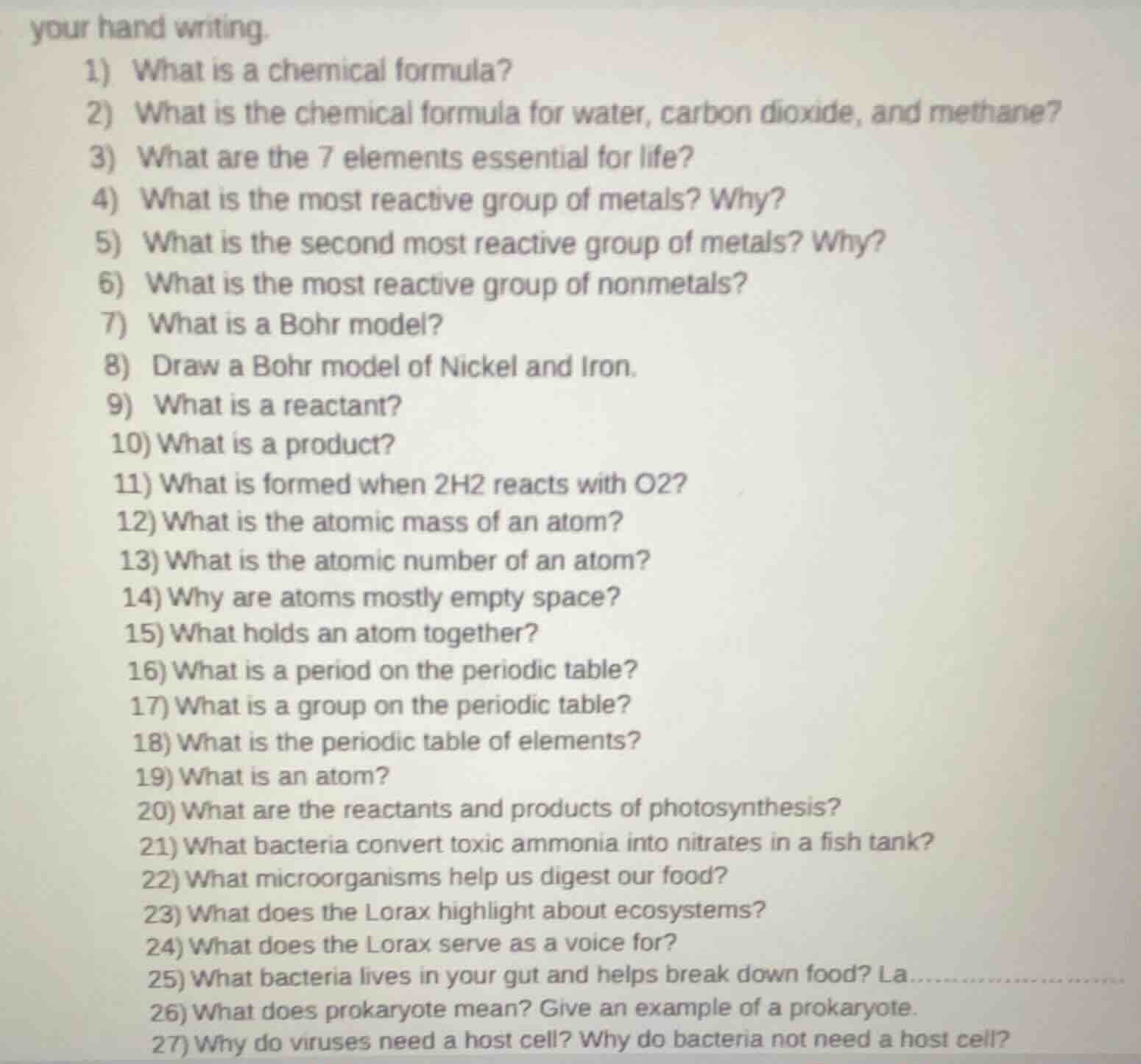
your hand writing.
- what is a chemical formula?
- what is the chemical formula for water, carbon dioxide, and methane?
- what are the 7 elements essential for life?
- what is the most reactive group of metals? why?
- what is the second most reactive group of metals? why?
- what is the most reactive group of nonmetals?
- what is a bohr model?
- draw a bohr model of nickel and iron.
- what is a reactant?
- what is a product?
- what is formed when 2h2 reacts with o2?
- what is the atomic mass of an atom?
- what is the atomic number of an atom?
- why are atoms mostly empty space?
- what holds an atom together?
- what is a period on the periodic table?
- what is a group on the periodic table?
- what is the periodic table of elements?
- what is an atom?
- what are the reactants and products of photosynthesis?
- what bacteria convert toxic ammonia into nitrates in a fish tank?
- what microorganisms help us digest our food?
- what does the lorax highlight about ecosystems?
- what does the lorax serve as a voice for?
- what bacteria lives in your gut and helps break down food? la......................
- what does prokaryote mean? give an example of a prokaryote.
- why do viruses need a host cell? why do bacteria not need a host cell?
Brief Explanations
- Defines chemical formula as element symbol/number notation.
- Lists standard formulas for 3 compounds.
- Names the 7 core life-essential elements.
- Identifies group 1 metals and their valence electron trait.
- Identifies group 2 metals and their valence electron trait.
- Names the most reactive nonmetal group.
- Describes Bohr's atomic structure model.
- Outlines electron shell configurations for Ni and Fe.
- Defines reactants as reaction starting substances.
- Defines products as reaction end substances.
- Notes the balanced reaction of H₂ and O₂.
- Defines atomic mass as proton/neutron mass sum.
- Defines atomic number as proton count.
- Explains empty space from tiny nucleus vs. electron cloud.
- Names the force holding atomic components together.
- Defines periodic table periods as horizontal rows.
- Defines periodic table groups as vertical columns.
- Describes the periodic table as an element organization tool.
- Defines atom as the smallest matter unit.
- Lists photosynthesis reactants and products.
- Names ammonia-converting bacteria in fish tanks.
- Names gut microorganisms aiding digestion.
- Summarizes The Lorax's ecosystem message.
- States who/what The Lorax advocates for.
- Names common gut bacteria aiding digestion.
- Defines prokaryote and gives an example.
- Explains virus vs. bacteria host dependence differences.

Snap & solve any problem in the app
Get step-by-step solutions on Sovi AI
Photo-based solutions with guided steps
Explore more problems and detailed explanations
- A chemical formula is a shorthand notation using element symbols and numerical subscripts to represent the composition of a chemical compound or molecule.
- Water: $\text{H}_2\text{O}$; Carbon dioxide: $\text{CO}_2$; Methane: $\text{CH}_4$
- Carbon (C), Hydrogen (H), Oxygen (O), Nitrogen (N), Phosphorus (P), Sulfur (S), Calcium (Ca)
- Group 1 (alkali metals). They have 1 valence electron, which is easily lost to form a stable +1 ion.
- Group 2 (alkaline earth metals). They have 2 valence electrons that are readily lost to form stable +2 ions.
- Group 17 (halogens)
- A Bohr model is a simplified atomic model that depicts electrons orbiting the nucleus in fixed, discrete energy levels (shells).
- - Nickel (atomic number 28): 2 electrons in the 1st shell, 8 in the 2nd, 16 in the 3rd, 2 in the 4th
- Iron (atomic number 26): 2 electrons in the 1st shell, 8 in the 2nd, 14 in the 3rd, 2 in the 4th
- A reactant is a substance that participates in and is consumed during a chemical reaction.
- A product is a new substance formed as a result of a chemical reaction.
- Water ($\text{H}_2\text{O}$) is formed, per the reaction: $2\text{H}_2 + \text{O}_2
ightarrow 2\text{H}_2\text{O}$
- The atomic mass is the total mass of protons and neutrons in the nucleus of an atom, measured in atomic mass units (amu).
- The atomic number is the number of protons in the nucleus of an atom, which uniquely identifies an element.
- Atoms are mostly empty space because the tiny, dense nucleus occupies a tiny fraction of the atom's total volume, while electrons occupy a large, diffuse cloud around it with significant empty space between the nucleus and electron cloud.
- The electrostatic attraction between the positively charged nucleus (protons) and negatively charged electrons holds an atom together.
- A period is a horizontal row on the periodic table; elements in the same period have the same number of electron shells.
- A group is a vertical column on the periodic table; elements in the same group have the same number of valence electrons and similar chemical properties.
- The periodic table of elements is a tabular arrangement of all known chemical elements, organized by their atomic number, electron configuration, and recurring chemical properties.
- An atom is the smallest unit of an element that retains the chemical properties of that element.
- Reactants: Carbon dioxide ($\text{CO}_2$) and water ($\text{H}_2\text{O}$); Products: Glucose ($\text{C}_6\text{H}_{12}\text{O}_6$) and oxygen ($\text{O}_2$)
- Nitrosomonas and Nitrobacter (nitrifying bacteria; Nitrosomonas converts ammonia to nitrites, Nitrobacter converts nitrites to nitrates)
- Bacteria (e.g., E. coli, Bacteroides) and archaea in the gastrointestinal tract, collectively called gut microbiota.
- It highlights the importance of protecting ecosystems from overexploitation, and the irreversible damage that can occur when natural resources are depleted without regard for environmental health.
- The Lorax serves as a voice for the trees (and more broadly, all non-human elements of the natural environment that cannot speak for themselves).
- Examples include Escherichia coli (E. coli), Bacteroides thetaiotaomicron, and Lactobacillus species.
- A prokaryote is a single-celled organism that lacks a nucleus and other membrane-bound organelles. Example: E. coli (bacteria) or Sulfolobus (archaea)
- Viruses need a host cell because they lack the cellular machinery (ribosomes, metabolic enzymes, etc.) to replicate or carry out metabolic processes on their own. Bacteria do not need a host cell because they are independent, single-celled organisms with their own cellular machinery to perform metabolism, growth, and replication.