QUESTION IMAGE
Question
having problems staying logged in or are you experiencing issues? please visit our troubleshooting section for solutic
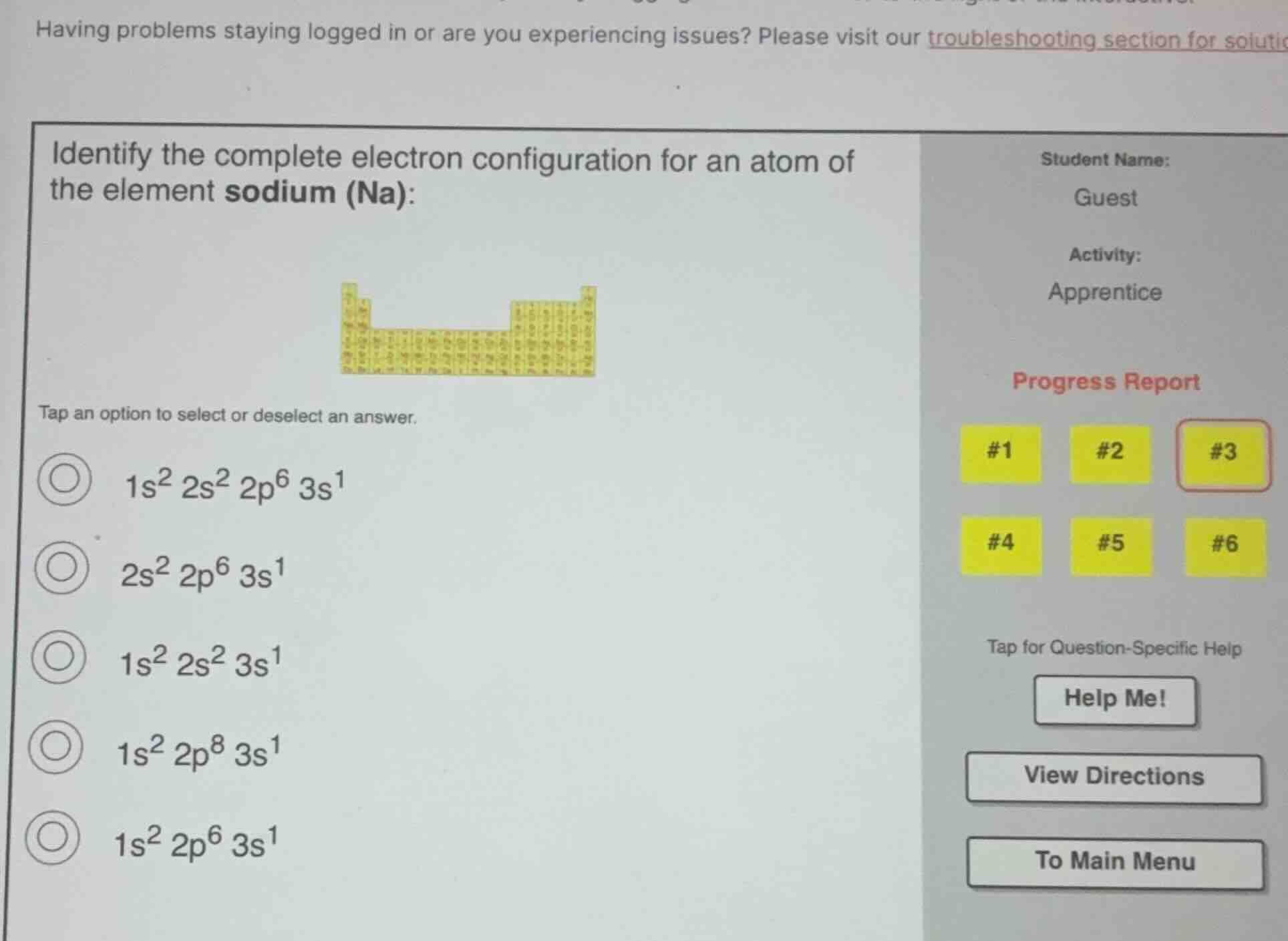
identify the complete electron configuration for an atom of
the element sodium (na):
tap an option to select or deselect an answer.
$1s^{2}2s^{2}2p^{6}3s^{1}$
$2s^{2}2p^{6}3s^{1}$
$1s^{2}2s^{2}3s^{1}$
$1s^{2}2p^{8}3s^{1}$
$1s^{2}2p^{6}3s^{1}$
student name:
guest
activity:
apprentice
progress report
#1 #2 #3
#4 #5 #6
tap for question-specific help
help me!
view directions
to main menu
Step1: Find Na's atomic number
Sodium (Na) has an atomic number of 11, so it has 11 electrons.
Step2: Fill orbitals by Aufbau principle
Fill orbitals in order: $1s$ (max 2 e⁻), $2s$ (max 2 e⁻), $2p$ (max 6 e⁻), $3s$ (remaining e⁻).
$1s^2$ uses 2 e⁻, $2s^2$ uses 2 e⁻, $2p^6$ uses 6 e⁻, total $2+2+6=10$ e⁻. 1 remaining e⁻ goes to $3s$: $3s^1$.
Total electrons: $2+2+6+1=11$, matching Na's electron count.
Step3: Eliminate incorrect options
- $2s^2 2p^6 3s^1$: missing $1s^2$ (only 9 e⁻)
- $1s^2 2s^2 3s^1$: missing $2p^6$ (only 5 e⁻)
- $1s^2 2p^8 3s^1$: $2p$ can only hold 6 e⁻
- $1s^2 2p^6 3s^1$: missing $2s^2$ (only 9 e⁻)

Snap & solve any problem in the app
Get step-by-step solutions on Sovi AI
Photo-based solutions with guided steps
Explore more problems and detailed explanations
$1s^2 2s^2 2p^6 3s^1$