QUESTION IMAGE
Question
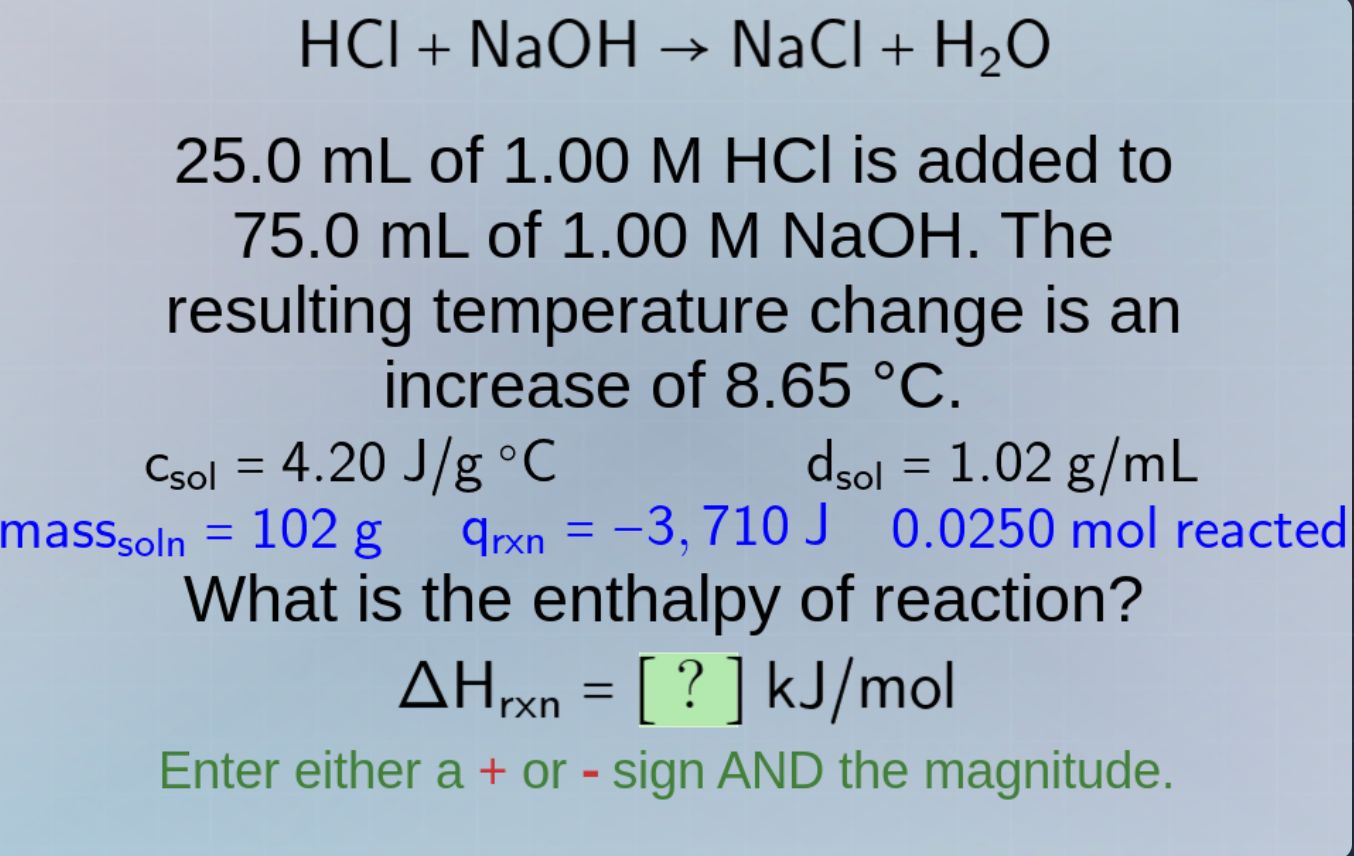
hcl + naoh → nacl + h₂o
25.0 ml of 1.00 m hcl is added to
75.0 ml of 1.00 m naoh. the
resulting temperature change is an
increase of 8.65 °c.
csol = 4.20 j/g °c dsol = 1.02 g/ml
masssoln = 102 g qrxn = −3,710 j 0.0250 mol reacted
what is the enthalpy of reaction?
δhrxn = ? kj/mol
enter either a + or - sign and the magnitude.
Step1: Recall enthalpy formula
Enthalpy of reaction \(\Delta H_{rxn}\) is given by \(\Delta H_{rxn}=\frac{q_{rxn}}{n}\), where \(q_{rxn}\) is heat of reaction and \(n\) is moles of reactant reacted.
Step2: Identify values
Given \(q_{rxn} = - 3710\space J=-3.710\space kJ\) (convert J to kJ by dividing by 1000) and \(n = 0.0250\space mol\).
Step3: Calculate \(\Delta H_{rxn}\)
Substitute values into formula: \(\Delta H_{rxn}=\frac{- 3.710\space kJ}{0.0250\space mol}\)
\(\Delta H_{rxn}=-148.4\space kJ/mol\) (Rounding or exact calculation as per given data, here we use the given \(q_{rxn}\) and \(n\))

Snap & solve any problem in the app
Get step-by-step solutions on Sovi AI
Photo-based solutions with guided steps
Explore more problems and detailed explanations
\(-148\) (or more precisely \(-148.4\)) kJ/mol (Note: If we calculate \(\frac{-3710\space J}{0.0250\space mol}=\frac{-3.710\space kJ}{0.0250\space mol}=-148.4\space kJ/mol\), so the answer can be \(-148\) or \(-148.4\) depending on precision. Commonly, with the given data, \(-148\) or \(-148.4\) is acceptable. But following the calculation, \(\frac{-3710}{0.0250}=-148400\space J/mol=-148.4\space kJ/mol\))