QUESTION IMAGE
Question
heat transfer
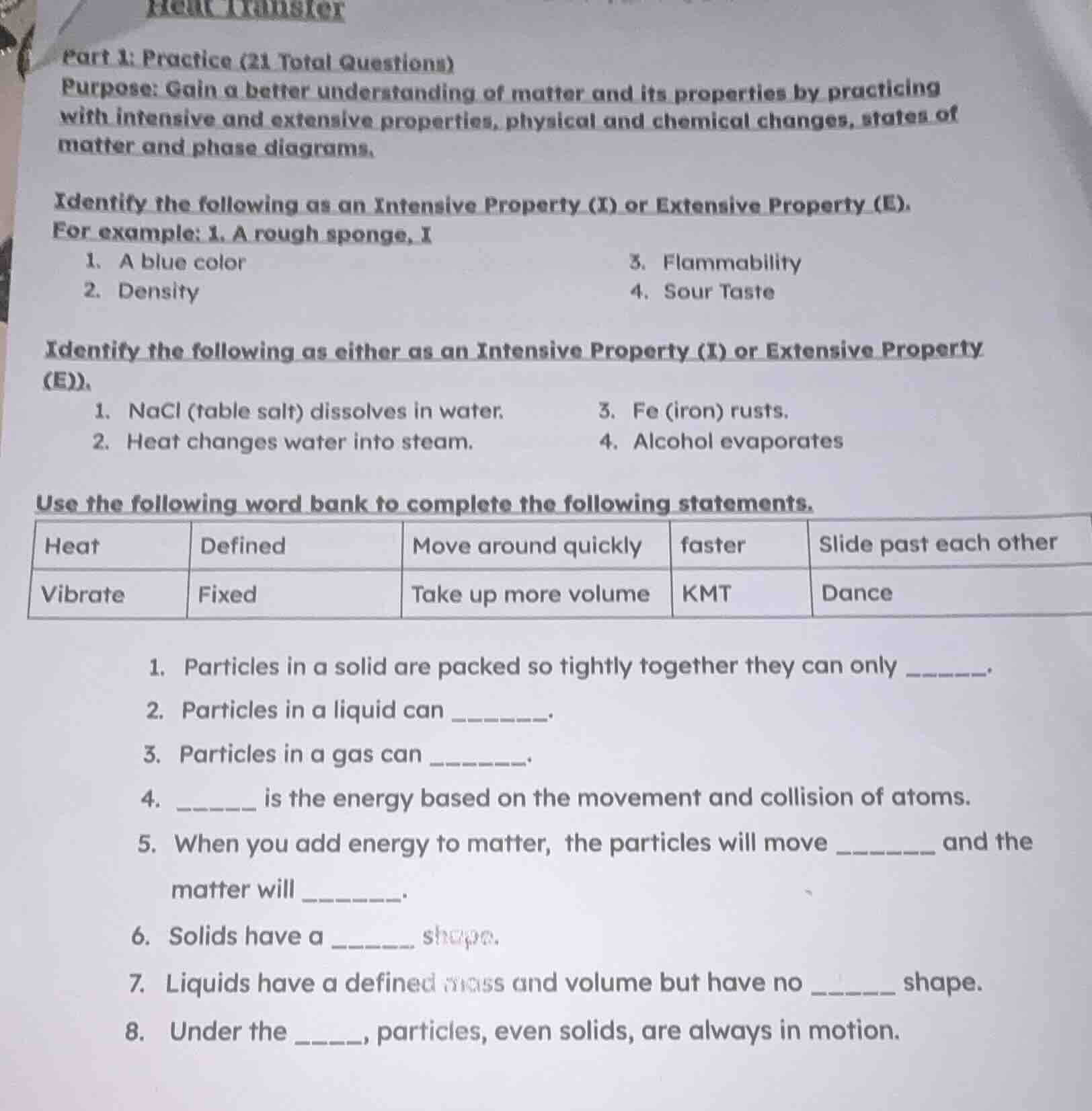
part 1: practice (21 total questions)
purpose: gain a better understanding of matter and its properties by practicing with intensive and extensive properties, physical and chemical changes, states of matter and phase diagrams.
identify the following as an intensive property (i) or extensive property (e).
for example: 1. a rough sponge, i
- a blue color
- flammability
- density
- sour taste
identify the following as either as an intensive property (i) or extensive property (e)).
- nacl (table salt) dissolves in water.
- fe (iron) rusts.
- heat changes water into steam.
- alcohol evaporates
use the following word bank to complete the following statements.
| heat | defined | move around quickly | faster | slide past each other |
| vibrate | fixed | take up more volume | kmt | dance |
- particles in a solid are packed so tightly together they can only ______.
- particles in a liquid can ______.
- particles in a gas can ______.
- ______ is the energy based on the movement and collision of atoms.
- when you add energy to matter, the particles will move ____ and the matter will ____.
- solids have a ______ shape.
- liquids have a defined mass and volume but have no ______ shape.
- under the ______, particles, even solids, are always in motion.
First Section (Intensive/Extensive Properties)
Intensive properties don't depend on sample amount; extensive do.
- Blue color: Doesn't change with sample size (I)
- Density: Ratio, independent of sample amount (I)
- Flammability: A chemical property not based on quantity (I)
- Sour taste: Sensory property not tied to sample size (I)
Second Section (Property Identification)
All describe physical/chemical behaviors, all are intensive (don't depend on sample amount):
- NaCl dissolving: Physical property, intensive (I)
- Water to steam: Physical change property, intensive (I)
- Iron rusting: Chemical property, intensive (I)
- Alcohol evaporating: Physical property, intensive (I)
Third Section (Kinetic Molecular Theory Fill-In)
Based on Kinetic Molecular Theory (KMT) of matter:
- Solid particles only vibrate in place
- Liquid particles slide past each other
- Gas particles move around quickly
- Heat is atomic motion/collision energy
- Adding energy makes particles move faster, matter takes more volume
- Solids have fixed shape
- Liquids have no defined shape
- KMT states all particles are in motion

Snap & solve any problem in the app
Get step-by-step solutions on Sovi AI
Photo-based solutions with guided steps
Explore more problems and detailed explanations
First Section
- A blue color: I
- Density: I
- Flammability: I
- Sour Taste: I
Second Section
- NaCl (table salt) dissolves in water: I
- Heat changes water into steam: I
- Fe (iron) rusts: I
- Alcohol evaporates: I
Third Section
- Vibrate
- Slide past each other
- Move around quickly
- Heat
- faster; Take up more volume
- Fixed
- Defined
- KMT