QUESTION IMAGE
Question
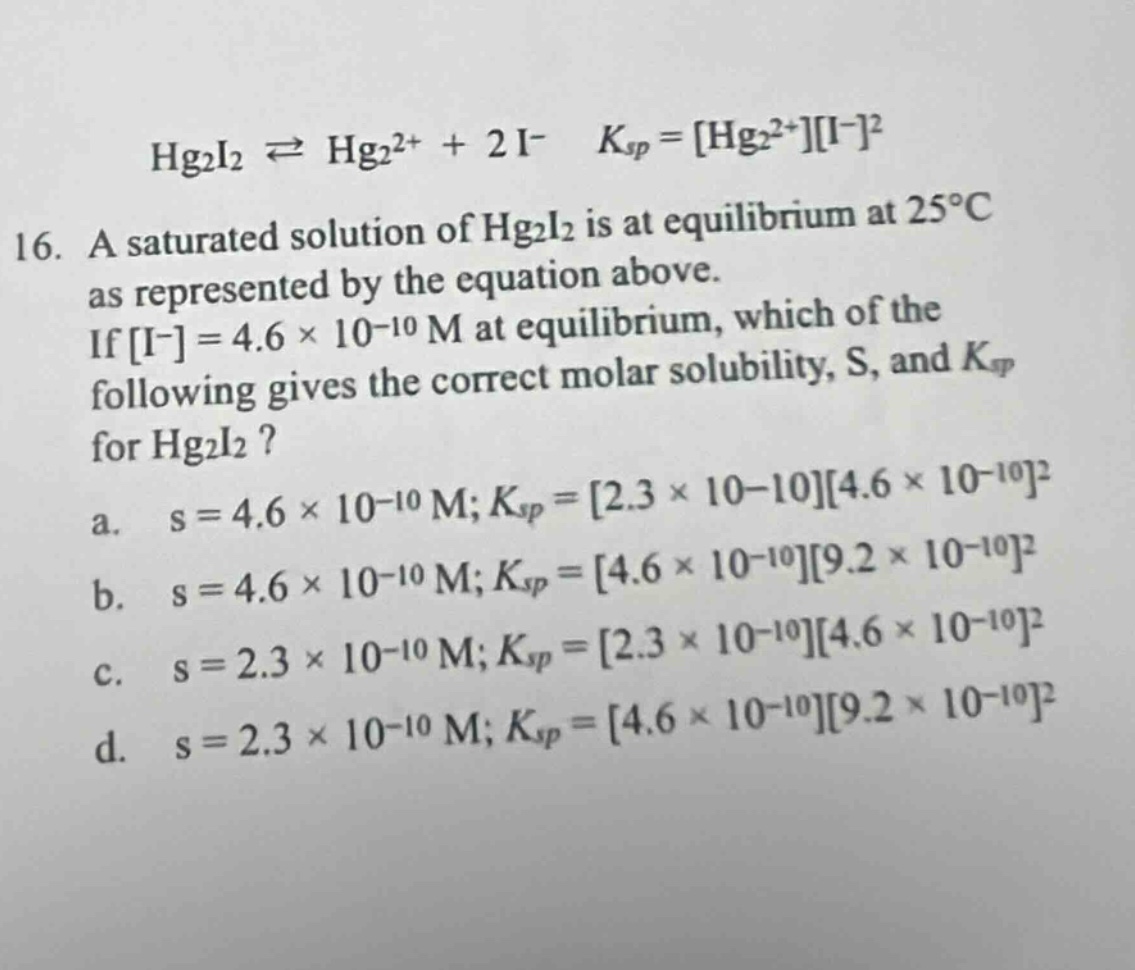
hg₂i₂ ⇌ hg₂²⁺ + 2 i⁻ ( k_{sp} = \text{hg}_2^{2+}\text{i}^-^2 )
- a saturated solution of hg₂i₂ is at equilibrium at 25°c as represented by the equation above.
if (\text{i}^- = 4.6 \times 10^{-10} \text{m}) at equilibrium, which of the following gives the correct molar solubility, ( s ), and ( k_{sp} ) for hg₂i₂ ?
a. ( s = 4.6 \times 10^{-10} \text{m}; k_{sp} = 2.3 \times 10^{-10}4.6 \times 10^{-10}^2 )
b. ( s = 4.6 \times 10^{-10} \text{m}; k_{sp} = 4.6 \times 10^{-10}9.2 \times 10^{-10}^2 )
c. ( s = 2.3 \times 10^{-10} \text{m}; k_{sp} = 2.3 \times 10^{-10}4.6 \times 10^{-10}^2 )
d. ( s = 2.3 \times 10^{-10} \text{m}; k_{sp} = 4.6 \times 10^{-10}9.2 \times 10^{-10}^2 )
Step1: Determine molar solubility (s)
From the dissociation equation $\ce{Hg2I2
ightleftharpoons Hg2^{2+} + 2 I^-}$, the molar solubility \( s \) of \(\ce{Hg2I2}\) is equal to the concentration of \(\ce{Hg2^{2+}}\) (since 1 mole of \(\ce{Hg2I2}\) produces 1 mole of \(\ce{Hg2^{2+}}\)). The concentration of \(\ce{I^-}\) is \( 2s \) (since 1 mole of \(\ce{Hg2I2}\) produces 2 moles of \(\ce{I^-}\)). Given \([\ce{I^-}] = 4.6 \times 10^{-10} \, \text{M}\), we solve for \( s \):
\( 2s = 4.6 \times 10^{-10} \, \text{M} \)
\( s = \frac{4.6 \times 10^{-10}}{2} = 2.3 \times 10^{-10} \, \text{M} \).
Step2: Calculate \( K_{sp} \)
The solubility product constant \( K_{sp} \) is given by \( K_{sp} = [\ce{Hg2^{2+}}][\ce{I^-}]^2 \). We know \( [\ce{Hg2^{2+}}] = s = 2.3 \times 10^{-10} \, \text{M} \) and \( [\ce{I^-}] = 4.6 \times 10^{-10} \, \text{M} \). Substituting these values:
\( K_{sp} = (2.3 \times 10^{-10})(4.6 \times 10^{-10})^2 \).

Snap & solve any problem in the app
Get step-by-step solutions on Sovi AI
Photo-based solutions with guided steps
Explore more problems and detailed explanations
c. \( \text{s} = 2.3 \times 10^{-10} \, \text{M}; K_{sp} = [2.3 \times 10^{-10}][4.6 \times 10^{-10}]^2 \)