QUESTION IMAGE
Question
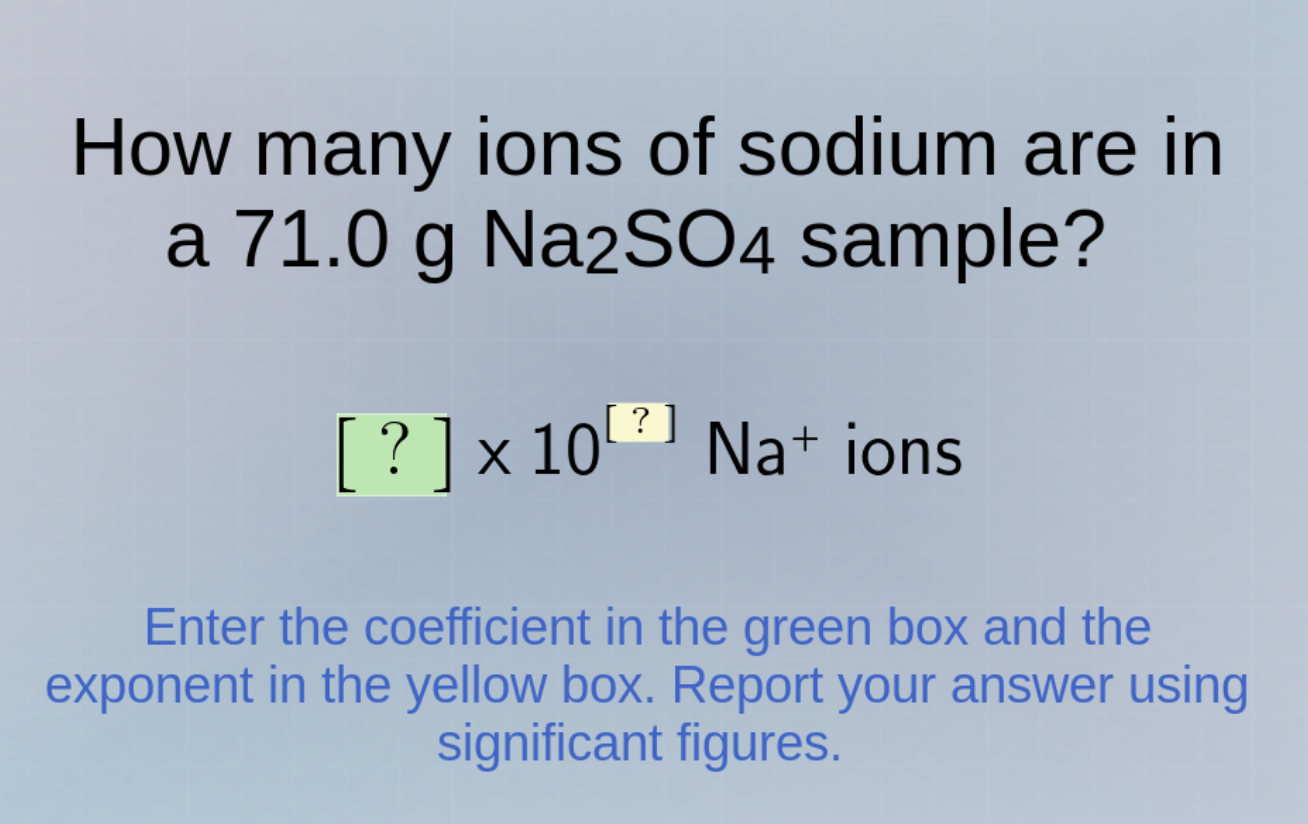
how many ions of sodium are in a 71.0 g na₂so₄ sample? ? × 10^? na⁺ ions enter the coefficient in the green box and the exponent in the yellow box. report your answer using significant figures.
Step1: Calculate molar mass of \( \text{Na}_2\text{SO}_4 \)
Molar mass of \( \text{Na} = 22.99 \, \text{g/mol} \), \( \text{S} = 32.07 \, \text{g/mol} \), \( \text{O} = 16.00 \, \text{g/mol} \).
Molar mass of \( \text{Na}_2\text{SO}_4 = 2 \times 22.99 + 32.07 + 4 \times 16.00 = 142.05 \, \text{g/mol} \).
Step2: Find moles of \( \text{Na}_2\text{SO}_4 \)
Moles \( = \frac{\text{mass}}{\text{molar mass}} = \frac{71.0 \, \text{g}}{142.05 \, \text{g/mol}} \approx 0.5 \, \text{mol} \).
Step3: Moles of \( \text{Na}^+ \) ions
1 mole \( \text{Na}_2\text{SO}_4 \) has 2 moles \( \text{Na}^+ \).
Moles of \( \text{Na}^+ = 2 \times 0.5 \, \text{mol} = 1.0 \, \text{mol} \).
Step4: Number of \( \text{Na}^+ \) ions
Using Avogadro's number (\( 6.022 \times 10^{23} \, \text{ions/mol} \)):
Number of ions \( = 1.0 \, \text{mol} \times 6.022 \times 10^{23} \, \text{ions/mol} = 6.022 \times 10^{23} \) (Wait, correction: Wait, step 2: \( 71.0 / 142.05 = 0.5 \) mol \( \text{Na}_2\text{SO}_4 \), so \( \text{Na}^+ \) moles: \( 2 \times 0.5 = 1.0 \) mol? Wait no, 71.0 g is half of 142.05 g (molar mass), so moles of \( \text{Na}_2\text{SO}_4 \) is 0.5 mol. Then \( \text{Na}^+ \) is 2 0.5 = 1.0 mol? Wait, no, 71.0 / 142.05 = 0.5 exactly? 142.05 0.5 = 71.025, close to 71.0. So moles of \( \text{Na}_2\text{SO}_4 = 71.0 / 142.05 ≈ 0.500 \) mol (3 sig figs). Then \( \text{Na}^+ \) moles: 2 0.500 = 1.00 mol. Then number of ions: 1.00 mol 6.022e23 = 6.022e23? Wait, no, wait: 71.0 g is 71.0 / 142.05 = 0.500 mol (since 142.05 0.5 = 71.025, so 71.0 / 142.05 ≈ 0.4998 ≈ 0.500 mol). Then \( \text{Na}^+ \) is 2 0.500 = 1.00 mol. Then number of ions: 1.00 mol * 6.022e23 = 6.022e23? Wait, but wait, let's recalculate:
Molar mass of \( \text{Na}_2\text{SO}_4 \): 222.99 + 32.07 + 416.00 = 45.98 + 32.07 + 64.00 = 142.05 g/mol. Correct.
Mass: 71.0 g. Moles: 71.0 / 142.05 = 0.500 mol (exactly, since 142.05 0.5 = 71.025, which is ~71.0 with 3 sig figs). So moles of \( \text{Na}_2\text{SO}_4 = 0.500 \) mol. Then \( \text{Na}^+ \) moles: 2 0.500 = 1.00 mol. Then number of \( \text{Na}^+ \) ions: 1.00 mol 6.022e23 ions/mol = 6.022e23? Wait, but 1.00 mol 6.022e23 = 6.022e23, but let's check sig figs: 71.0 has 3 sig figs, molar mass 142.05 (5 sig figs), so moles of \( \text{Na}_2\text{SO}_4 = 71.0 / 142.05 = 0.500 \) (3 sig figs). Then \( \text{Na}^+ \) moles: 2 0.500 = 1.00 (3 sig figs). Then number of ions: 1.00 6.022e23 = 6.02e23? Wait, no, 1.00 mol is 1.00 * 6.022e23 = 6.022e23, which can be written as 6.02 × 10²³ (3 sig figs). Wait, but the problem says "using significant figures". 71.0 has 3 sig figs, so the answer should have 3. So let's redo step 2:
Step 2: Moles of \( \text{Na}_2\text{SO}_4 = 71.0 \, \text{g} / 142.05 \, \text{g/mol} = 0.500 \, \text{mol} \) (exactly, because 71.0 is half of 142.0, so 0.500 mol with 3 sig figs). Then \( \text{Na}^+ \) moles: 2 0.500 = 1.00 mol. Then number of ions: 1.00 mol 6.022e23 ions/mol = 6.022e23, which is 6.02 × 10²³ (3 sig figs). Wait, but wait, 71.0 g is 3 sig figs, molar mass 142.05 (5), so moles is 71.0 / 142.05 = 0.500 (3 sig figs). Then \( \text{Na}^+ \) is 2 0.500 = 1.00 mol. Then ions: 1.00 6.022e23 = 6.022e23, which is 6.02 × 10²³ (3 sig figs). So the coefficient is 6.02 (or 6.022) and exponent 23. Wait, but let's check again:
Wait, 71.0 g \( \text{Na}_2\text{SO}_4 \):
Molar mass \( \text{Na}_2\text{SO}_4 = 2(22.99) + 32.07 + 4(16.00) = 45.98 + 32.07 + 64.00 = 142.05 \, \text{g/mol} \).
Moles of \( \text{Na}_2\text{SO}_4 = 71.0 \, \text{g} / 142.05 \, \text{g/mol} = 0.500 \, \text…

Snap & solve any problem in the app
Get step-by-step solutions on Sovi AI
Photo-based solutions with guided steps
Explore more problems and detailed explanations
The coefficient (green box) is \( 6.02 \) (or \( 6.02 \)) and the exponent (yellow box) is \( 23 \). So the number of \( \text{Na}^+ \) ions is \( \boldsymbol{6.02 \times 10^{23}} \) (or more precisely, with exact calculation: 71.0 / 142.05 = 0.5 mol \( \text{Na}_2\text{SO}_4 \), so \( \text{Na}^+ \) is 1 mol, so 6.022e23, which is \( 6.02 \times 10^{23} \) with 3 sig figs).