QUESTION IMAGE
Question
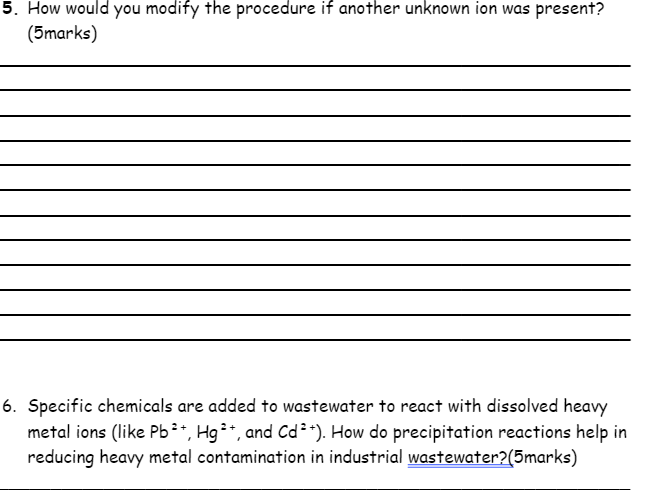
- how would you modify the procedure if another unknown ion was present? (5marks)
- specific chemicals are added to wastewater to react with dissolved heavy metal ions (like pb²⁺, hg²⁺, and cd²⁺). how do precipitation reactions help in reducing heavy metal contamination in industrial wastewater?(5marks)
Response
Question 5
Brief Explanations
- Identify the new ion's properties: First, determine the chemical properties (e.g., charge, solubility, reactivity) of the unknown ion. This helps in selecting appropriate reagents and conditions.
- Adjust reagent selection: Choose reagents that can selectively react with the new ion without interfering with the existing ions. For example, if the new ion is a cation, find an anion that forms a precipitate or complex with it uniquely.
- Modify separation steps: Introduce additional separation steps (e.g., precipitation, filtration, extraction) to isolate the new ion. This may involve adding new reagents at specific pH or temperature conditions.
- Update analytical techniques: If needed, use new analytical methods (e.g., spectroscopy, titration) to detect and quantify the new ion. Ensure these methods are compatible with the existing procedure.
- Validate the modified procedure: Test the new procedure with known samples containing the new ion and existing ions to ensure accuracy and precision.
Brief Explanations
- Principle of precipitation reactions: Precipitation reactions involve adding a reagent (precipitant) that forms an insoluble salt with heavy metal ions. For example, adding sulfide ions ($\text{S}^{2-}$) or hydroxide ions ($\text{OH}^-$) to form $\text{PbS}$, $\text{HgS}$, or $\text{Cd(OH)}_2$.
- Removal of heavy metals: The insoluble precipitate can be removed from the wastewater by filtration or sedimentation. This reduces the concentration of dissolved heavy metal ions.
- Reducing bioavailability: Heavy metal precipitates are less bioavailable (toxic) than dissolved ions. This minimizes their uptake by organisms in the environment.
- Compliance with regulations: Precipitation helps industries meet environmental standards by reducing heavy metal concentrations to permissible levels.
- Cost-effectiveness: Precipitation is a relatively simple and cost-effective method for treating large volumes of industrial wastewater.

Snap & solve any problem in the app
Get step-by-step solutions on Sovi AI
Photo-based solutions with guided steps
Explore more problems and detailed explanations
To modify the procedure for an additional unknown ion:
- Determine the new ion’s chemical properties (charge, solubility, reactivity).
- Select reagents that selectively react with the new ion (e.g., forming a unique precipitate/complex).
- Add separation steps (e.g., precipitation, filtration) to isolate the new ion (adjust pH/temperature if needed).
- Update analytical methods (e.g., spectroscopy, titration) to detect/quantify the new ion.
- Validate the modified procedure with known samples.