QUESTION IMAGE
Question
Question was provided via image upload.
Brief Explanations
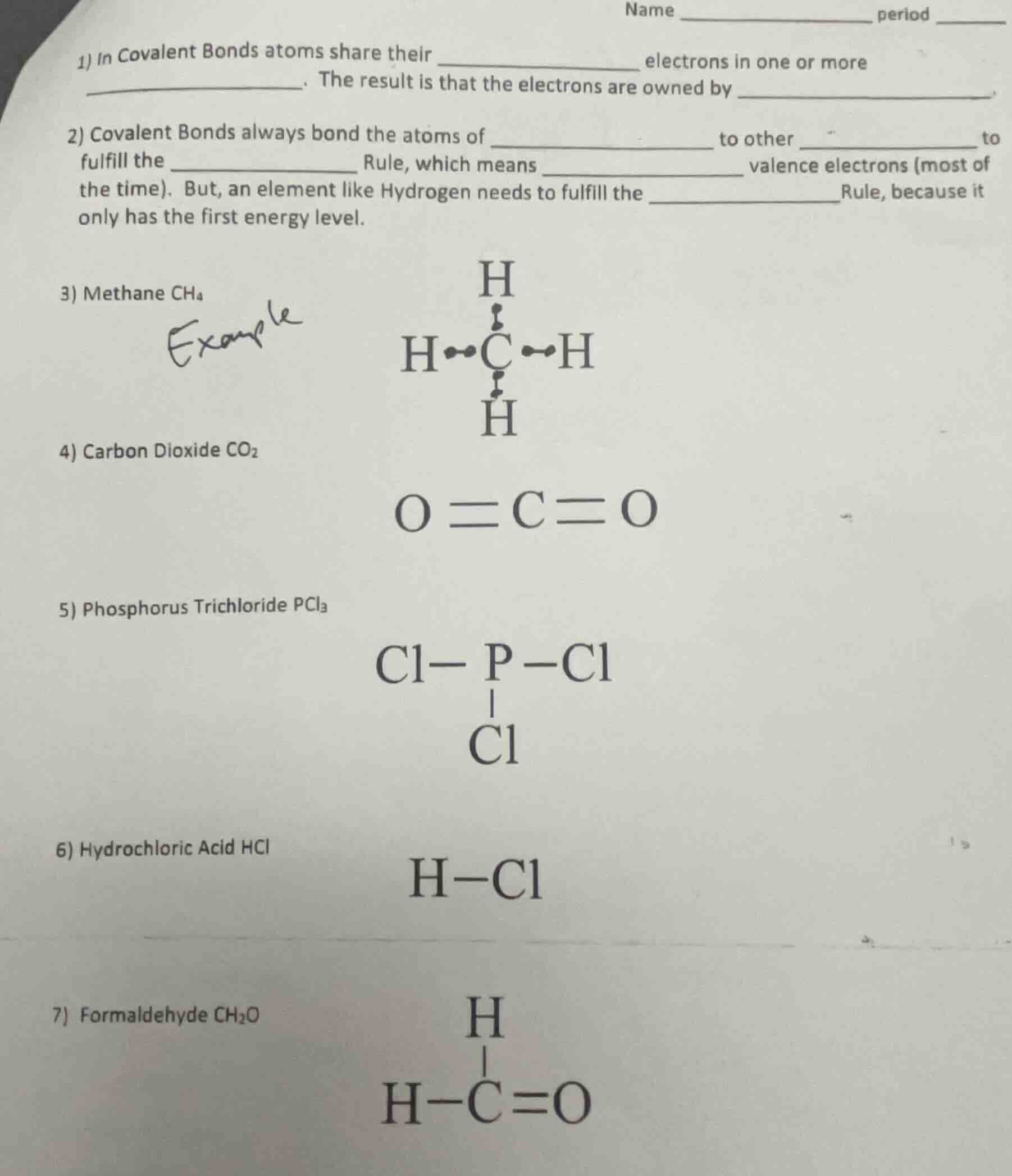
- Covalent bonds involve sharing of valence electrons in paired form, with electrons belonging to both atoms involved in the bond.
- Covalent bonds form between nonmetal atoms, following the octet rule (8 valence electrons for stability) for most elements; hydrogen only needs 2 valence electrons, following the duet rule, as its first energy level holds a maximum of 2 electrons.
- Carbon has 4 valence electrons, each hydrogen has 1; they share electrons to form 4 single bonds, with carbon having 8 valence electrons and each hydrogen having 2.
- Carbon has 4 valence electrons, each oxygen has 6; carbon forms double bonds with each oxygen, giving all atoms 8 valence electrons.
- Phosphorus has 5 valence electrons, each chlorine has 7; phosphorus forms 3 single bonds with chlorine atoms, keeping 1 lone pair, and each chlorine has 3 lone pairs, satisfying the octet rule for all atoms.
- Hydrogen has 1 valence electron, chlorine has 7; they form a single bond, giving hydrogen 2 valence electrons and chlorine 8.
- Carbon has 4 valence electrons, hydrogen has 1 each, oxygen has 6; carbon forms single bonds with two hydrogens and a double bond with oxygen, giving all atoms full valence shells (carbon/oxygen have 8, hydrogens have 2).

Snap & solve any problem in the app
Get step-by-step solutions on Sovi AI
Photo-based solutions with guided steps
Explore more problems and detailed explanations
- valence; electron pairs; both bonded atoms
- nonmetals; nonmetals; Octet; 8; Duet
- (Lewis structure provided as example, complete with lone pairs:
    H
    ··
H··C··H
    ··
    H
)
- (Complete Lewis structure with lone pairs:
:O::C::O:)
- (Complete Lewis structure with lone pairs:
      ..
Cl: P :Cl
      ..
      |
      Cl:
         ..
)
- (Complete Lewis structure with lone pairs:
H:Cl:
   ..
)
- (Complete Lewis structure with lone pairs:
    H
    |
H-C=O
    :
)