QUESTION IMAGE
Question
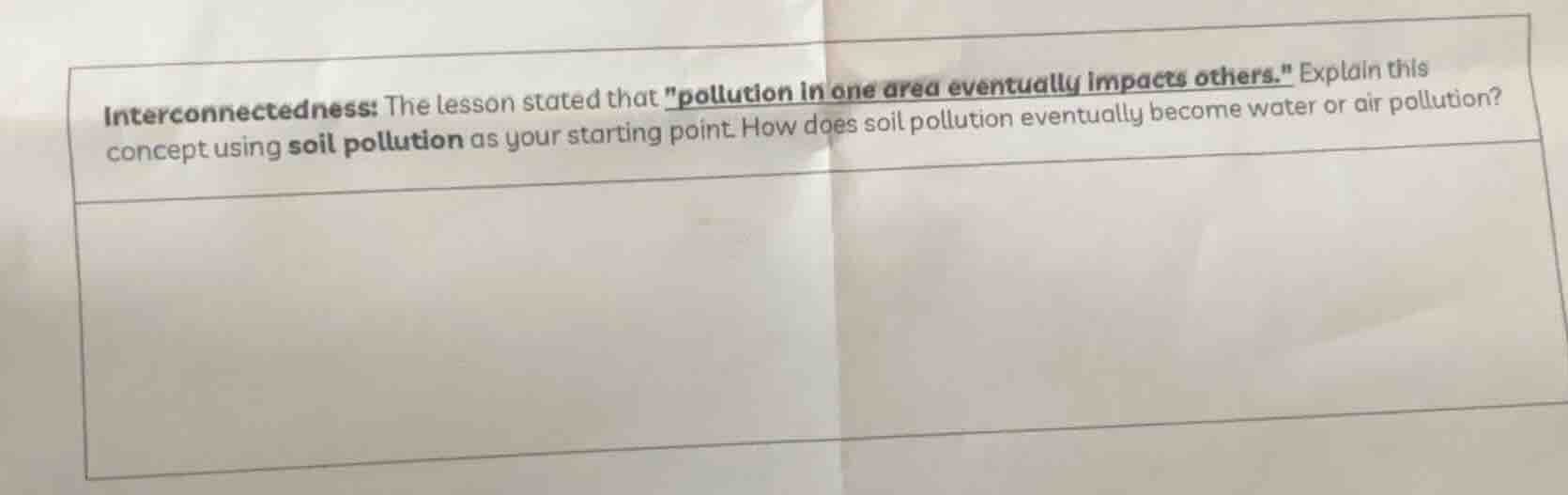
interconnectedness: the lesson stated that \pollution in one area eventually impacts others.\ explain this concept using soil pollution as your starting point. how does soil pollution eventually become water or air pollution?
Soil pollution has contaminants like heavy metals, chemicals, or pesticides. For water pollution: Rainwater or irrigation can leach these contaminants from polluted soil into groundwater or surface water (like rivers, lakes). This runoff carries the pollutants, contaminating water bodies. For air pollution: Pollutants in soil (e.g., volatile organic compounds, dust - bound pollutants) can be released into the air through processes like wind erosion (carrying polluted soil particles) or volatilization (chemicals turning into gas and entering the atmosphere). So soil pollution, via leaching (for water) and erosion/volatilization (for air), connects to water and air pollution, showing environmental interconnectedness.

Snap & solve any problem in the app
Get step-by-step solutions on Sovi AI
Photo-based solutions with guided steps
Explore more problems and detailed explanations
Soil pollution can lead to water pollution when rain or irrigation water leaches contaminants (e.g., chemicals, heavy metals) from polluted soil into groundwater or surface water (rivers, lakes). For air pollution, wind erosion can carry polluted soil particles (with contaminants) into the air, and some soil - based chemicals can volatilize into gaseous pollutants that enter the atmosphere. This shows how pollution in one environmental component (soil) impacts others (water, air) due to natural processes like leaching, erosion, and volatilization.