QUESTION IMAGE
Question
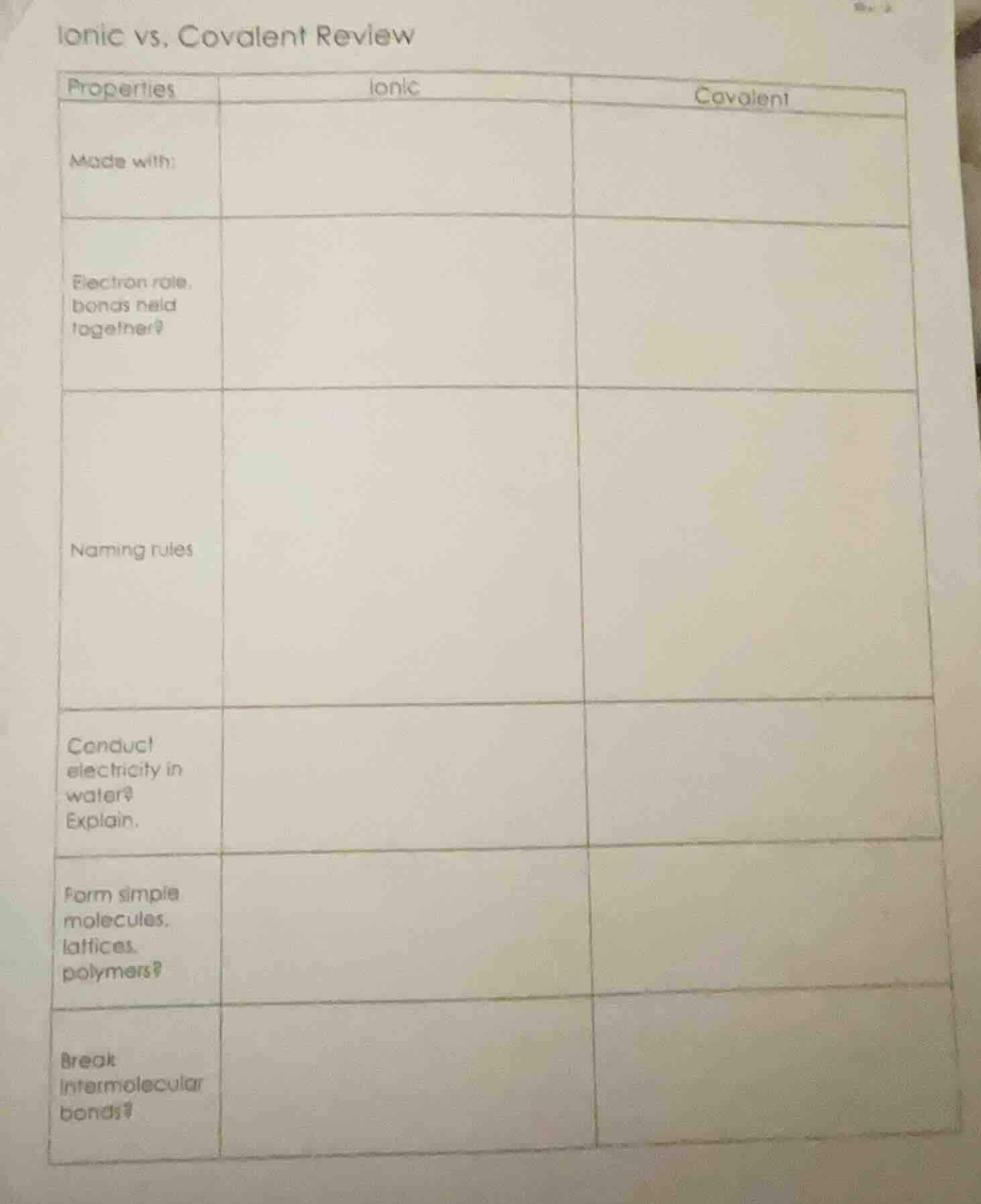
ionic vs. covalent review
properties\tionic\tcovalent
made with:
electron role, bonds held together?
naming rules
conduct electricity in water? explain.
form simple molecules, lattices, polymers?
break intermolecular bonds?
Response
To complete the "Ionic vs. Covalent Review" table, we analyze each property:
1. Made with:
- Ionic: Metal + Non - metal (or polyatomic ion). Ionic bonds form between atoms with large electronegativity differences, typically a metal (loses electrons) and a non - metal (gains electrons).
- Covalent: Non - metal + Non - metal (or metalloid + non - metal). Covalent bonds involve sharing of electrons between atoms with similar electronegativities.
2. Electron role (bonds held together?):
- Ionic: Electrons are transferred from metal to non - metal. The resulting ions (cation: +, anion: -) are held together by electrostatic attraction (ionic bond).
- Covalent: Electrons are shared between atoms. Atoms are held together by the shared electron pair(s) (covalent bond).
3. Naming rules:
- Ionic:
- Binary: Name the metal (cation), then the non - metal (anion) with “-ide” suffix (e.g., NaCl = Sodium Chloride).
- With polyatomic ions: Name the cation (metal or polyatomic like NH₄⁺), then the polyatomic anion (e.g., NaOH = Sodium Hydroxide).
- Covalent:
- Use prefixes (mono -, di -, tri - …) to indicate the number of each atom (except “mono - ” for the first element). Name the first non - metal, then the second with “-ide” (e.g., CO₂ = Carbon Dioxide, N₂O = Dinitrogen Oxide).
4. Conduct electricity in water? Explain.
- Ionic: Yes. When dissolved in water, ionic compounds dissociate into free - moving ions (e.g., NaCl → Na⁺ + Cl⁻). These ions carry electric charge, allowing current to flow.
- Covalent: No (for most simple covalent compounds). Covalent compounds (e.g., sugar, CO₂ dissolved) do not dissociate into ions in water; they remain as neutral molecules, so no charge carriers.
5. Form simple molecules, lattices, polymers?
- Ionic: Form ionic lattices (a repeating 3D structure of ions, e.g., NaCl crystal lattice). Do not form simple molecules (the formula unit is the smallest repeating unit) or typical polymers (ionic bonding is too rigid for polymer chains).
- Covalent:
- Simple molecules: Yes (e.g., H₂O, CO₂, CH₄).
- Lattices: Some form covalent lattices (e.g., diamond, SiO₂), but most simple covalent compounds are molecular.
- Polymers: Yes (e.g., plastics like polyethylene, where covalent bonds link monomers into long chains).
6. Break intermolecular bonds?
- Ionic: Ionic compounds have strong ionic bonds (intramolecular) and relatively weak intermolecular forces (ion - ion attractions between lattices). When melted or dissolved, the ionic bonds (intramolecular) break, not intermolecular (though intermolecular forces are overcome in dissolution).
- Covalent: For molecular covalent compounds, melting/boiling breaks intermolecular forces (e.g., London dispersion, dipole - dipole, H - bonds). For covalent lattices (e.g., diamond), covalent bonds (intramolecular) must break, which is rare and requires high energy.
Filled Table:
| Properties | Ionic | Covalent |
|---|
| Electron role…

Snap & solve any problem in the app
Get step-by-step solutions on Sovi AI
Photo-based solutions with guided steps
Explore more problems and detailed explanations
To complete the "Ionic vs. Covalent Review" table, we analyze each property:
1. Made with:
- Ionic: Metal + Non - metal (or polyatomic ion). Ionic bonds form between atoms with large electronegativity differences, typically a metal (loses electrons) and a non - metal (gains electrons).
- Covalent: Non - metal + Non - metal (or metalloid + non - metal). Covalent bonds involve sharing of electrons between atoms with similar electronegativities.
2. Electron role (bonds held together?):
- Ionic: Electrons are transferred from metal to non - metal. The resulting ions (cation: +, anion: -) are held together by electrostatic attraction (ionic bond).
- Covalent: Electrons are shared between atoms. Atoms are held together by the shared electron pair(s) (covalent bond).
3. Naming rules:
- Ionic:
- Binary: Name the metal (cation), then the non - metal (anion) with “-ide” suffix (e.g., NaCl = Sodium Chloride).
- With polyatomic ions: Name the cation (metal or polyatomic like NH₄⁺), then the polyatomic anion (e.g., NaOH = Sodium Hydroxide).
- Covalent:
- Use prefixes (mono -, di -, tri - …) to indicate the number of each atom (except “mono - ” for the first element). Name the first non - metal, then the second with “-ide” (e.g., CO₂ = Carbon Dioxide, N₂O = Dinitrogen Oxide).
4. Conduct electricity in water? Explain.
- Ionic: Yes. When dissolved in water, ionic compounds dissociate into free - moving ions (e.g., NaCl → Na⁺ + Cl⁻). These ions carry electric charge, allowing current to flow.
- Covalent: No (for most simple covalent compounds). Covalent compounds (e.g., sugar, CO₂ dissolved) do not dissociate into ions in water; they remain as neutral molecules, so no charge carriers.
5. Form simple molecules, lattices, polymers?
- Ionic: Form ionic lattices (a repeating 3D structure of ions, e.g., NaCl crystal lattice). Do not form simple molecules (the formula unit is the smallest repeating unit) or typical polymers (ionic bonding is too rigid for polymer chains).
- Covalent:
- Simple molecules: Yes (e.g., H₂O, CO₂, CH₄).
- Lattices: Some form covalent lattices (e.g., diamond, SiO₂), but most simple covalent compounds are molecular.
- Polymers: Yes (e.g., plastics like polyethylene, where covalent bonds link monomers into long chains).
6. Break intermolecular bonds?
- Ionic: Ionic compounds have strong ionic bonds (intramolecular) and relatively weak intermolecular forces (ion - ion attractions between lattices). When melted or dissolved, the ionic bonds (intramolecular) break, not intermolecular (though intermolecular forces are overcome in dissolution).
- Covalent: For molecular covalent compounds, melting/boiling breaks intermolecular forces (e.g., London dispersion, dipole - dipole, H - bonds). For covalent lattices (e.g., diamond), covalent bonds (intramolecular) must break, which is rare and requires high energy.
Filled Table:
| Properties | Ionic | Covalent |
|---|---|---|
| Electron role, bonds held together? | Electrons transferred; held by electrostatic attraction (ionic bond) | Electrons shared; held by shared electron pairs (covalent bond) |
| Naming rules | Metal + non - metal (ide) or polyatomic ion; no prefixes | Prefixes (mono -, di - …) for atom count; non - metal + non - metal (ide) |
| Conduct electricity in water? Explain. | Yes; dissociates into ions (charge carriers) | No; remains as neutral molecules (no charge carriers) |
| Form simple molecules, lattices, polymers? | Lattices (no simple molecules, rare polymers) | Simple molecules (most); some lattices (e.g., diamond); polymers (e.g., plastics) |
| Break intermolecular bonds? | Ionic bonds (intramolecular) break (intermolecular forces are weak) | Intermolecular forces break (for molecular covalent); covalent bonds (intramolecular) break (for covalent lattices, rare) |
This table summarizes the key differences between ionic and covalent compounds across the listed properties.