QUESTION IMAGE
Question
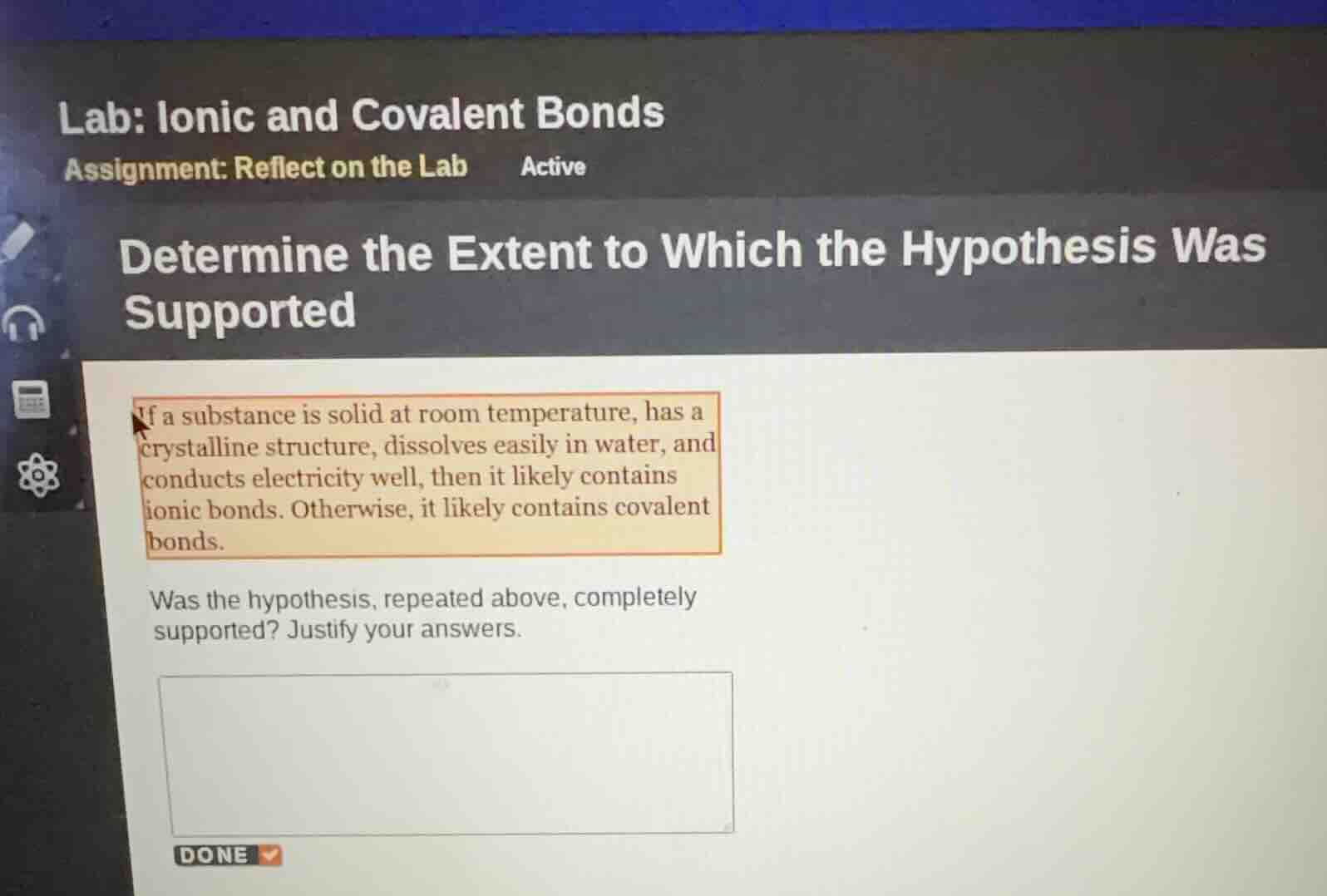
lab: ionic and covalent bonds
assignment: reflect on the lab active
determine the extent to which the hypothesis was supported
if a substance is solid at room temperature, has a crystalline structure, dissolves easily in water, and conducts electricity well, then it likely contains ionic bonds. otherwise, it likely contains covalent bonds.
was the hypothesis, repeated above, completely supported? justify your answers.
done
The hypothesis is not completely supported. While ionic compounds typically match the described properties (solid at room temp, crystalline, water-soluble, conductive in solution/melt), there are exceptions:
- Some covalent network solids (like diamond) are solid, crystalline, and non-conductive, but do not dissolve in water—this fits the "otherwise covalent" part, but
- Some polar covalent compounds (like hydrogen chloride, HCl) dissolve easily in water and can conduct electricity in solution, yet have covalent bonds. Additionally, some ionic compounds are insoluble in water (e.g., silver chloride, AgCl) but still have ionic bonds, which contradicts the "dissolves easily in water" requirement for ionic classification in the hypothesis.

Snap & solve any problem in the app
Get step-by-step solutions on Sovi AI
Photo-based solutions with guided steps
Explore more problems and detailed explanations
No, the hypothesis is not completely supported. There are key exceptions: some polar covalent substances dissolve in water and conduct electricity in solution, and some ionic substances are insoluble in water, which do not align with the strict criteria laid out in the hypothesis.