QUESTION IMAGE
Question
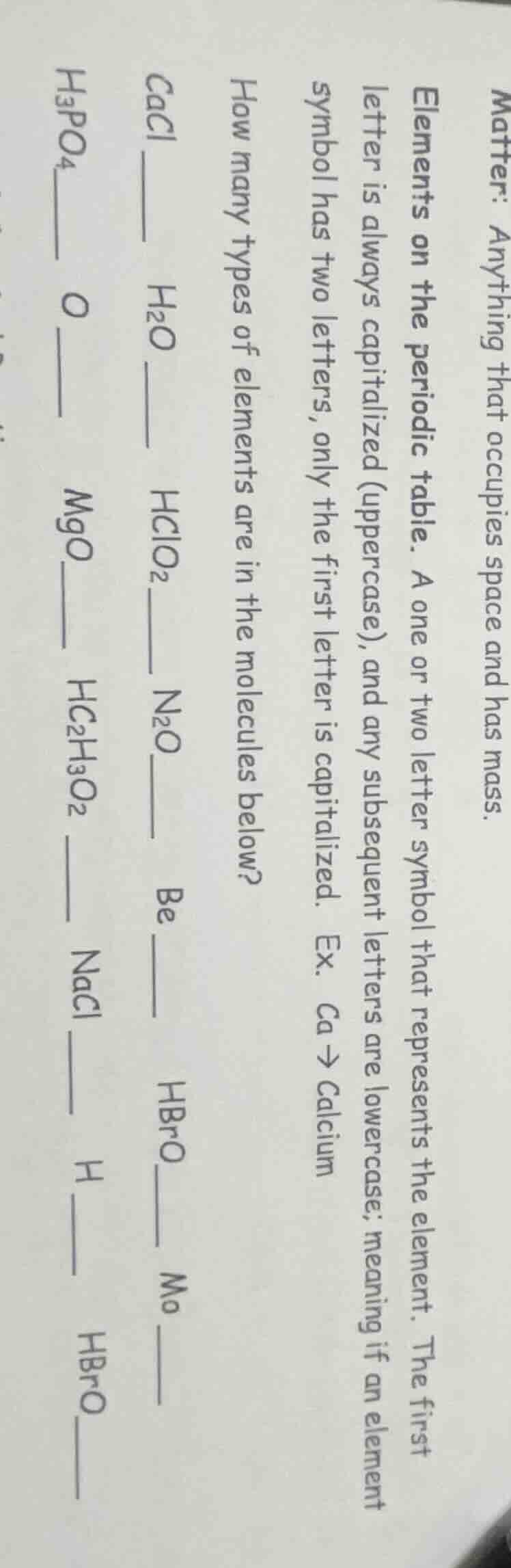
matter: anything that occupies space and has mass.
elements on the periodic table. a one or two letter symbol that represents the element. the first letter is always capitalized (uppercase), and any subsequent letters are lowercase; meaning if an element symbol has two letters, only the first letter is capitalized. ex. ca → calcium
how many types of elements are in the molecules below?
cacl ____
h₂o ____
hclo₂ ____
n₂o ____
be ____
hbro ____
mo ____
h₃po₄ ____
o ____
mgo ____
hc₂h₃o₂ ____
nacl ____
h ____
hbro ____
To determine the number of element types in each molecule/atom, we identify unique elements by their symbols (first letter capitalized, subsequent lowercase):
1. \( \boldsymbol{CaCl} \)
- Elements: \( Ca \) (Calcium), \( Cl \) (Chlorine)
- Count: \( 2 \)
2. \( \boldsymbol{H_2O} \)
- Elements: \( H \) (Hydrogen), \( O \) (Oxygen)
- Count: \( 2 \)
3. \( \boldsymbol{HClO_2} \)
- Elements: \( H \) (Hydrogen), \( Cl \) (Chlorine), \( O \) (Oxygen)
- Count: \( 3 \)
4. \( \boldsymbol{N_2O} \)
- Elements: \( N \) (Nitrogen), \( O \) (Oxygen)
- Count: \( 2 \)
5. \( \boldsymbol{Be} \)
- Element: \( Be \) (Beryllium)
- Count: \( 1 \)
6. \( \boldsymbol{HBrO} \)
- Elements: \( H \) (Hydrogen), \( Br \) (Bromine), \( O \) (Oxygen)
- Count: \( 3 \)
7. \( \boldsymbol{Mo} \)
- Element: \( Mo \) (Molybdenum)
- Count: \( 1 \)
8. \( \boldsymbol{H_3PO_4} \)
- Elements: \( H \) (Hydrogen), \( P \) (Phosphorus), \( O \) (Oxygen)
- Count: \( 3 \)
9. \( \boldsymbol{O} \)
- Element: \( O \) (Oxygen)
- Count: \( 1 \)
10. \( \boldsymbol{MgO} \)
- Elements: \( Mg \) (Magnesium), \( O \) (Oxygen)
- Count: \( 2 \)
11. \( \boldsymbol{HC_2H_3O_2} \) (Acetic Acid, \( CH_3COOH \))
- Elements: \( H \) (Hydrogen), \( C \) (Carbon), \( O \) (Oxygen)
- Count: \( 3 \)
12. \( \boldsymbol{NaCl} \)
- Elements: \( Na \) (Sodium), \( Cl \) (Chlorine)
- Count: \( 2 \)
13. \( \boldsymbol{H} \)
- Element: \( H \) (Hydrogen)
- Count: \( 1 \)
14. \( \boldsymbol{HBrO} \) (Repeat, same as #6)
- Elements: \( H \), \( Br \), \( O \)
- Count: \( 3 \)
Final Counts (per compound/atom):
\( CaCl \): \( 2 \)
\( H_2O \): \( 2 \)
\( HClO_2 \): \( 3 \)
\( N_2O \): \( 2 \)
\( Be \): \( 1 \)
\( HBrO \): \( 3 \)
\( Mo \): \( 1 \)
\( H_3PO_4 \): \( 3 \)
\( O \): \( 1 \)
\( MgO \): \( 2 \)
\( HC_2H_3O_2 \): \( 3 \)
\( NaCl \): \( 2 \)
\( H \): \( 1 \)
\( HBrO \) (Repeat): \( 3 \)
If you need a summary (e.g., total unique elements across all, or counts per item), clarify the question! For individual counts, use the above.

Snap & solve any problem in the app
Get step-by-step solutions on Sovi AI
Photo-based solutions with guided steps
Explore more problems and detailed explanations
To determine the number of element types in each molecule/atom, we identify unique elements by their symbols (first letter capitalized, subsequent lowercase):
1. \( \boldsymbol{CaCl} \)
- Elements: \( Ca \) (Calcium), \( Cl \) (Chlorine)
- Count: \( 2 \)
2. \( \boldsymbol{H_2O} \)
- Elements: \( H \) (Hydrogen), \( O \) (Oxygen)
- Count: \( 2 \)
3. \( \boldsymbol{HClO_2} \)
- Elements: \( H \) (Hydrogen), \( Cl \) (Chlorine), \( O \) (Oxygen)
- Count: \( 3 \)
4. \( \boldsymbol{N_2O} \)
- Elements: \( N \) (Nitrogen), \( O \) (Oxygen)
- Count: \( 2 \)
5. \( \boldsymbol{Be} \)
- Element: \( Be \) (Beryllium)
- Count: \( 1 \)
6. \( \boldsymbol{HBrO} \)
- Elements: \( H \) (Hydrogen), \( Br \) (Bromine), \( O \) (Oxygen)
- Count: \( 3 \)
7. \( \boldsymbol{Mo} \)
- Element: \( Mo \) (Molybdenum)
- Count: \( 1 \)
8. \( \boldsymbol{H_3PO_4} \)
- Elements: \( H \) (Hydrogen), \( P \) (Phosphorus), \( O \) (Oxygen)
- Count: \( 3 \)
9. \( \boldsymbol{O} \)
- Element: \( O \) (Oxygen)
- Count: \( 1 \)
10. \( \boldsymbol{MgO} \)
- Elements: \( Mg \) (Magnesium), \( O \) (Oxygen)
- Count: \( 2 \)
11. \( \boldsymbol{HC_2H_3O_2} \) (Acetic Acid, \( CH_3COOH \))
- Elements: \( H \) (Hydrogen), \( C \) (Carbon), \( O \) (Oxygen)
- Count: \( 3 \)
12. \( \boldsymbol{NaCl} \)
- Elements: \( Na \) (Sodium), \( Cl \) (Chlorine)
- Count: \( 2 \)
13. \( \boldsymbol{H} \)
- Element: \( H \) (Hydrogen)
- Count: \( 1 \)
14. \( \boldsymbol{HBrO} \) (Repeat, same as #6)
- Elements: \( H \), \( Br \), \( O \)
- Count: \( 3 \)
Final Counts (per compound/atom):
\( CaCl \): \( 2 \)
\( H_2O \): \( 2 \)
\( HClO_2 \): \( 3 \)
\( N_2O \): \( 2 \)
\( Be \): \( 1 \)
\( HBrO \): \( 3 \)
\( Mo \): \( 1 \)
\( H_3PO_4 \): \( 3 \)
\( O \): \( 1 \)
\( MgO \): \( 2 \)
\( HC_2H_3O_2 \): \( 3 \)
\( NaCl \): \( 2 \)
\( H \): \( 1 \)
\( HBrO \) (Repeat): \( 3 \)
If you need a summary (e.g., total unique elements across all, or counts per item), clarify the question! For individual counts, use the above.