QUESTION IMAGE
Question
module 0: intro. to chemistry and measurement
- your height (66 inches), your age (15 years), and your body temperature (98.6 °f) are examples of measurements.
- the metric system:
- the standards of measurement used in science are those of the __________.
- all metric units are based on multiples of 10. as a result, you can convert between units easily.
- the __________________ (abbreviated __ after the french name le système international d’unités) is a revised version of the metric system.
- the metric system was originally established in france in 1795.
- the si was adopted by international agreement in 1960.
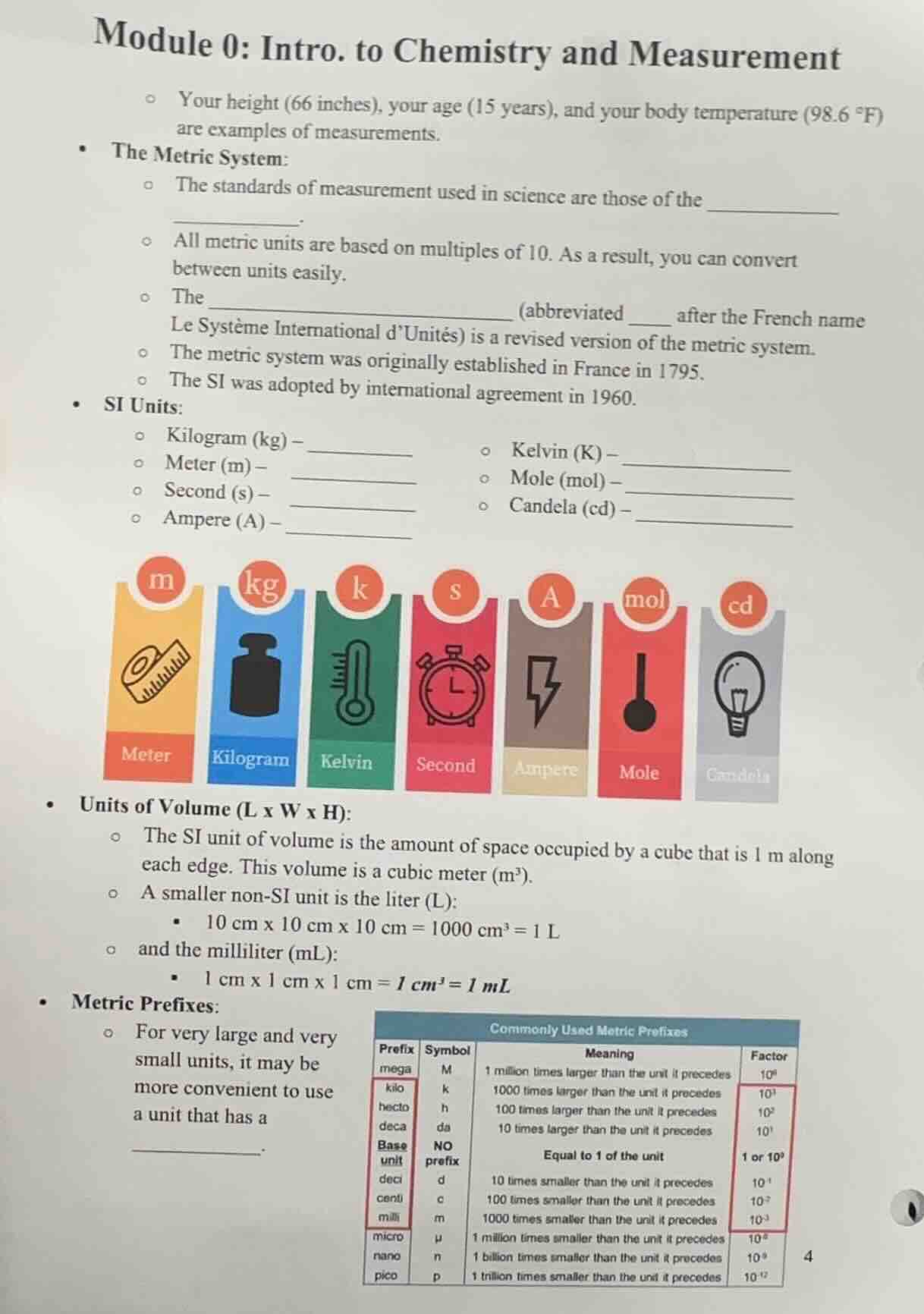
- si units:
- kilogram (kg) – ______
- meter (m) – ______
- second (s) – ______
- ampere (a) – ______
- kelvin (k) – ______
- mole (mol) – ______
- candela (cd) – ______
image with icons for meter, kilogram, kelvin, second, ampere, mole, candela
- units of volume (l x w x h):
- the si unit of volume is the amount of space occupied by a cube that is 1 m along each edge. this volume is a cubic meter (m³).
- a smaller non - si unit is the liter (l):
- 10 cm x 10 cm x 10 cm = 1000 cm³ = 1 l
- and the milliliter (ml):
- 1 cm x 1 cm x 1 cm = 1 cm³ = 1 ml
- metric prefixes:
- for very large and very small units, it may be more convenient to use a unit that has a __________.
table of commonly used metric prefixes with prefix, symbol, meaning, factor (mega (m): 1 million times larger, kilo (k): 1000 times larger, hecto (h): 100 times larger, deca (da): 10 times larger, base unit (no prefix): equal to 1 of the unit, deci (d): 10 times smaller, centi (c): 100 times smaller, milli (m): 1000 times smaller, micro (μ): 1 million times smaller, nano (n): 1 billion times smaller, pico (p): 1 trillion times smaller)
These are fill-in-the-blank questions about foundational chemistry measurement systems. Answers are based on standard definitions of the metric system, SI units, and related terminology.

Snap & solve any problem in the app
Get step-by-step solutions on Sovi AI
Photo-based solutions with guided steps
Explore more problems and detailed explanations
- The standards of measurement used in science are those of the metric system.
- The International System of Units (abbreviated SI after the French name Le Système International d'Unités) is a revised version of the metric system.
- Kilogram (kg) – unit of mass
- Meter (m) – unit of length
- Second (s) – unit of time
- Ampere (A) – unit of electric current
- Kelvin (K) – unit of temperature
- Mole (mol) – unit of amount of substance
- Candela (cd) – unit of luminous intensity
- For very large and very small units, it may be more convenient to use a unit that has a metric prefix.