QUESTION IMAGE
Question
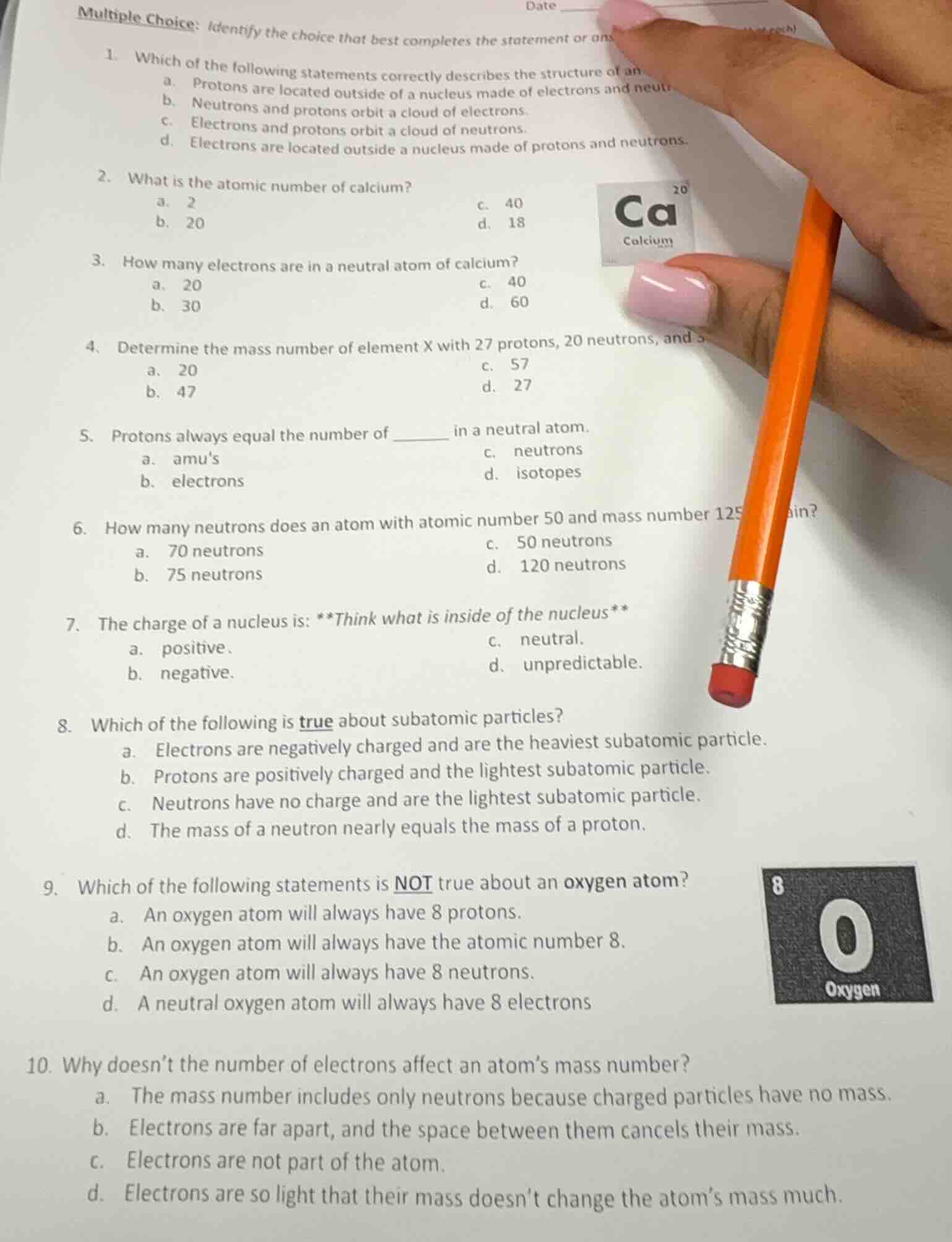
multiple choice: identify the choice that best completes the statement or ans
- which of the following statements correctly describes the structure of an
a. protons are located outside of a nucleus made of electrons and neut
b. neutrons and protons orbit a cloud of electrons.
c. electrons and protons orbit a cloud of neutrons.
d. electrons are located outside a nucleus made of protons and neutrons.
- what is the atomic number of calcium?
a. 2
c. 40
b. 20
d. 18
- how many electrons are in a neutral atom of calcium?
a. 20
c. 40
b. 30
d. 60
- determine the mass number of element x with 27 protons, 20 neutrons, and
a. 20
c. 57
b. 47
d. 27
- protons always equal the number of ______ in a neutral atom.
a. amus
c. neutrons
b. electrons
d. isotopes
- how many neutrons does an atom with atomic number 50 and mass number 125 ain?
a. 70 neutrons
c. 50 neutrons
b. 75 neutrons
d. 120 neutrons
- the charge of a nucleus is: think what is inside of the nucleus
a. positive.
c. neutral.
b. negative.
d. unpredictable.
- which of the following is true about subatomic particles?
a. electrons are negatively charged and are the heaviest subatomic particle.
b. protons are positively charged and the lightest subatomic particle.
c. neutrons have no charge and are the lightest subatomic particle.
d. the mass of a neutron nearly equals the mass of a proton.
- which of the following statements is not true about an oxygen atom?
a. an oxygen atom will always have 8 protons.
b. an oxygen atom will always have the atomic number 8.
c. an oxygen atom will always have 8 neutrons.
d. a neutral oxygen atom will always have 8 electrons
- why doesnt the number of electrons affect an atoms mass number?
a. the mass number includes only neutrons because charged particles have no mass.
b. electrons are far apart, and the space between them cancels their mass.
c. electrons are not part of the atom.
d. electrons are so light that their mass doesnt change the atoms mass much.
Step1: Analyze atomic structure (Q1)
Atoms have a nucleus of protons/neutrons, electrons outside.
Step2: Atomic number definition (Q2)
Atomic number = proton count, Ca has 20.
Step3: Neutral atom electron count (Q3)
Neutral atoms have equal protons/electrons = 20.
Step4: Mass number calculation (Q4)
Mass number = protons + neutrons = $27+20=47$.
Step5: Neutral atom proton-electron relation (Q5)
Neutral atoms have equal protons/electrons.
Step6: Neutron count calculation (Q6)
Neutrons = mass number - atomic number = $125-50=75$.
Step7: Nucleus charge (Q7)
Nucleus has positively charged protons, so positive.
Step8: Subatomic particle properties (Q8)
Neutron and proton masses are nearly equal; electrons are lightest, protons positive, neutrons neutral.
Step9: Oxygen atom properties (Q9)
Oxygen has isotopes (e.g., O-17 with 9 neutrons), so neutrons not always 8.
Step10: Electron mass impact (Q10)
Electron mass is negligible compared to protons/neutrons.

Snap & solve any problem in the app
Get step-by-step solutions on Sovi AI
Photo-based solutions with guided steps
Explore more problems and detailed explanations
- d. Electrons are located outside a nucleus made of protons and neutrons.
- b. 20
- a. 20
- b. 47
- b. electrons
- b. 75 neutrons
- a. positive.
- d. The mass of a neutron nearly equals the mass of a proton.
- c. An oxygen atom will always have 8 neutrons.
- d. Electrons are so light that their mass doesn't change the atom's mass much.