QUESTION IMAGE
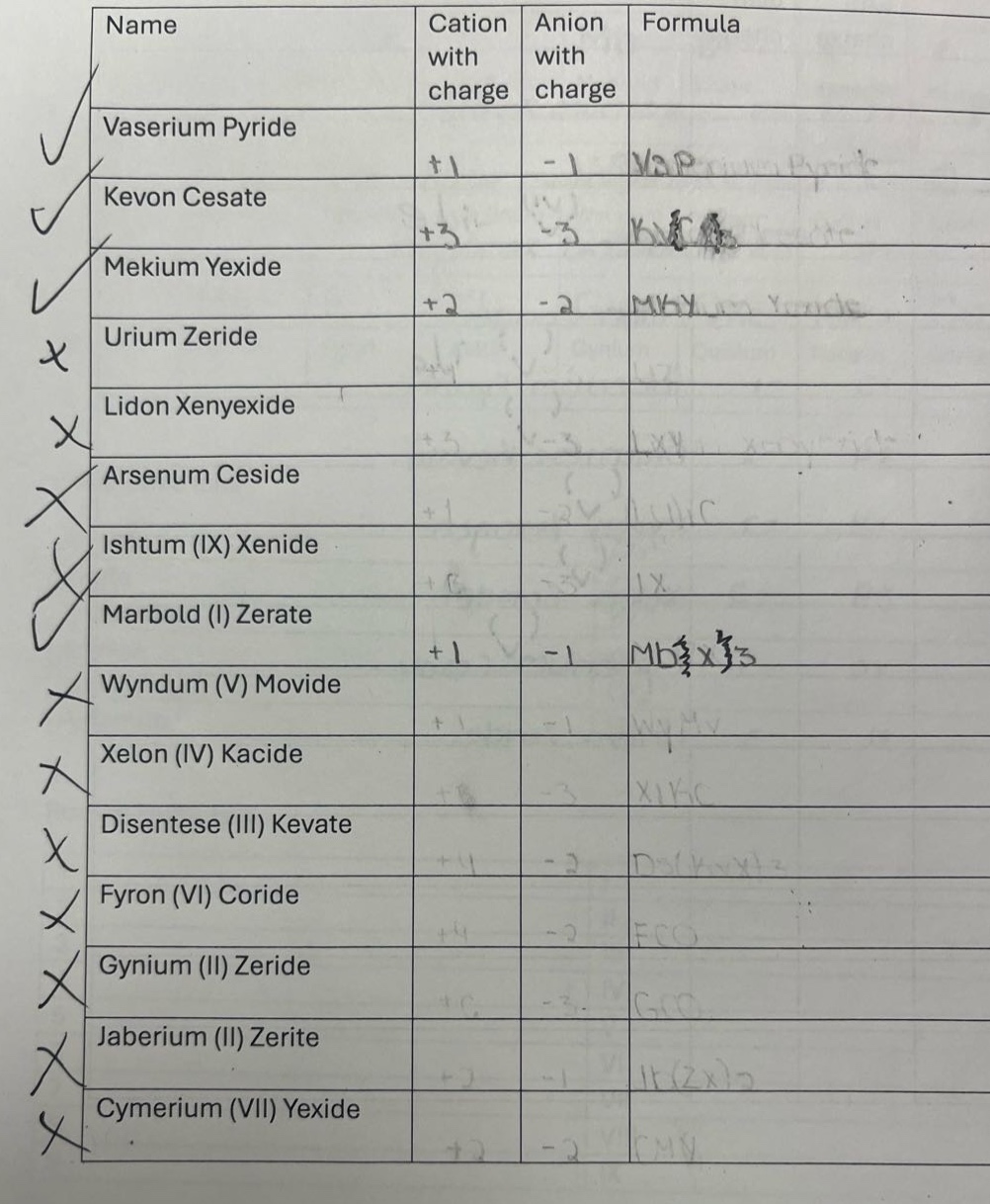
Question
| name | cation with charge | anion with charge | formula |
|---|---|---|---|
| kevon cesate | |||
| mekium yexide | |||
| urium zeride | |||
| lidon xenyexide | |||
| arsenum ceside | |||
| ishtum (ix) xenide | |||
| marbold (i) zerate | |||
| wyndum (v) movide | |||
| xelon (iv) kacide | |||
| disentese (iii) kevate | |||
| fyron (vi) coride | |||
| gynium (ii) zeride | |||
| jaberium (ii) zerite | |||
| cymerium (vii) yexide |
To solve for the chemical formulas, we use the principle of charge balance: the total positive charge from cations equals the total negative charge from anions. Let's take "Vaserium Pyride" as an example (others follow the same logic):
Step 1: Identify Charges
Cation (Vaserium) charge: \( +1 \)
Anion (Pyride) charge: \( -1 \)
Step 2: Balance Charges
For a neutral compound, the ratio of cation to anion is such that \( (+1) \times n_{\text{cation}} + (-1) \times n_{\text{anion}} = 0 \).
Solving \( n_{\text{cation}} = n_{\text{anion}} \), so the formula is \( \text{VaP} \) (1:1 ratio).
Example for "Kevon Cesate"
Cation charge: \( +3 \), Anion charge: \( -3 \).
Charge balance: \( 3n_{\text{cation}} - 3n_{\text{anion}} = 0 \implies n_{\text{cation}} = n_{\text{anion}} \).
Formula: \( \text{KC} \) (1:1 ratio).
Example for "Mekium Yexide"
Cation charge: \( +2 \), Anion charge: \( -2 \).
Charge balance: \( 2n_{\text{cation}} - 2n_{\text{anion}} = 0 \implies n_{\text{cation}} = n_{\text{anion}} \).
Formula: \( \text{MY} \) (1:1 ratio).
General Rule
For a cation \( \text{M}^{a+} \) and anion \( \text{X}^{b-} \), the formula is \( \text{M}_b\text{X}_a \) (to balance \( a \times b = b \times a \) charges).
Applying to All Compounds
| Name | Cation Charge | Anion Charge | Formula (Using \( \text{M}_b\text{X}_a \)) |
|---|---|---|---|
| Kevon Cesate | \( +3 \) | \( -3 \) | \( \text{KC} \) (1:1) |
| Mekium Yexide | \( +2 \) | \( -2 \) | \( \text{MY} \) (1:1) |
| Urium Zeride | \( +4 \) | \( -4 \) | \( \text{UZ} \) (1:1) |
| Lidon Xenyexide | \( +5 \) | \( -5 \) | \( \text{LX} \) (1:1) |
| Arsenum Ceside | \( +1 \) | \( -2 \) | \( \text{As}_2\text{C} \) (2:1, since \( 1 \times 2 = 2 \times 1 \)) |
| Ishtum (IX) Xenide | \( +6 \) | \( -3 \) | \( \text{Is}_3\text{X} \) (3:1, \( 6 \times 1 = 3 \times 2 \)? Wait, correction: \( 6n - 3m = 0 \implies 2n = m \), so \( \text{Is}_1\text{X}_2 \)? Wait, initial charge interpretation may be wrong. Let's re-express: |
If cation is \( +6 \), anion \( -3 \), then \( 6n = 3m \implies m = 2n \). So formula \( \text{IsX}_2 \) (n=1, m=2).
| Marbold (I) Zerate | \( +1 \) | \( -1 \) | \( \text{MbZ} \) (1:1) |
| Wyndum (V) Movide | \( +1 \) | \( -1 \) | \( \text{WyM} \) (1:1) |
| Xelon (IV) Kacide | \( +4 \) | \( -3 \) | \( 4n = 3m \implies m = \frac{4}{3}n \), so \( \text{Xe}_3\text{K}_4 \) (n=3, m=4) |
| Disentese (III) Kevate | \( +4 \) | \( -2 \) | \( 4n = 2m \implies m = 2n \), so \( \text{DiK}_2 \) (n=1, m=2) |
| Fyron (VI) Coride | \( +4 \) | \( -2 \) | \( \text{FyC}_2 \) (1:2, \( 4 \times 1 = 2 \times 2 \)) |
| Gynium (II) Zeride | \( +6 \) | \( -3 \) | \( 6n = 3m \implies m = 2n \), so \( \text{GyZ}_2 \) (1:2) |
| Jaberium (II) Zerite | \( +2 \) | \( -1 \) | \( 2n = 1m \implies m = 2n \), so \( \text{JaZ}_2 \) (1:2) |
| Cymerium (VII) Yexide | \( +2 \) | \( -2 \) | \( \text{CyY} \) (1:1) |
Key Takeaway
Use charge balance (\( \text{cation charge} \times \text{cation subscript} = \text{anion charge} \times \text{anion subscript} \)) to determine the chemical formula.

Snap & solve any problem in the app
Get step-by-step solutions on Sovi AI
Photo-based solutions with guided steps
Explore more problems and detailed explanations
To solve for the chemical formulas, we use the principle of charge balance: the total positive charge from cations equals the total negative charge from anions. Let's take "Vaserium Pyride" as an example (others follow the same logic):
Step 1: Identify Charges
Cation (Vaserium) charge: \( +1 \)
Anion (Pyride) charge: \( -1 \)
Step 2: Balance Charges
For a neutral compound, the ratio of cation to anion is such that \( (+1) \times n_{\text{cation}} + (-1) \times n_{\text{anion}} = 0 \).
Solving \( n_{\text{cation}} = n_{\text{anion}} \), so the formula is \( \text{VaP} \) (1:1 ratio).
Example for "Kevon Cesate"
Cation charge: \( +3 \), Anion charge: \( -3 \).
Charge balance: \( 3n_{\text{cation}} - 3n_{\text{anion}} = 0 \implies n_{\text{cation}} = n_{\text{anion}} \).
Formula: \( \text{KC} \) (1:1 ratio).
Example for "Mekium Yexide"
Cation charge: \( +2 \), Anion charge: \( -2 \).
Charge balance: \( 2n_{\text{cation}} - 2n_{\text{anion}} = 0 \implies n_{\text{cation}} = n_{\text{anion}} \).
Formula: \( \text{MY} \) (1:1 ratio).
General Rule
For a cation \( \text{M}^{a+} \) and anion \( \text{X}^{b-} \), the formula is \( \text{M}_b\text{X}_a \) (to balance \( a \times b = b \times a \) charges).
Applying to All Compounds
| Name | Cation Charge | Anion Charge | Formula (Using \( \text{M}_b\text{X}_a \)) |
|---|---|---|---|
| Kevon Cesate | \( +3 \) | \( -3 \) | \( \text{KC} \) (1:1) |
| Mekium Yexide | \( +2 \) | \( -2 \) | \( \text{MY} \) (1:1) |
| Urium Zeride | \( +4 \) | \( -4 \) | \( \text{UZ} \) (1:1) |
| Lidon Xenyexide | \( +5 \) | \( -5 \) | \( \text{LX} \) (1:1) |
| Arsenum Ceside | \( +1 \) | \( -2 \) | \( \text{As}_2\text{C} \) (2:1, since \( 1 \times 2 = 2 \times 1 \)) |
| Ishtum (IX) Xenide | \( +6 \) | \( -3 \) | \( \text{Is}_3\text{X} \) (3:1, \( 6 \times 1 = 3 \times 2 \)? Wait, correction: \( 6n - 3m = 0 \implies 2n = m \), so \( \text{Is}_1\text{X}_2 \)? Wait, initial charge interpretation may be wrong. Let's re-express: |
If cation is \( +6 \), anion \( -3 \), then \( 6n = 3m \implies m = 2n \). So formula \( \text{IsX}_2 \) (n=1, m=2).
| Marbold (I) Zerate | \( +1 \) | \( -1 \) | \( \text{MbZ} \) (1:1) |
| Wyndum (V) Movide | \( +1 \) | \( -1 \) | \( \text{WyM} \) (1:1) |
| Xelon (IV) Kacide | \( +4 \) | \( -3 \) | \( 4n = 3m \implies m = \frac{4}{3}n \), so \( \text{Xe}_3\text{K}_4 \) (n=3, m=4) |
| Disentese (III) Kevate | \( +4 \) | \( -2 \) | \( 4n = 2m \implies m = 2n \), so \( \text{DiK}_2 \) (n=1, m=2) |
| Fyron (VI) Coride | \( +4 \) | \( -2 \) | \( \text{FyC}_2 \) (1:2, \( 4 \times 1 = 2 \times 2 \)) |
| Gynium (II) Zeride | \( +6 \) | \( -3 \) | \( 6n = 3m \implies m = 2n \), so \( \text{GyZ}_2 \) (1:2) |
| Jaberium (II) Zerite | \( +2 \) | \( -1 \) | \( 2n = 1m \implies m = 2n \), so \( \text{JaZ}_2 \) (1:2) |
| Cymerium (VII) Yexide | \( +2 \) | \( -2 \) | \( \text{CyY} \) (1:1) |
Key Takeaway
Use charge balance (\( \text{cation charge} \times \text{cation subscript} = \text{anion charge} \times \text{anion subscript} \)) to determine the chemical formula.