QUESTION IMAGE
Question
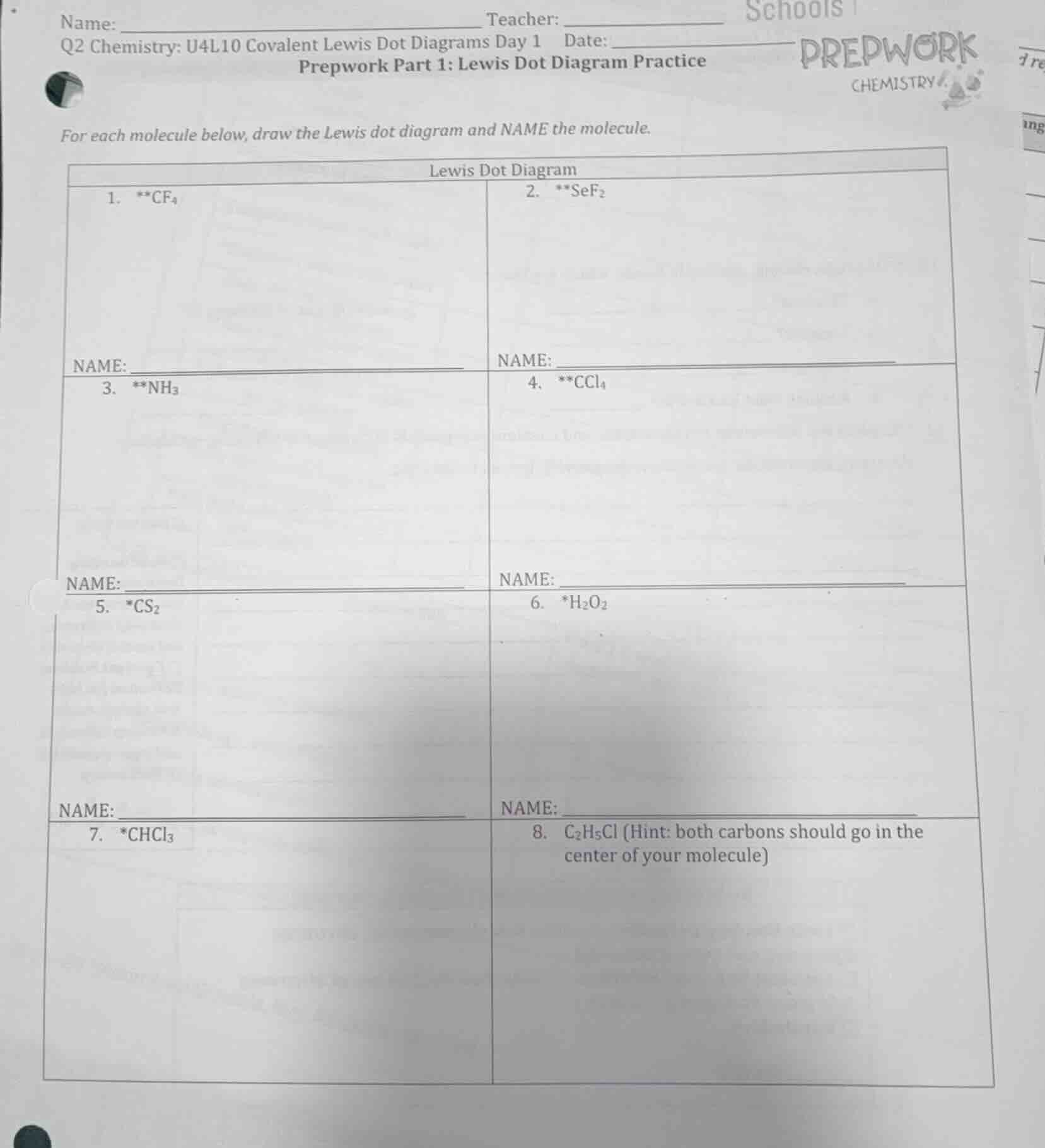
name: teacher: schools q2 chemistry: u4l10 covalent lewis dot diagrams day 1 date: prepwork part 1: lewis dot diagram practice prepwork chemistry for each molecule below, draw the lewis dot diagram and name the molecule. lewis dot diagram 1. cf₄ 2. sef₂ name: name: 3. nh₃ 4. ccl₄ name: name: 5. cs₂ 6. h₂o₂ name: name: 7. *chcl₃ 8. c₂h₅cl (hint: both carbons should go in the center of your molecule)
1. $\boldsymbol{CF_4}$
Lewis Dot Diagram:
- Carbon (C) is central, has 4 valence electrons.
- Four Fluorine (F) atoms, each with 7 valence electrons.
- C forms 4 single bonds with F (sharing 1 electron pair per bond).
- Each F has 3 lone pairs (6 electrons) after bonding.
- Diagram: C in center, 4 F atoms around it, each F with 3 lone pairs, and a single bond (2 electrons) between C and each F.
NAME:
Using prefixes for covalent compounds: 1 C = “carbon”, 4 F = “tetrafluoride”.
Name: Carbon Tetrafluoride
2. $\boldsymbol{SeF_2}$
Lewis Dot Diagram:
- Selenium (Se) is central, has 6 valence electrons.
- Two Fluorine (F) atoms, each with 7 valence electrons.
- Se forms 2 single bonds with F (sharing 1 electron pair per bond), leaving 2 lone pairs on Se.
- Each F has 3 lone pairs (6 electrons) after bonding.
- Diagram: Se in center, 2 F atoms (with 3 lone pairs each) bonded to Se, and 2 lone pairs on Se.
NAME:
1 Se = “selenium”, 2 F = “difluoride”.
Name: Selenium Difluoride
3. $\boldsymbol{NH_3}$
Lewis Dot Diagram:
- Nitrogen (N) is central, has 5 valence electrons.
- Three Hydrogen (H) atoms, each with 1 valence electron.
- N forms 3 single bonds with H (sharing 1 electron pair per bond), leaving 1 lone pair on N.
- Diagram: N in center, 3 H atoms bonded to N, and 1 lone pair on N.
NAME:
Common name: Ammonia (systematic: Nitrogen Trihydride, but “Ammonia” is standard).
4. $\boldsymbol{CCl_4}$
Lewis Dot Diagram:
- Carbon (C) is central, has 4 valence electrons.
- Four Chlorine (Cl) atoms, each with 7 valence electrons.
- C forms 4 single bonds with Cl (sharing 1 electron pair per bond).
- Each Cl has 3 lone pairs (6 electrons) after bonding.
- Diagram: C in center, 4 Cl atoms around it, each Cl with 3 lone pairs, and a single bond between C and each Cl.
NAME:
1 C = “carbon”, 4 Cl = “tetrachloride”.
Name: Carbon Tetrachloride
5. $\boldsymbol{CS_2}$
Lewis Dot Diagram:
- Carbon (C) is central, has 4 valence electrons.
- Two Sulfur (S) atoms, each with 6 valence electrons.
- C forms 2 double bonds with S (sharing 2 electron pairs per bond, so 4 electrons per double bond).
- Each S has 2 lone pairs (4 electrons) after bonding (since 6 - 2 (from double bond) = 4, forming 2 lone pairs).
- Diagram: C in center, 2 S atoms (with 2 lone pairs each) bonded to C with double bonds.
NAME:
1 C = “carbon”, 2 S = “disulfide”.
Name: Carbon Disulfide
6. $\boldsymbol{H_2O_2}$
Lewis Dot Diagram:
- Two Oxygen (O) atoms bonded to each other (single bond), each O bonded to 1 Hydrogen (H).
- Each O has 6 valence electrons: after bonding (O-O single bond, O-H single bond), each O has 2 lone pairs (4 electrons).
- H has 1 valence electron, shared in the O-H bond.
- Diagram: H-O-O-H, with 2 lone pairs on each O.
NAME:
Common name: Hydrogen Peroxide (systematic: Dihydrogen Dioxide, but “Hydrogen Peroxide” is standard).
7. $\boldsymbol{CHCl_3}$
Lewis Dot Diagram:
- Carbon (C) is central, has 4 valence electrons.
- One Hydrogen (H), three Chlorine (Cl) atoms.
- C forms 1 single bond with H, 3 single bonds with Cl.
- H has no lone pairs, each Cl has 3 lone pairs (6 electrons) after bonding.
- Diagram: C in center, H and 3 Cl atoms around it, Cl atoms with 3 lone pairs, single bonds between C and H/Cl.
NAME:
1 C = “carbon”, 1 H = “hydrogen”, 3 Cl = “trichloride”.
Name: Chloroform (common) or Carbon Hydrogen Trichloride (systematic, but “Chloroform” is standard).
8. $\boldsymbol{C_2H_5Cl}$
Lewis Dot Diagram:
- Two Carbon (C…

Snap & solve any problem in the app
Get step-by-step solutions on Sovi AI
Photo-based solutions with guided steps
Explore more problems and detailed explanations
1. $\boldsymbol{CF_4}$
Lewis Dot Diagram:
- Carbon (C) is central, has 4 valence electrons.
- Four Fluorine (F) atoms, each with 7 valence electrons.
- C forms 4 single bonds with F (sharing 1 electron pair per bond).
- Each F has 3 lone pairs (6 electrons) after bonding.
- Diagram: C in center, 4 F atoms around it, each F with 3 lone pairs, and a single bond (2 electrons) between C and each F.
NAME:
Using prefixes for covalent compounds: 1 C = “carbon”, 4 F = “tetrafluoride”.
Name: Carbon Tetrafluoride
2. $\boldsymbol{SeF_2}$
Lewis Dot Diagram:
- Selenium (Se) is central, has 6 valence electrons.
- Two Fluorine (F) atoms, each with 7 valence electrons.
- Se forms 2 single bonds with F (sharing 1 electron pair per bond), leaving 2 lone pairs on Se.
- Each F has 3 lone pairs (6 electrons) after bonding.
- Diagram: Se in center, 2 F atoms (with 3 lone pairs each) bonded to Se, and 2 lone pairs on Se.
NAME:
1 Se = “selenium”, 2 F = “difluoride”.
Name: Selenium Difluoride
3. $\boldsymbol{NH_3}$
Lewis Dot Diagram:
- Nitrogen (N) is central, has 5 valence electrons.
- Three Hydrogen (H) atoms, each with 1 valence electron.
- N forms 3 single bonds with H (sharing 1 electron pair per bond), leaving 1 lone pair on N.
- Diagram: N in center, 3 H atoms bonded to N, and 1 lone pair on N.
NAME:
Common name: Ammonia (systematic: Nitrogen Trihydride, but “Ammonia” is standard).
4. $\boldsymbol{CCl_4}$
Lewis Dot Diagram:
- Carbon (C) is central, has 4 valence electrons.
- Four Chlorine (Cl) atoms, each with 7 valence electrons.
- C forms 4 single bonds with Cl (sharing 1 electron pair per bond).
- Each Cl has 3 lone pairs (6 electrons) after bonding.
- Diagram: C in center, 4 Cl atoms around it, each Cl with 3 lone pairs, and a single bond between C and each Cl.
NAME:
1 C = “carbon”, 4 Cl = “tetrachloride”.
Name: Carbon Tetrachloride
5. $\boldsymbol{CS_2}$
Lewis Dot Diagram:
- Carbon (C) is central, has 4 valence electrons.
- Two Sulfur (S) atoms, each with 6 valence electrons.
- C forms 2 double bonds with S (sharing 2 electron pairs per bond, so 4 electrons per double bond).
- Each S has 2 lone pairs (4 electrons) after bonding (since 6 - 2 (from double bond) = 4, forming 2 lone pairs).
- Diagram: C in center, 2 S atoms (with 2 lone pairs each) bonded to C with double bonds.
NAME:
1 C = “carbon”, 2 S = “disulfide”.
Name: Carbon Disulfide
6. $\boldsymbol{H_2O_2}$
Lewis Dot Diagram:
- Two Oxygen (O) atoms bonded to each other (single bond), each O bonded to 1 Hydrogen (H).
- Each O has 6 valence electrons: after bonding (O-O single bond, O-H single bond), each O has 2 lone pairs (4 electrons).
- H has 1 valence electron, shared in the O-H bond.
- Diagram: H-O-O-H, with 2 lone pairs on each O.
NAME:
Common name: Hydrogen Peroxide (systematic: Dihydrogen Dioxide, but “Hydrogen Peroxide” is standard).
7. $\boldsymbol{CHCl_3}$
Lewis Dot Diagram:
- Carbon (C) is central, has 4 valence electrons.
- One Hydrogen (H), three Chlorine (Cl) atoms.
- C forms 1 single bond with H, 3 single bonds with Cl.
- H has no lone pairs, each Cl has 3 lone pairs (6 electrons) after bonding.
- Diagram: C in center, H and 3 Cl atoms around it, Cl atoms with 3 lone pairs, single bonds between C and H/Cl.
NAME:
1 C = “carbon”, 1 H = “hydrogen”, 3 Cl = “trichloride”.
Name: Chloroform (common) or Carbon Hydrogen Trichloride (systematic, but “Chloroform” is standard).
8. $\boldsymbol{C_2H_5Cl}$
Lewis Dot Diagram:
- Two Carbon (C) atoms bonded to each other (single bond, central chain: C-C).
- First C: bonded to 3 H (1 bond each) and 1 C.
- Second C: bonded to 2 H, 1 C, and 1 Cl.
- Valence electrons: Each C has 4, H has 1, Cl has 7.
- Bonds: C-C (single), C-H (single, 3 on first C, 2 on second C), C-Cl (single).
- Cl has 3 lone pairs (6 electrons) after bonding.
- Diagram: H₃C-CH₂Cl (structural), with all single bonds, Cl with 3 lone pairs.
NAME:
Using IUPAC: Parent chain (2 C = “ethane”), Cl substituent on C₂.
Name: Chloroethane (or Ethyl Chloride).
Final Answers (Names):
- Carbon Tetrafluoride
- Selenium Difluoride
- Ammonia
- Carbon Tetrachloride
- Carbon Disulfide
- Hydrogen Peroxide
- Chloroform (Carbon Hydrogen Trichloride)
- Chloroethane (Ethyl Chloride)