QUESTION IMAGE
Question
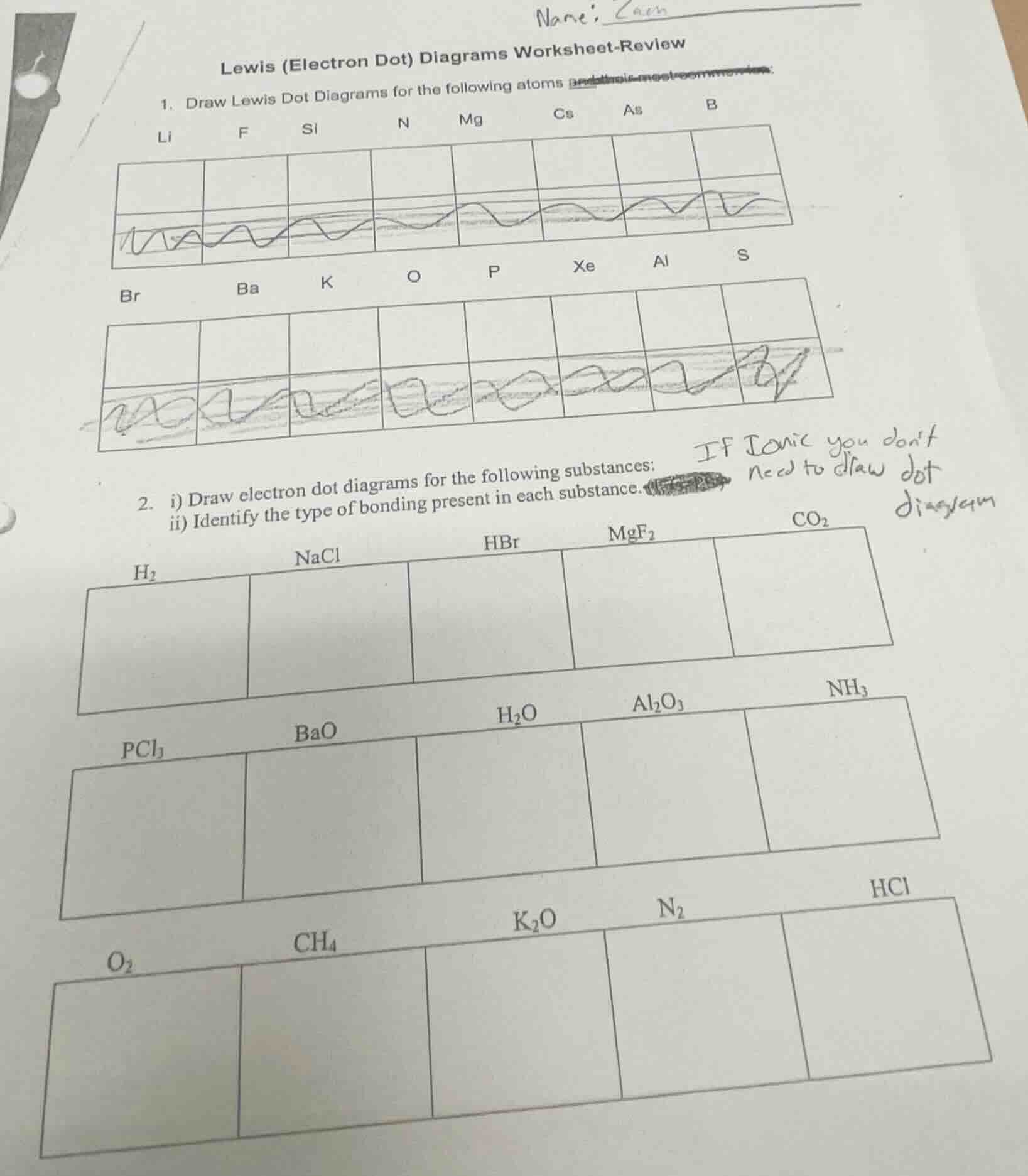
name: zach
lewis (electron dot) diagrams worksheet - review
- draw lewis dot diagrams for the following atoms
li f si n mg cs as b
br ba k o p xe al s
- i) draw electron dot diagrams for the following substances:
ii) identify the type of bonding present in each substance.
if ionic you dont need to draw dot diagram
h₂ nacl hbr mgf₂ co₂
pcl₃ bao h₂o al₂o₃ nh₃
o₂ ch₄ k₂o n₂ hcl
Step1: Find valence electrons for atoms
Valence electrons = main group number (from periodic table)
- Li: 1, F:7, Si:4, N:5, Mg:2, Cs:1, As:5, B:3
- Br:7, Ba:2, K:1, O:6, P:5, Xe:8, Al:3, S:6
Step2: Draw single-atom Lewis diagrams
Place valence electrons as dots around element symbol, max 2 per side, 8 total.
- $\text{Li} \cdot$
- $\cdot \ddot{\text{F}} :$
- $\cdot \ddot{\text{Si}} \cdot$
$\quad \cdot$
- $\cdot \ddot{\text{N}} :$
$\quad \cdot$
- $\text{Mg} :$
- $\text{Cs} \cdot$
- $\cdot \ddot{\text{As}} :$
$\quad \cdot$
- $\cdot \text{B} \cdot$
$\quad \cdot$
- $: \ddot{\text{Br}} :$
$\quad \cdot$
- $\text{Ba} :$
- $\text{K} \cdot$
- $: \ddot{\text{O}} :$
- $\cdot \ddot{\text{P}} :$
$\quad \cdot$
- $: \ddot{\text{Xe}} :$
$\quad \cdot \quad \cdot$
- $\cdot \text{Al} \cdot$
$\quad \cdot$
- $: \ddot{\text{S}} :$
Step3: Classify bonding for compounds
Ionic = metal + nonmetal; Covalent = nonmetal + nonmetal
- $\text{H}_2$: Covalent; $\text{NaCl}$: Ionic; $\text{HBr}$: Covalent; $\text{MgF}_2$: Ionic; $\text{CO}_2$: Covalent
- $\text{PCl}_3$: Covalent; $\text{BaO}$: Ionic; $\text{H}_2\text{O}$: Covalent; $\text{Al}_2\text{O}_3$: Ionic; $\text{NH}_3$: Covalent
- $\text{O}_2$: Covalent; $\text{CH}_4$: Covalent; $\text{K}_2\text{O}$: Ionic; $\text{N}_2$: Covalent; $\text{HCl}$: Covalent
Step4: Draw covalent compound Lewis diagrams
Share electrons to fill octets (duet for H):
- $\text{H}_2$: $\text{H} - \text{H}$ (or $\text{H} \cdot \text{H}$)
- $\text{HBr}$: $\text{H} - \ddot{\text{Br}} :$
$\quad :$
- $\text{CO}_2$: $: \ddot{\text{O}} = \text{C} = \ddot{\text{O}} :$
- $\text{PCl}_3$: $: \ddot{\text{Cl}} - \ddot{\text{P}} - \ddot{\text{Cl}} :$
$\quad : \quad \cdot \quad :$
$\quad \text{Cl} :$
- $\text{H}_2\text{O}$: $\text{H} - \ddot{\text{O}} - \text{H}$
$\quad :$
- $\text{NH}_3$: $\text{H} - \ddot{\text{N}} - \text{H}$
$\quad : \quad \text{H}$
- $\text{O}_2$: $: \ddot{\text{O}} = \ddot{\text{O}} :$
- $\text{CH}_4$: $\text{H}$
$\quad |$
$\text{H} - \text{C} - \text{H}$
$\quad |$
$\text{H}$
- $\text{N}_2$: $: \text{N} \equiv \text{N} :$
- $\text{HCl}$: $\text{H} - \ddot{\text{Cl}} :$
$\quad :$
Ionic compounds ($\text{NaCl}$, $\text{MgF}_2$, $\text{BaO}$, $\text{Al}_2\text{O}_3$, $\text{K}_2\text{O}$) do not use shared electron dot diagrams; they are represented as ions (e.g., $\text{Na}^+ : \ddot{\text{Cl}} :^-$)

Snap & solve any problem in the app
Get step-by-step solutions on Sovi AI
Photo-based solutions with guided steps
Explore more problems and detailed explanations
1. Single-Atom Lewis Diagrams:
- $\text{Li} \cdot$
- $\cdot \ddot{\text{F}} :$
- $\cdot \ddot{\text{Si}} \cdot$
$\quad \cdot$
- $\cdot \ddot{\text{N}} :$
$\quad \cdot$
- $\text{Mg} :$
- $\text{Cs} \cdot$
- $\cdot \ddot{\text{As}} :$
$\quad \cdot$
- $\cdot \text{B} \cdot$
$\quad \cdot$
- $: \ddot{\text{Br}} :$
$\quad \cdot$
- $\text{Ba} :$
- $\text{K} \cdot$
- $: \ddot{\text{O}} :$
- $\cdot \ddot{\text{P}} :$
$\quad \cdot$
- $: \ddot{\text{Xe}} :$
$\quad \cdot \quad \cdot$
- $\cdot \text{Al} \cdot$
$\quad \cdot$
- $: \ddot{\text{S}} :$
2. Compound Diagrams & Bonding:
| Substance | Lewis Diagram (Covalent Only) | Bonding Type | ||
|---|---|---|---|---|
| $\text{NaCl}$ | (Ionic: $\text{Na}^+ : \ddot{\text{Cl}} :^-$) | Ionic | ||
| $\text{HBr}$ | $\text{H} - \ddot{\text{Br}} :$ <br> $\quad :$ | Covalent | ||
| $\text{MgF}_2$ | (Ionic: $\text{Mg}^{2+} [: \ddot{\text{F}} :]^-_2$) | Ionic | ||
| $\text{CO}_2$ | $: \ddot{\text{O}} = \text{C} = \ddot{\text{O}} :$ | Covalent | ||
| $\text{PCl}_3$ | $: \ddot{\text{Cl}} - \ddot{\text{P}} - \ddot{\text{Cl}} :$ <br> $\quad : \quad \cdot \quad :$ <br> $\quad \text{Cl} :$ | Covalent | ||
| $\text{BaO}$ | (Ionic: $\text{Ba}^{2+} [: \ddot{\text{O}} :]^{2-}$) | Ionic | ||
| $\text{H}_2\text{O}$ | $\text{H} - \ddot{\text{O}} - \text{H}$ <br> $\quad :$ | Covalent | ||
| $\text{Al}_2\text{O}_3$ | (Ionic: $\text{Al}^{3+}_2 [: \ddot{\text{O}} :]^{2-}_3$) | Ionic | ||
| $\text{NH}_3$ | $\text{H} - \ddot{\text{N}} - \text{H}$ <br> $\quad : \quad \text{H}$ | Covalent | ||
| $\text{O}_2$ | $: \ddot{\text{O}} = \ddot{\text{O}} :$ | Covalent | ||
| $\text{CH}_4$ | $\text{H}$ <br> $\quad | $ $\text{H} - \text{C} - \text{H}$ $\quad | $ $\text{H}$ | Covalent |
| $\text{K}_2\text{O}$ | (Ionic: $\text{K}^+_2 [: \ddot{\text{O}} :]^{2-}$) | Ionic | ||
| $\text{N}_2$ | $: \text{N} \equiv \text{N} :$ | Covalent | ||
| $\text{HCl}$ | $\text{H} - \ddot{\text{Cl}} :$ <br> $\quad :$ | Covalent |