QUESTION IMAGE
Question
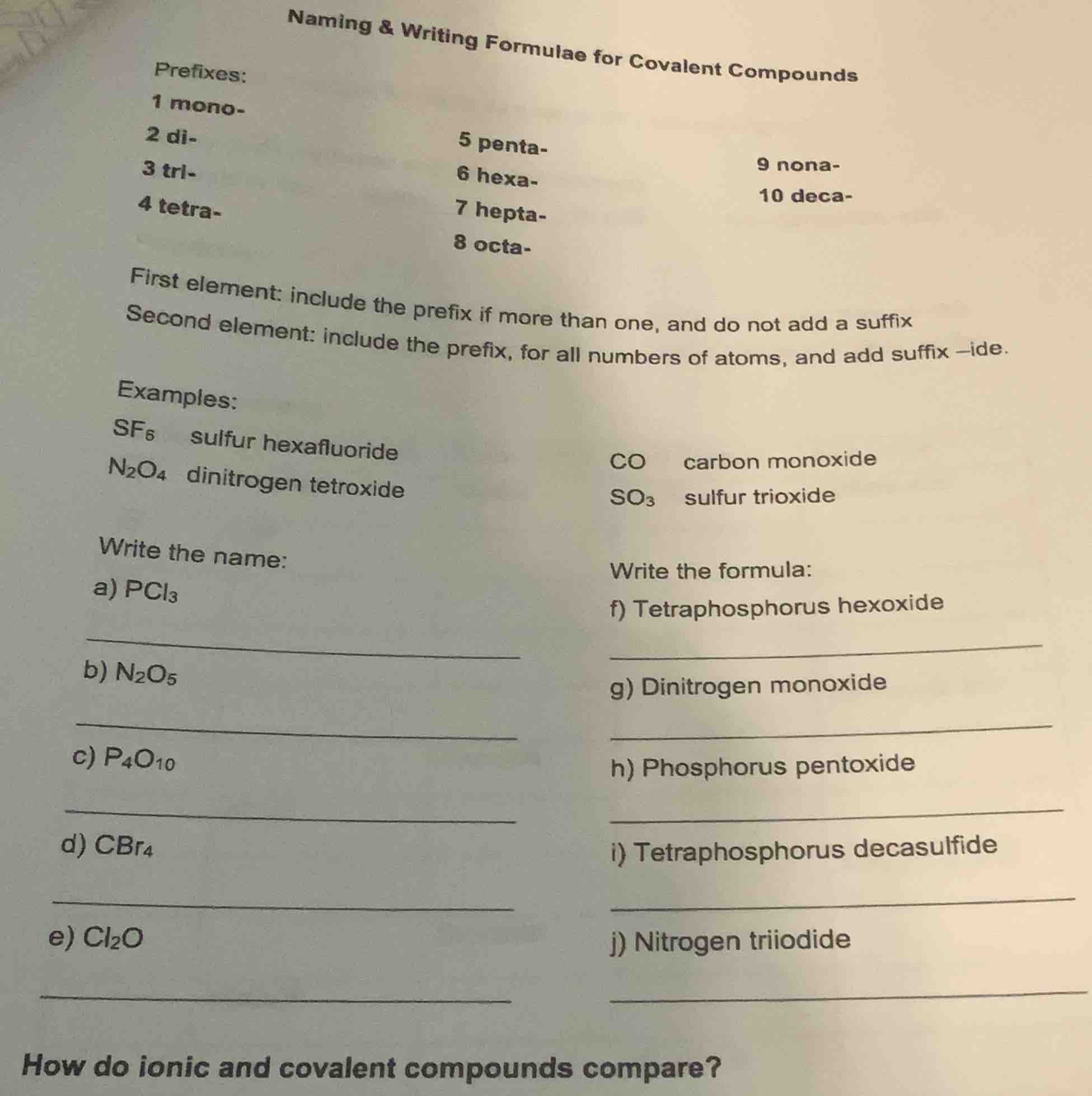
naming & writing formulae for covalent compounds
prefixes:
1 mono-
2 di-
3 tri-
4 tetra-
5 penta-
6 hexa-
7 hepta-
8 octa-
9 nona-
10 deca-
first element: include the prefix if more than one, and do not add a suffix
second element: include the prefix, for all numbers of atoms, and add suffix –ide.
examples:
sf₆ sulfur hexafluoride
n₂o₄ dinitrogen tetroxide
co carbon monoxide
so₃ sulfur trioxide
write the name:
a) pcl₃
_________________________
b) n₂o₅
_________________________
c) p₄o₁₀
_________________________
d) cbr₄
_________________________
e) cl₂o
_________________________
write the formula:
f) tetraphosphorus hexoxide
_________________________
g) dinitrogen monoxide
_________________________
h) phosphorus pentoxide
_________________________
i) tetraphosphorus decasulfide
_________________________
j) nitrogen triiodide
_________________________
how do ionic and covalent compounds compare?
Step1: Name covalent compounds (a-e)
Use given prefix rules for each element.
a) $\text{PCl}_3$: 1 P, 3 Cl → phosphorus trichloride
b) $\text{N}_2\text{O}_5$: 2 N, 5 O → dinitrogen pentoxide
c) $\text{P}_4\text{O}_{10}$: 4 P, 10 O → tetraphosphorus decoxide
d) $\text{CBr}_4$: 1 C, 4 Br → carbon tetrabromide
e) $\text{Cl}_2\text{O}$: 2 Cl, 1 O → dichlorine monoxide
Step2: Write formulas (f-j)
Convert prefixes to subscripts.
f) Tetraphosphorus hexoxide: 4 P, 6 O → $\text{P}_4\text{O}_6$
g) Dinitrogen monoxide: 2 N, 1 O → $\text{N}_2\text{O}$
h) Phosphorus pentoxide: 1 P, 5 O → $\text{P}_2\text{O}_5$ (common empirical formula; strict: $\text{P}_4\text{O}_{10}$ matches c, but $\text{P}_2\text{O}_5$ is standard name usage)
i) Tetraphosphorus decasulfide: 4 P, 10 S → $\text{P}_4\text{S}_{10}$
j) Nitrogen triiodide: 1 N, 3 I → $\text{NI}_3$
Step3: Compare ionic/covalent compounds
Differentiate by bonding, structure, properties.
- Bonding: Ionic = electron transfer (ions); Covalent = electron sharing (molecules)
- Structure: Ionic = lattice; Covalent = discrete molecules
- Properties: Ionic = high MP/BP, conductive dissolved; Covalent = low MP/BP, non-conductive

Snap & solve any problem in the app
Get step-by-step solutions on Sovi AI
Photo-based solutions with guided steps
Explore more problems and detailed explanations
Write the name:
a) phosphorus trichloride
b) dinitrogen pentoxide
c) tetraphosphorus decoxide
d) carbon tetrabromide
e) dichlorine monoxide
Write the formula:
f) $\text{P}_4\text{O}_6$
g) $\text{N}_2\text{O}$
h) $\text{P}_2\text{O}_5$
i) $\text{P}_4\text{S}_{10}$
j) $\text{NI}_3$
How do ionic and covalent compounds compare?
Ionic compounds form via electron transfer between metals and nonmetals, creating a charged ionic lattice structure. They have high melting/boiling points, are brittle, and conduct electricity when dissolved in water or molten. Covalent compounds form via electron sharing between nonmetals, creating discrete molecules. They have low melting/boiling points, are often soft or gaseous, and do not conduct electricity in any state.