QUESTION IMAGE
Question
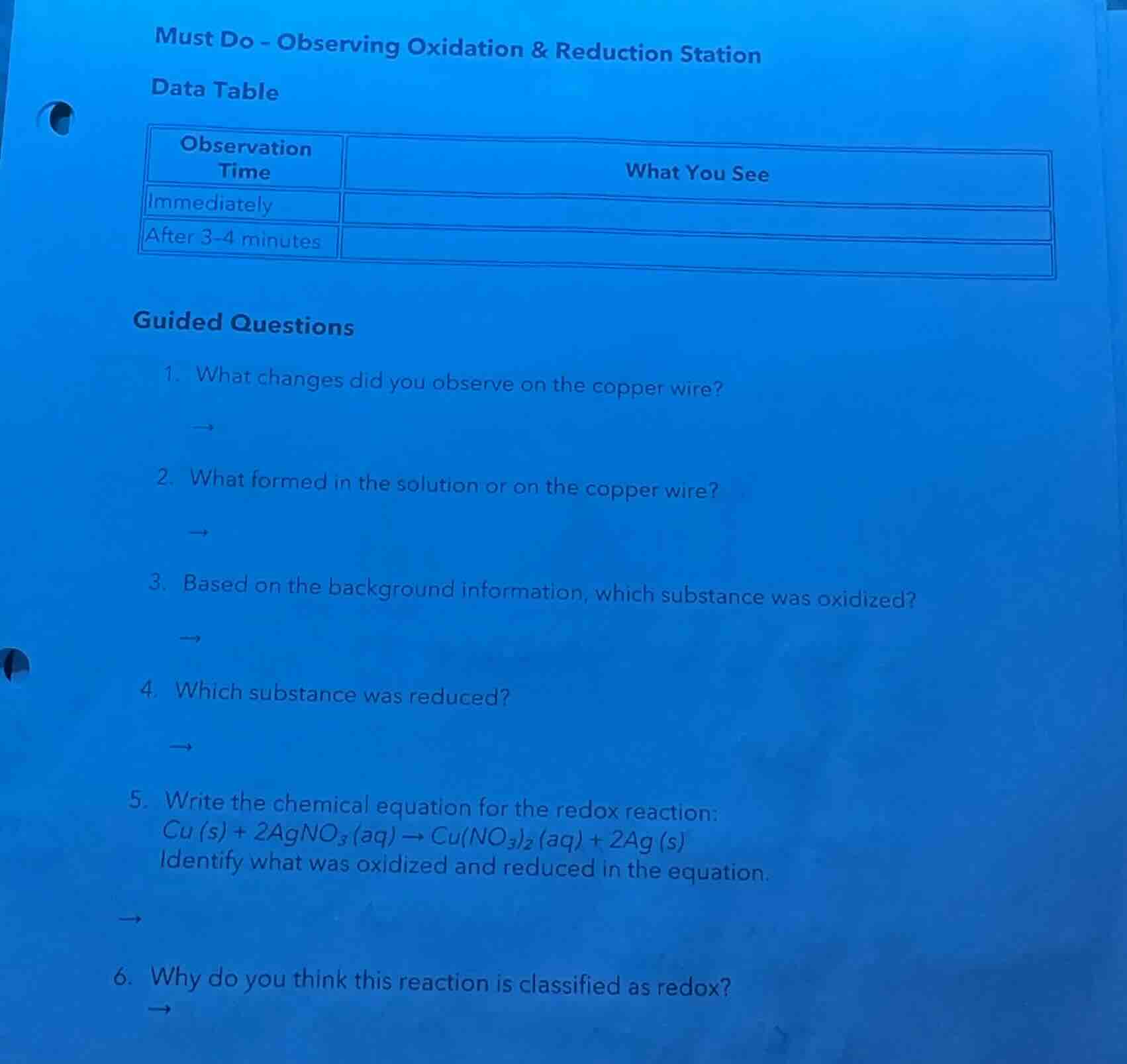
must do - observing oxidation & reduction station
data table
observation time | what you see
immediately |
after 3 - 4 minutes |
guided questions
- what changes did you observe on the copper wire?
- what formed in the solution or on the copper wire?
- based on the background information, which substance was oxidized?
- which substance was reduced?
- write the chemical equation for the redox reaction:
cu(s) + 2agno₃(aq) → cu(no₃)₂(aq) + 2ag(s)
identify what was oxidized and reduced in the equation.
- why do you think this reaction is classified as redox?
Step1: Fill observation table
Immediately: Copper wire is shiny reddish-brown; solution is colorless.
After 3-4 minutes: Shiny silvery solid deposits on copper wire; solution turns light blue.
Step2: Answer question 1
Copper wire develops silvery coating; solution turns blue.
Step3: Answer question 2
Silver metal forms on wire; copper(II) nitrate forms in solution.
Step4: Answer question 3
Copper (Cu) loses electrons, so it is oxidized.
Step5: Answer question 4
Silver ions ($\text{Ag}^+$) gain electrons, so they are reduced.
Step6: Answer question 5
Oxidized: $\text{Cu}(s)$ (oxidation state 0 → +2)
Reduced: $\text{Ag}^+$ (from $\text{AgNO}_3$, oxidation state +1 → 0)
Step7: Answer question 6
Reaction has electron transfer: Cu loses e⁻, $\text{Ag}^+$ gains e⁻.

Snap & solve any problem in the app
Get step-by-step solutions on Sovi AI
Photo-based solutions with guided steps
Explore more problems and detailed explanations
Data Table
| Observation Time | What You See |
|---|---|
| After 3-4 minutes | Silvery solid deposits on copper wire; solution turns light blue |
- A shiny silvery solid forms on the surface of the reddish-brown copper wire, and the surrounding solution turns light blue.
- Silver metal ($\text{Ag}$) forms on the copper wire; copper(II) nitrate ($\text{Cu(NO}_3\text{)}_2$) forms in the solution (causing the blue color).
- Copper ($\text{Cu}(s)$)
- Silver ions ($\text{Ag}^+$ from $\text{AgNO}_3(aq)$)
- Oxidized: $\text{Cu}(s)$ (its oxidation state increases from 0 to +2)
Reduced: $\text{Ag}^+$ (its oxidation state decreases from +1 to 0)
- This reaction is a redox reaction because it involves a transfer of electrons: copper atoms lose electrons (oxidation) and silver ions gain those electrons (reduction), which is the defining characteristic of redox reactions.