QUESTION IMAGE
Question
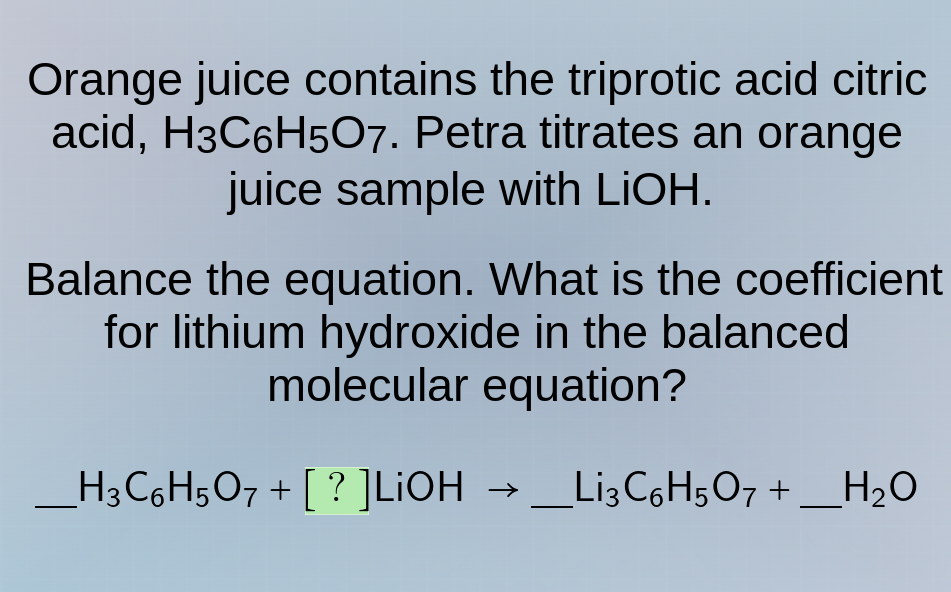
orange juice contains the triprotic acid citric acid, h₃c₆h₅o₇. petra titrates an orange juice sample with lioh. balance the equation. what is the coefficient for lithium hydroxide in the balanced molecular equation? h₃c₆h₅o₇ + ?lioh → li₃c₆h₅o₇ + __h₂o
Step1: Balance Li atoms
On the product side, in $\ce{Li3C6H5O7}$, there are 3 Li atoms. So, we need 3 Li atoms on the reactant side from $\ce{LiOH}$. Thus, the coefficient of $\ce{LiOH}$ is initially set to 3 to balance Li. But we also need to check other atoms.
Step2: Balance H and O atoms
Now, let's check H and O. The reactants are $\ce{H3C6H5O7}$ (which has 8 H atoms: 3 from the first H and 5 from the second H group) and 3 $\ce{LiOH}$ (each $\ce{LiOH}$ has 1 H, so 3 H). So total H on reactant side: 8 + 3 = 11? Wait, no, let's do it properly. The formula $\ce{H3C6H5O7}$ can be written as $\ce{C6H8O7}$ (combining the H: 3 + 5 = 8). Then $\ce{LiOH}$ is $\ce{LiOH}$. The reaction is an acid-base neutralization, so the acid ($\ce{C6H8O7}$) donates H+ and the base ($\ce{LiOH}$) donates OH-. The acid has 3 acidic H (since it's triprotic: $\ce{H3C6H5O7}$ means 3 H that can be donated). So each $\ce{H3C6H5O7}$ donates 3 H+, and each $\ce{LiOH}$ donates 1 OH-. So to neutralize 3 H+, we need 3 OH-, so 3 $\ce{LiOH}$. Then the products are $\ce{Li3C6H5O7}$ (the salt, where the 3 H+ are replaced by 3 Li+) and $\ce{H2O}$. The number of $\ce{H2O}$ formed is equal to the number of H+ (or OH-) reacted, which is 3. Let's check the atoms:
Reactants:
- $\ce{H3C6H5O7}$: 1 molecule, so C:6, H:8 (3 + 5), O:7
- $\ce{LiOH}$: 3 molecules, so Li:3, O:3, H:3
Products:
- $\ce{Li3C6H5O7}$: 1 molecule, so Li:3, C:6, H:5, O:7
- $\ce{H2O}$: 3 molecules, so H:6 (3×2), O:3 (3×1)
Now check H: Reactant H: 8 + 3 = 11? Wait, no, $\ce{H3C6H5O7}$ has H: 3 (from the first H group) + 5 (from the $\ce{C6H5}$ part)? Wait, maybe the correct way is to consider the triprotic acid: $\ce{H3C6H5O7}$ has 3 acidic hydrogens (the 3 H at the start). So when it reacts with $\ce{LiOH}$, the reaction is:
$\ce{H3C6H5O7 + 3LiOH -> Li3C6H5O7 + 3H2O}$
Now check all atoms:
C: 6 on both sides (reactant: 6, product: 6)
Li: 3 on both sides (reactant: 3, product: 3)
H: Reactant: 3 (from acid) + 3 (from 3 LiOH) = 6? Wait, no, the acid's formula: $\ce{H3C6H5O7}$: the 3 H are the acidic ones, and the $\ce{C6H5O7}$ part has 5 H? Wait, maybe I messed up the H count. Let's count H in each compound:
- $\ce{H3C6H5O7}$: H atoms: 3 (from the first H) + 5 (from $\ce{C6H5}$) = 8
- $\ce{LiOH}$: H atoms: 1 per molecule, 3 molecules: 3
- Total H reactant: 8 + 3 = 11
- $\ce{Li3C6H5O7}$: H atoms: 5
- $\ce{H2O}$: 3 molecules, H atoms: 6 (3×2)
- Total H product: 5 + 6 = 11. Good.
O atoms:
- $\ce{H3C6H5O7}$: 7
- $\ce{LiOH}$: 3 (1 per molecule, 3 molecules)
- Total O reactant: 7 + 3 = 10
- $\ce{Li3C6H5O7}$: 7
- $\ce{H2O}$: 3 (1 per molecule, 3 molecules)
- Total O product: 7 + 3 = 10. Good.
C atoms: 6 on both sides. Li atoms: 3 on both sides. So the balanced equation is:
$\ce{1H3C6H5O7 + 3LiOH -> 1Li3C6H5O7 + 3H2O}$

Snap & solve any problem in the app
Get step-by-step solutions on Sovi AI
Photo-based solutions with guided steps
Explore more problems and detailed explanations
3