QUESTION IMAGE
Question
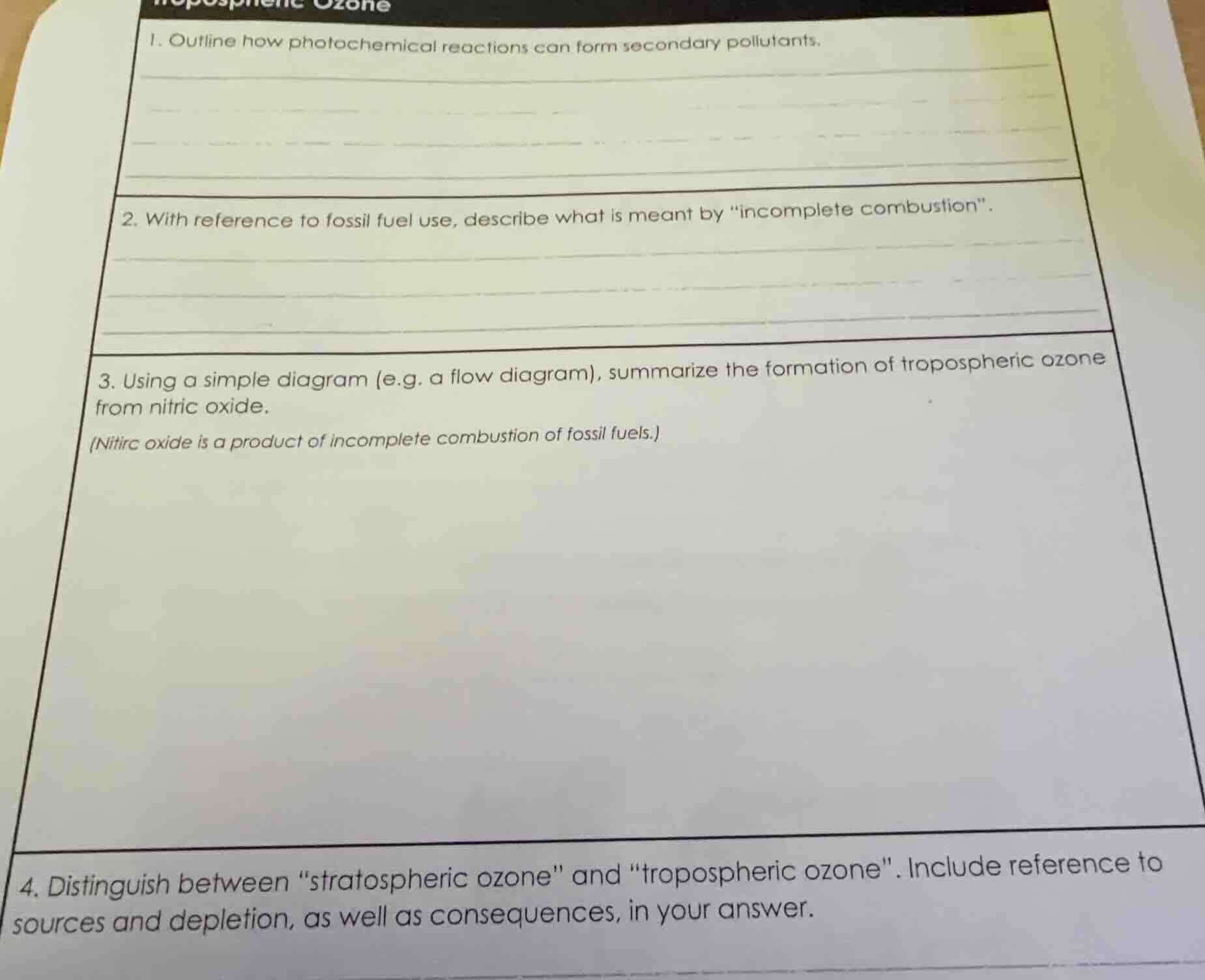
- outline how photochemical reactions can form secondary pollutants.
- with reference to fossil fuel use, describe what is meant by \incomplete combustion\.
- using a simple diagram (e.g. a flow diagram), summarize the formation of tropospheric ozone from nitric oxide.
(nitric oxide is a product of incomplete combustion of fossil fuels.)
- distinguish between \stratospheric ozone\ and \tropospheric ozone\. include reference to sources and depletion, as well as consequences, in your answer.
Brief Explanations
- For Question 1: Secondary pollutants form when primary pollutants (emitted directly) react with sunlight, water vapor, or other chemicals in the atmosphere via photochemical reactions. For example, nitrogen oxides (NOₓ) and volatile organic compounds (VOCs) absorb UV radiation, triggering reactions that create ozone, peroxyl nitrates, and other secondary pollutants.
- For Question 2: Incomplete combustion of fossil fuels occurs when there is insufficient oxygen to convert the fuel's carbon completely to carbon dioxide (CO₂). Instead, products like carbon monoxide (CO), elemental carbon (soot), and unburnt hydrocarbons form, alongside partial oxidation products. This happens in engines with poor air-fuel mixing, inefficient burners, or restricted air supply.
- For Question 3:
    graph LR
    A[Incomplete Fossil Fuel Combustion] --> B[Nitric Oxide (NO) Emitted]
    B --> C[NO reacts with O₂ in air]
    C --> D[Nitrogen Dioxide (NO₂) Formed]
    D --> E[NO₂ absorbs UV radiation]
    E --> F[NO₂ splits into NO + O•]
    F --> G[O• reacts with O₂]
G --> H[Tropospheric Ozone (O₃) Formed]- For Question 4:
- Stratospheric Ozone:
- Sources: Formed naturally via UV radiation splitting O₂ into oxygen atoms, which bond with O₂ to make O₃.
- Depletion: Caused by CFCs (formerly in aerosols, refrigerants) and halons, which break down to release chlorine/bromine that catalytically destroys O₃.
- Consequences: Acts as a protective layer, absorbing harmful UV-B radiation; depletion increases skin cancer, crop damage, and ecosystem disruption.
- Tropospheric Ozone:
- Sources: A secondary pollutant formed via photochemical reactions of NOₓ, VOCs, and sunlight (linked to fossil fuel combustion, industrial emissions).
- Depletion: Broken down by reactions with NO, VOCs, or surface deposition; not naturally depleted at harmful rates, but human activity drives excess formation.
- Consequences: A toxic air pollutant; irritates respiratory systems, damages plants/crops, and contributes to smog and climate change as a greenhouse gas.

Snap & solve any problem in the app
Get step-by-step solutions on Sovi AI
Photo-based solutions with guided steps
Explore more problems and detailed explanations
- Secondary pollutants form when primary pollutants (e.g., NOₓ, VOCs) undergo sunlight-driven photochemical reactions in the atmosphere, producing new toxic compounds like ozone and peroxyl nitrates.
- Incomplete combustion of fossil fuels is the incomplete oxidation of fuel due to insufficient oxygen, producing carbon monoxide, soot, unburnt hydrocarbons, and partial oxidation products instead of full conversion to CO₂ and water.
- (See the flow diagram above for the formation of tropospheric ozone from nitric oxide.)
- Stratospheric ozone is a naturally formed protective layer depleted by CFCs, while tropospheric ozone is a human-caused secondary pollutant that harms health and ecosystems; their sources, depletion mechanisms, and consequences are fundamentally distinct as detailed above.