QUESTION IMAGE
Question
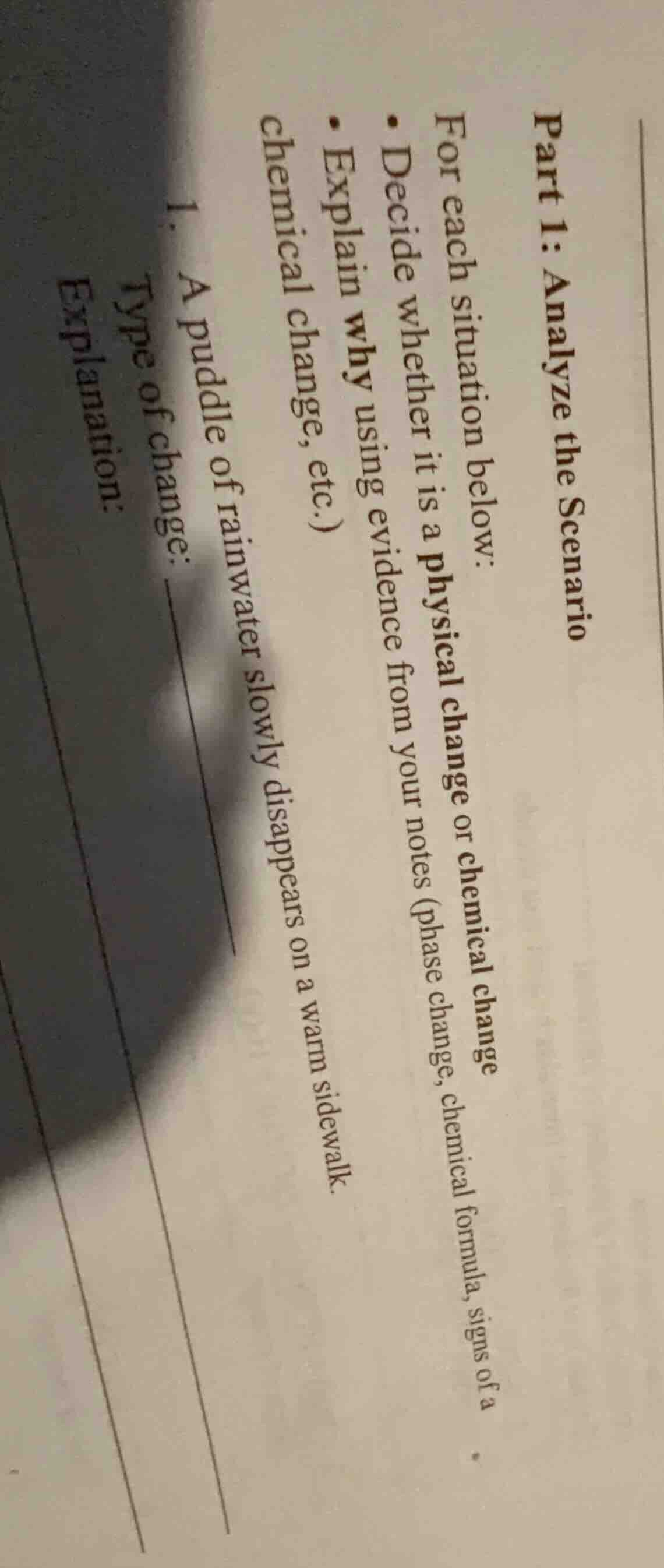
part 1: analyze the scenario
for each situation below:
- decide whether it is a physical change or chemical change
- explain why using evidence from your notes (phase change, chemical formula, signs of a chemical change, etc.)
- a puddle of rainwater slowly disappears on a warm sidewalk.
type of change:
explanation:
Type of change:
Physical change (specifically a phase change - evaporation)
When a puddle of rainwater disappears on a warm sidewalk, the water is undergoing evaporation. In this process, liquid water ($H_2O$) is changing into water vapor (gaseous $H_2O$). A physical change is defined as a change in which the chemical composition of the substance remains the same, and only the physical state (or other physical properties) changes. Here, the water molecules are still $H_2O$ before and after the change; there is no new substance formed (which would be the case for a chemical change). The warmth of the sidewalk provides the energy for the liquid water to gain enough kinetic energy to escape into the air as gas, which is a phase transition from liquid to gas, a type of physical change.

Snap & solve any problem in the app
Get step-by-step solutions on Sovi AI
Photo-based solutions with guided steps
Explore more problems and detailed explanations
When a puddle of rainwater disappears on a warm sidewalk, the water is undergoing evaporation. In this process, liquid water ($H_2O$) is changing into water vapor (gaseous $H_2O$). A physical change is defined as a change in which the chemical composition of the substance remains the same, and only the physical state (or other physical properties) changes. Here, the water molecules are still $H_2O$ before and after the change; there is no new substance formed (which would be the case for a chemical change). The warmth of the sidewalk provides the energy for the liquid water to gain enough kinetic energy to escape into the air as gas, which is a phase transition from liquid to gas, a type of physical change.