QUESTION IMAGE
Question
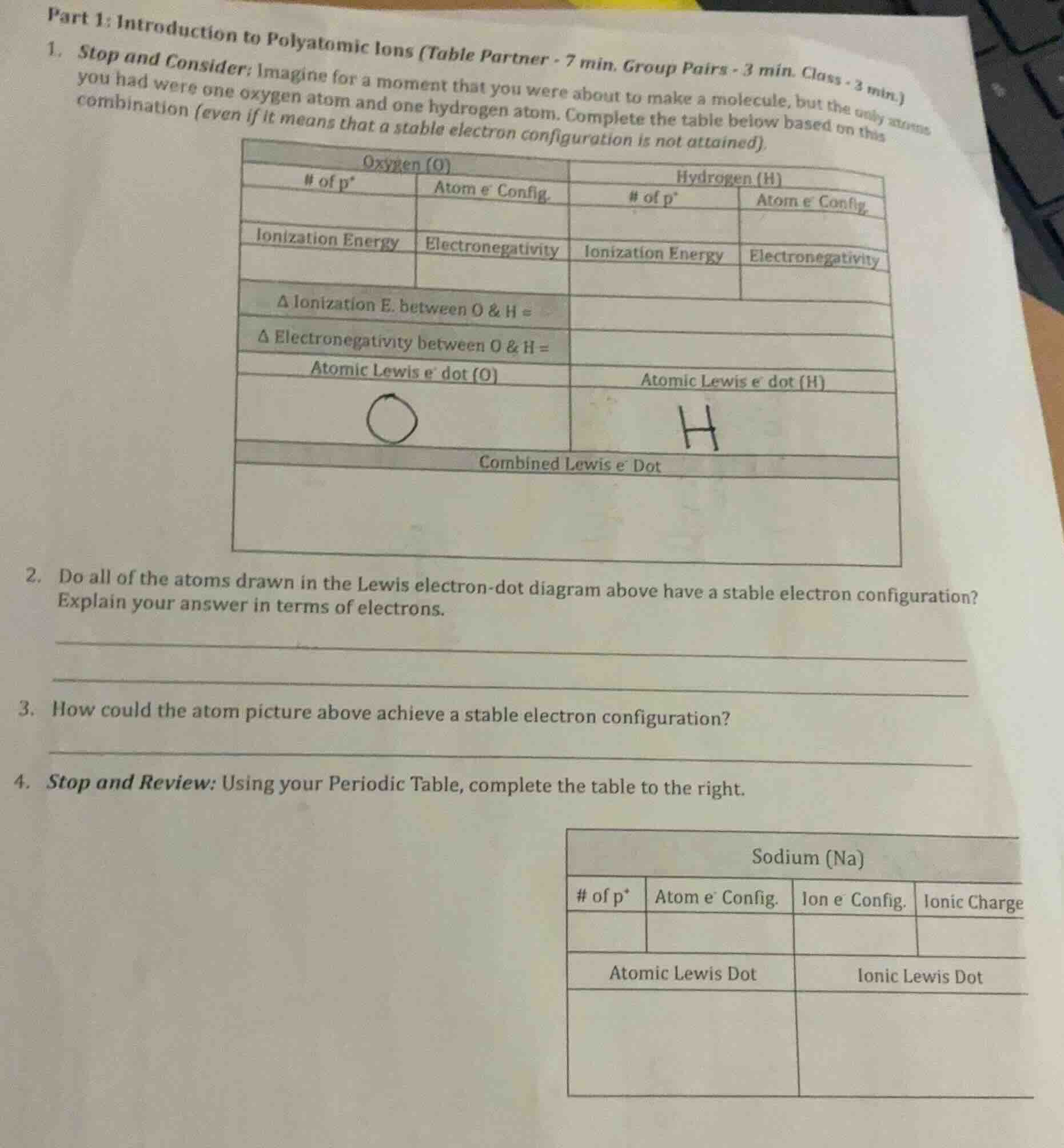
part 1: introduction to polyatomic ions (table partner - 7 min. group pairs - 3 min. class - 3 min.)
- stop and consider: imagine for a moment that you were about to make a molecule, but the only atoms you had were one oxygen atom and one hydrogen atom. complete the table below based on this combination (even if it means that a stable electron configuration is not attained).
| oxygen (o) | hydrogen (h) | ||
|---|---|---|---|
| ionization energy | electronegativity | ionization energy | electronegativity |
| δ ionization e. between o & h = | |||
| δ electronegativity between o & h = | |||
| atomic lewis e⁻ dot (o) | atomic lewis e⁻ dot (h) | ||
| (o with a circle) | h | ||
| combined lewis e⁻ dot |
- do all of the atoms drawn in the lewis electron - dot diagram above have a stable electron configuration? explain your answer in terms of electrons.
- how could the atom picture above achieve a stable electron configuration?
- stop and review: using your periodic table, complete the table to the right.
| sodium (na) | |||
|---|---|---|---|
| atomic lewis dot | ionic lewis dot |
Response
Question 1: Completing the Table for Oxygen (O) and Hydrogen (H)
Step 1: Oxygen (O) Details
- # of p⁺ (protons): Oxygen has an atomic number of 8, so \(\#\text{ of } p^+ = 8\).
- Atom e⁻ Config. (Electron Configuration): The electron configuration of O is \(1s^2 2s^2 2p^4\).
- Ionization Energy: Oxygen has a relatively high ionization energy (approx. 1314 kJ/mol, but for the table, we can note it's higher than H).
- Electronegativity: Oxygen has an electronegativity of 3.44 (Pauling scale).
- Atomic Lewis e⁻ dot: Oxygen has 6 valence electrons, so the Lewis dot is \(\cdot \underset{\cdot \cdot}{\overset{\cdot \cdot}{O}} \cdot\) (but the given diagram has a circle, we can represent the valence electrons as 6 dots around O).
Step 2: Hydrogen (H) Details
- # of p⁺ (protons): Hydrogen has an atomic number of 1, so \(\#\text{ of } p^+ = 1\).
- Atom e⁻ Config. (Electron Configuration): The electron configuration of H is \(1s^1\).
- Ionization Energy: Hydrogen has an ionization energy of approx. 1312 kJ/mol.
- Electronegativity: Hydrogen has an electronegativity of 2.20 (Pauling scale).
- Atomic Lewis e⁻ dot: Hydrogen has 1 valence electron, so the Lewis dot is \(\text{H} \cdot\) (matches the given diagram).
Step 3: Δ (Difference) Calculations
- Δ Ionization E. between O & H: \(|1314 - 1312| = 2\) kJ/mol (approximate values).
- Δ Electronegativity between O & H: \(|3.44 - 2.20| = 1.24\).
Step 4: Combined Lewis e⁻ Dot
- Oxygen has 6 valence electrons, Hydrogen has 1. When combined (as OH, though unstable), the Lewis dot would show O with its 6 dots and H with its 1 dot, e.g., \(\cdot \underset{\cdot \cdot}{\overset{\cdot \cdot}{O}} - \text{H}\) (a single bond, sharing one electron from H with O).
Question 2: Stable Electron Configuration?
Brief Explanations
- Oxygen: Needs 2 more electrons to fill its 2p subshell (to get \(2p^6\), a stable octet).
- Hydrogen: Needs 1 more electron to fill its 1s subshell (to get \(1s^2\), a stable duet).
- In the combined Lewis dot (as drawn), O has 6 + 1 (from H) = 7 valence electrons (not an octet), and H has 1 + 1 (from O) = 2? Wait, no—if they share, H would have 2 (stable), but O would have 7 (not stable). So no, not all atoms have a stable configuration. O lacks an octet (has 7 valence electrons in the shared case), and if not shared, O has 6, H has 1—both unstable.
Brief Explanations
- Oxygen: Can gain 2 electrons (forming \(O^{2-}\)) to get a stable octet (\(1s^2 2s^2 2p^6\)).
- Hydrogen: Can gain 1 electron (forming \(H^-\)) to get a stable duet (\(1s^2\)), or lose its 1 electron (forming \(H^+\)) to have no electrons (but \(H^+\) is stable as a proton).
- Alternatively, they can form a covalent bond and share electrons, but O would need another H (to form \(H_2O\)) to get 2 shared electrons (total 8 valence electrons: 6 + 2 from 2 H atoms).

Snap & solve any problem in the app
Get step-by-step solutions on Sovi AI
Photo-based solutions with guided steps
Explore more problems and detailed explanations
No. Oxygen needs an octet (8 valence electrons) and has 6 (or 7 in the shared case), while Hydrogen needs a duet (2 valence electrons) and has 1 (or 2 in the shared case, but O is still unstable).