QUESTION IMAGE
Question
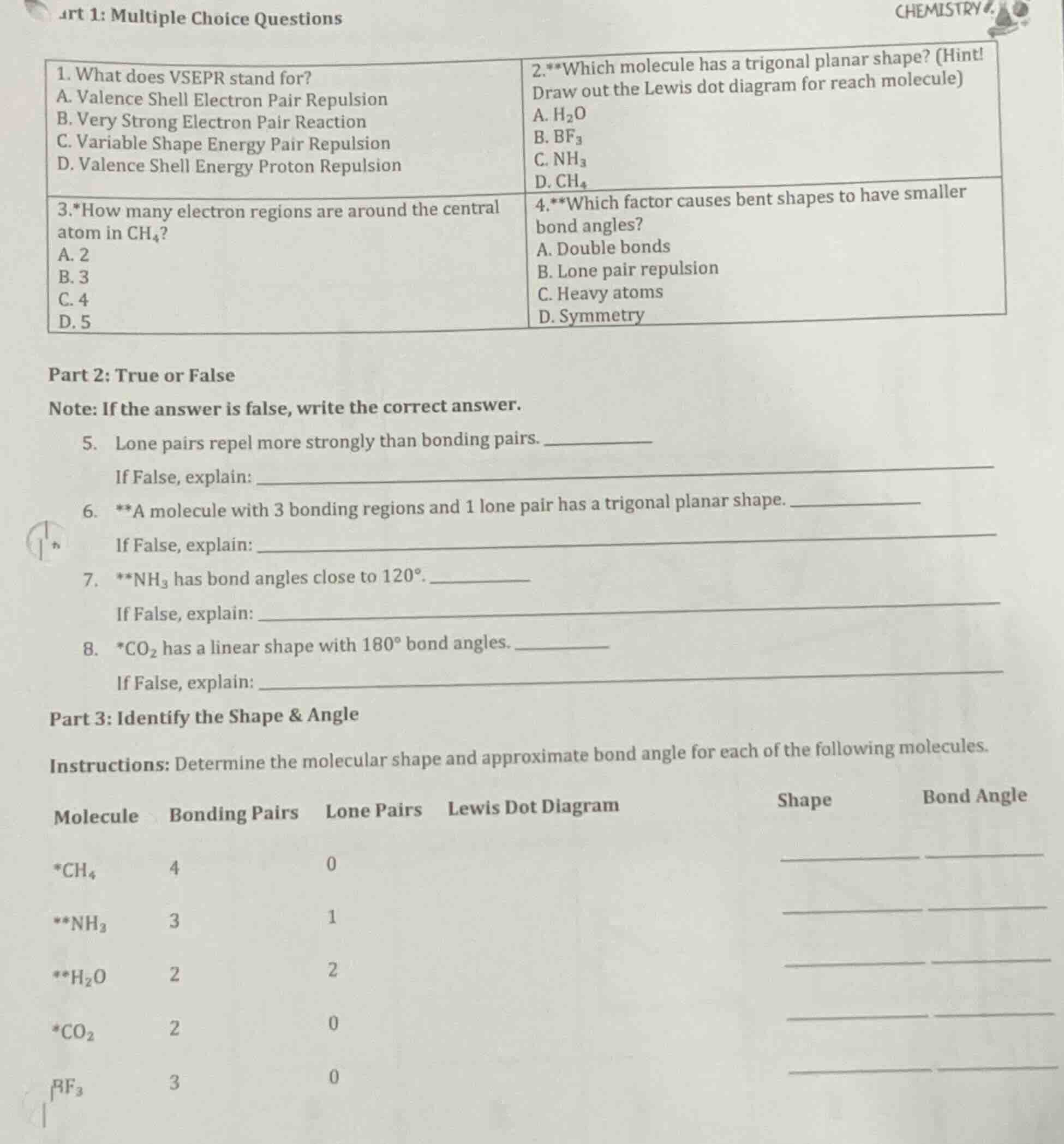
part 1: multiple choice questions
- what does vsepr stand for?
a. valence shell electron pair repulsion
b. very strong electron pair reaction
c. variable shape energy pair repulsion
d. valence shell energy proton repulsion
2.**which molecule has a trigonal planar shape? (hint! draw out the lewis dot diagram for reach molecule)
a. h₂o
b. bf₃
c. nh₃
d. ch₄
3.*how many electron regions are around the central atom in ch₄?
a. 2
b. 3
c. 4
d. 5
4.**which factor causes bent shapes to have smaller bond angles?
a. double bonds
b. lone pair repulsion
c. heavy atoms
d. symmetry
part 2: true or false
note: if the answer is false, write the correct answer.
- lone pairs repel more strongly than bonding pairs.
if false, explain:
- **a molecule with 3 bonding regions and 1 lone pair has a trigonal planar shape.
if false, explain:
- **nh₃ has bond angles close to 120°.
if false, explain:
- *co₂ has a linear shape with 180° bond angles.
if false, explain:
part 3: identify the shape & angle
instructions: determine the molecular shape and approximate bond angle for each of the following molecules.
molecule bonding pairs lone pairs lewis dot diagram shape bond angle
*ch₄ 4 0
**nh₃ 3 1
**h₂o 2 2
*co₂ 2 0
bf₃ 3 0
Part 1: Multiple Choice Questions
Question 1
VSEPR is a theory to predict molecular shapes, and its full name is Valence Shell Electron Pair Repulsion.
- \( \ce{H2O} \): 2 bonding pairs, 2 lone pairs → bent.
- \( \ce{BF3} \): 3 bonding pairs, 0 lone pairs → trigonal planar.
- \( \ce{NH3} \): 3 bonding pairs, 1 lone pair → trigonal pyramidal.
- \( \ce{CH4} \): 4 bonding pairs, 0 lone pairs → tetrahedral.
In \( \ce{CH4} \), the central C atom has 4 single bonds (bonding pairs) with H atoms, so there are 4 electron regions.

Snap & solve any problem in the app
Get step-by-step solutions on Sovi AI
Photo-based solutions with guided steps
Explore more problems and detailed explanations
A. Valence Shell Electron Pair Repulsion