QUESTION IMAGE
Question
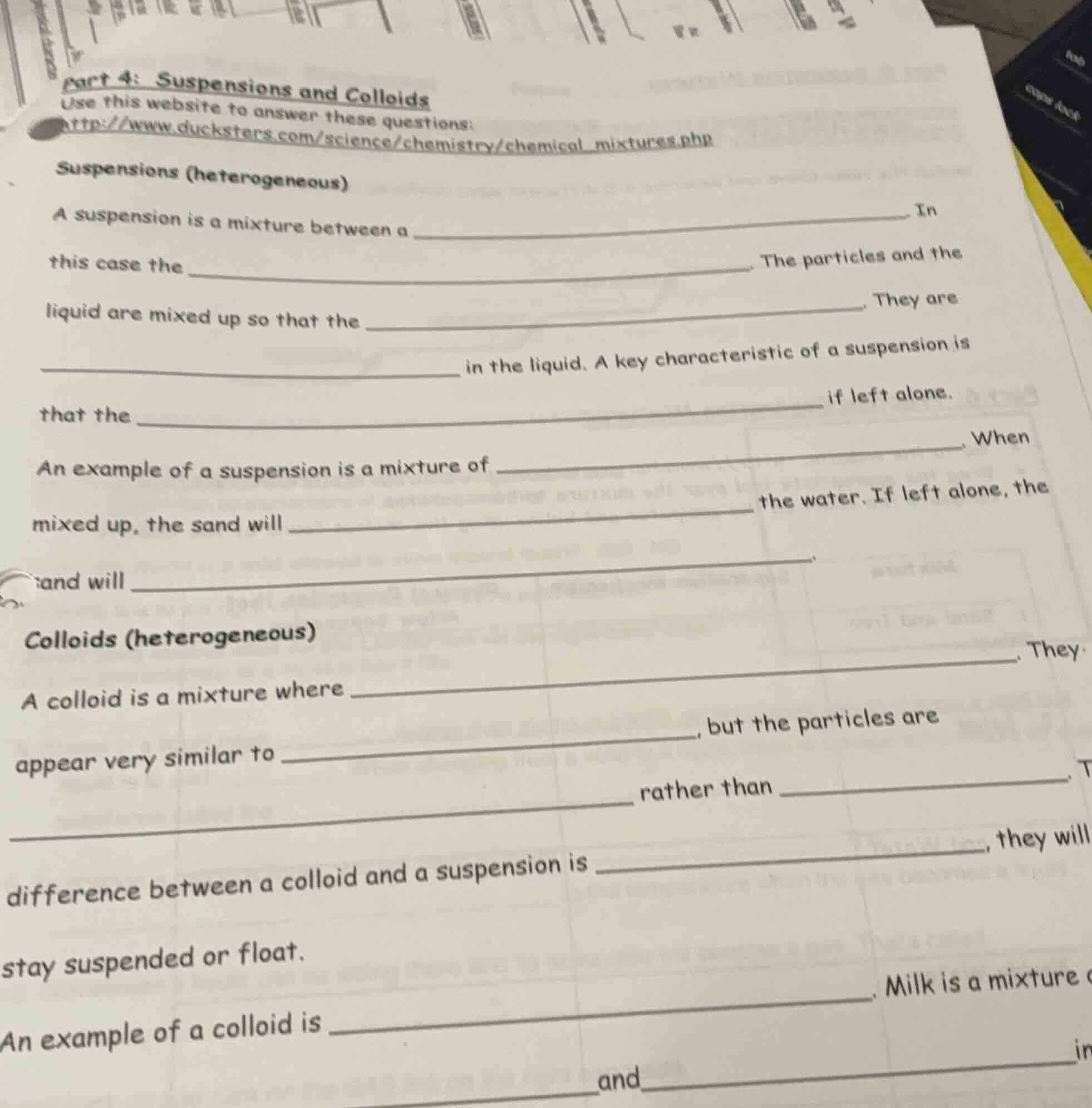
part 4: suspensions and colloids
use this website to answer these questions:
http://www.ducksters.com/science/chemistry/chemical_mixtures.php
suspensions (heterogeneous)
a suspension is a mixture between a ______________________________. in
this case the ______________________________________. the particles and the
liquid are mixed up so that the ________________________________. they are
______________________________ in the liquid. a key characteristic of a suspension is
that the ________________________________________ if left alone.
an example of a suspension is a mixture of __________________________. when
mixed up, the sand will _________________________ the water. if left alone, the
and will __________________________.
colloids (heterogeneous)
a colloid is a mixture where __________________________. they
appear very similar to ______________________, but the particles are
____________________ rather than ________________________. t
difference between a colloid and a suspension is ______________________, they will
stay suspended or float.
an example of a colloid is ______________________. milk is a mixture o
____________________ and____________________in
To answer these questions, we can refer to the provided website (http://www.ducksters.com/science/chemistry/chemical_mixtures.php) and recall basic concepts about suspensions and colloids:
Suspensions (heterogeneous)
- A suspension is a mixture between a solid and a liquid. In this case the solid particles are large enough to be seen. The particles and the liquid are mixed up so that the particles are dispersed throughout the liquid. They are not dissolved in the liquid. A key characteristic of a suspension is that the particles will settle out if left alone.
- An example of a suspension is a mixture of sand and water. When mixed up, the sand will be suspended in the water. If left alone, the sand will settle to the bottom of the container.
Colloids (heterogeneous)
- A colloid is a mixture where very small particles are dispersed throughout another substance. They appear very similar to solutions, but the particles are larger than those in a solution rather than dissolved. The difference between a colloid and a suspension is the size of the particles and their ability to stay suspended; in a colloid, the particles are small enough that they will stay suspended or float.
- An example of a colloid is milk (or fog, whipped cream, etc.). Milk is a mixture of fat globules and protein particles in water.
These answers are based on the definitions and properties of suspensions and colloids in chemistry. If you need more detailed or specific information, you can visit the provided website for further exploration.

Snap & solve any problem in the app
Get step-by-step solutions on Sovi AI
Photo-based solutions with guided steps
Explore more problems and detailed explanations
To answer these questions, we can refer to the provided website (http://www.ducksters.com/science/chemistry/chemical_mixtures.php) and recall basic concepts about suspensions and colloids:
Suspensions (heterogeneous)
- A suspension is a mixture between a solid and a liquid. In this case the solid particles are large enough to be seen. The particles and the liquid are mixed up so that the particles are dispersed throughout the liquid. They are not dissolved in the liquid. A key characteristic of a suspension is that the particles will settle out if left alone.
- An example of a suspension is a mixture of sand and water. When mixed up, the sand will be suspended in the water. If left alone, the sand will settle to the bottom of the container.
Colloids (heterogeneous)
- A colloid is a mixture where very small particles are dispersed throughout another substance. They appear very similar to solutions, but the particles are larger than those in a solution rather than dissolved. The difference between a colloid and a suspension is the size of the particles and their ability to stay suspended; in a colloid, the particles are small enough that they will stay suspended or float.
- An example of a colloid is milk (or fog, whipped cream, etc.). Milk is a mixture of fat globules and protein particles in water.
These answers are based on the definitions and properties of suspensions and colloids in chemistry. If you need more detailed or specific information, you can visit the provided website for further exploration.