QUESTION IMAGE
Question
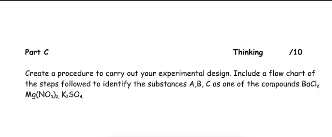
part c thinking /10 create a procedure to carry out your experimental design. include a flow chart of the steps followed to identify the substances a, b, c, as one of the compounds bacl₂, mg(no₃)₂, k₂so₄.
To identify substances A, B, C (one of BaCl₂, Mg(NO₃)₂, K₂SO₄), a procedure can be designed using chemical tests. First, recall the solubility rules and reaction properties: BaCl₂ forms a white precipitate with sulfate (Ba²⁺ + SO₄²⁻ → BaSO₄↓), Mg(NO₃)₂ forms a white precipitate with hydroxide (Mg²⁺ + 2OH⁻ → Mg(OH)₂↓), and K₂SO₄ is soluble in most cases and reacts with Ba²⁺ to form BaSO₄.
- Step 1: Test with BaCl₂ solution
Take three samples of A, B, C. Add BaCl₂ solution to each. The one that forms a white precipitate (BaSO₄) is either K₂SO₄ (if the other reactant is sulfate) or BaCl₂? Wait, no—BaCl₂ + K₂SO₄ → BaSO₄↓ + 2KCl. Mg(NO₃)₂ + BaCl₂ → no reaction (both soluble). So the sample with precipitate is either K₂SO₄ (if reacting with BaCl₂) or if the sample is K₂SO₄, adding BaCl₂ gives precipitate. Wait, let's correct:
- If we add BaCl₂ to each:
- Sample with Ba²⁺ (BaCl₂) + K₂SO₄ (if K₂SO₄ is another sample) → but we are testing A, B, C. So for each sample (A, B, C), add BaCl₂:
- If sample is K₂SO₄: BaCl₂ + K₂SO₄ → BaSO₄↓ (white).
- If sample is BaCl₂: no reaction (same ion).
- If sample is Mg(NO₃)₂: no reaction (Mg(NO₃)₂ + BaCl₂ → MgCl₂ + Ba(NO₃)₂, both soluble).
So the sample that gives a precipitate with BaCl₂ is K₂SO₄.
- Step 2: Test the remaining two samples with NaOH solution
Take the two non - precipitating samples (BaCl₂ and Mg(NO₃)₂). Add NaOH solution to each. Mg(NO₃)₂ + 2NaOH → Mg(OH)₂↓ (white), while BaCl₂ + NaOH → no reaction (Ba(OH)₂ is slightly soluble, but in dilute solution, no precipitate). So the one that forms a white precipitate is Mg(NO₃)₂, and the remaining is BaCl₂.
Flowchart Steps (Simplified):
- Start → Take three samples (A, B, C) → Add BaCl₂ solution to each → Observe precipitate?
- Yes: Substance is K₂SO₄ → Proceed to test remaining two.
- No: Proceed to next test.
- For remaining two, add NaOH solution → Observe precipitate?
- Yes: Substance is Mg(NO₃)₂.
- No: Substance is BaCl₂.
- End.
This procedure uses chemical reactions based on ionic precipitation to distinguish the three compounds by their unique reaction profiles with BaCl₂ (for sulfate detection) and NaOH (for magnesium detection).

Snap & solve any problem in the app
Get step-by-step solutions on Sovi AI
Photo-based solutions with guided steps
Explore more problems and detailed explanations
Procedure to Identify Substances (BaCl₂, Mg(NO₃)₂, K₂SO₄)
1. Experimental Design Rationale
Use chemical precipitation reactions (based on solubility rules and ionic interactions) to distinguish \( \text{BaCl}_2 \), \( \text{Mg(NO}_3\text{)}_2 \), and \( \text{K}_2\text{SO}_4 \). Key reactions:
- \( \text{Ba}^{2+} + \text{SO}_4^{2-}
ightarrow \text{BaSO}_4 \downarrow \) (white precipitate, insoluble).
- \( \text{Mg}^{2+} + 2\text{OH}^-
ightarrow \text{Mg(OH)}_2 \downarrow \) (white precipitate, insoluble).
2. Step - by - Step Procedure (with Flowchart Logic)
| Step | Action | Observation | Interpretation |
|---|
ightarrow \text{BaSO}_4 \downarrow + 2\text{KCl} \)). <br> Clear samples = \( \text{BaCl}_2 \) or \( \text{Mg(NO}_3\text{)}_2 \) (no reaction with \( \text{BaCl}_2 \)). |
| 2 | Take the two clear samples from Step 1. Add aqueous NaOH to each. | - One sample forms a white precipitate. <br> - The other remains clear. | Precipitate = \( \text{Mg(NO}_3\text{)}_2 \) (reaction: \( \text{Mg(NO}_3\text{)}_2 + 2\text{NaOH} |
ightarrow \text{Mg(OH)}_2 \downarrow + 2\text{NaNO}_3 \)). <br> Clear sample = \( \text{BaCl}_2 \) (no reaction with \( \text{NaOH} \), as \( \text{Ba(OH)}_2 \) is slightly soluble in dilute solution). |
3. Flowchart (Simplified)
flowchart LR
    A[Start: Identify A, B, C] --> B[Add BaCl₂ to all samples]
    B --> C{Precipitate?}
    C -->|Yes| D[Substance = K₂SO₄]
    C -->|No| E[Proceed to NaOH test]
    E[Take remaining 2 samples] --> F[Add NaOH to both]
    F --> G{Precipitate?}
    G -->|Yes| H[Substance = Mg(NO₃)₂]
    G -->|No| I[Substance = BaCl₂]
    D & H & I --> J[End: All substances identified]
Key Notes
- Ensure all reagents (BaCl₂, NaOH) are dilute and freshly prepared.
- Use clean test tubes/glassware to avoid contamination.
- Interpret results based on unique precipitation patterns (K₂SO₄ reacts with BaCl₂; Mg(NO₃)₂ reacts with NaOH; BaCl₂ reacts with neither in these steps).