QUESTION IMAGE
Question
period:
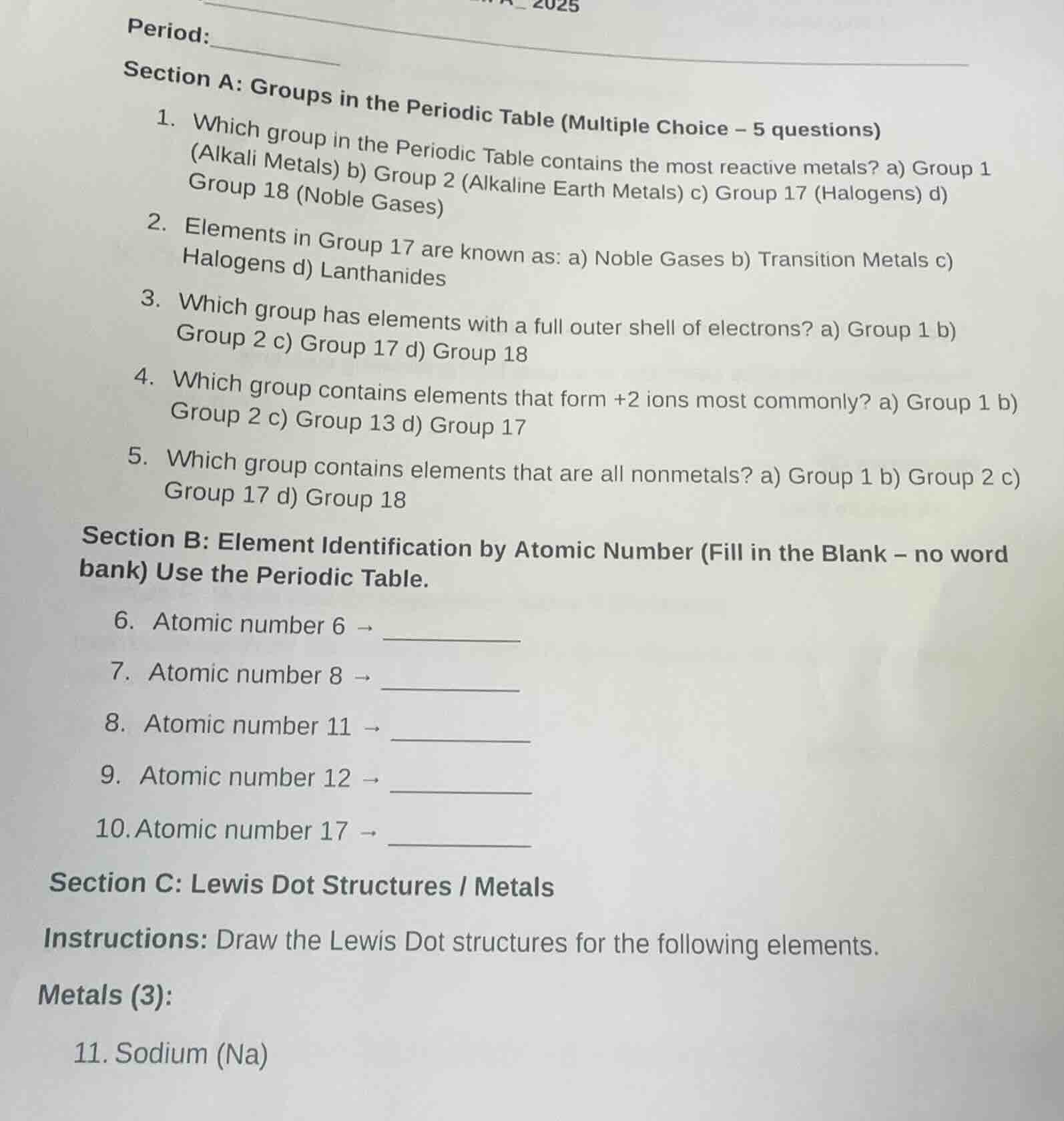
section a: groups in the periodic table (multiple choice – 5 questions)
- which group in the periodic table contains the most reactive metals? a) group 1 (alkali metals) b) group 2 (alkaline earth metals) c) group 17 (halogens) d) group 18 (noble gases)
- elements in group 17 are known as: a) noble gases b) transition metals c) halogens d) lanthanides
- which group has elements with a full outer shell of electrons? a) group 1 b) group 2 c) group 17 d) group 18
- which group contains elements that form +2 ions most commonly? a) group 1 b) group 2 c) group 13 d) group 17
- which group contains elements that are all nonmetals? a) group 1 b) group 2 c) group 17 d) group 18
section b: element identification by atomic number (fill in the blank – no word bank) use the periodic table.
- atomic number 6 → ______
- atomic number 8 → ______
- atomic number 11 → ______
- atomic number 12 → ______
- atomic number 17 → ______
section c: lewis dot structures / metals
instructions: draw the lewis dot structures for the following elements.
metals (3):
- sodium (na)
Section A
1.
Group 1 (Alkali Metals) are the most reactive metals because they have one valence electron that is easily lost, making them highly reactive. Group 2 metals are less reactive than Group 1, Group 17 are non - metals (halogens) and are reactive non - metals, and Group 18 are noble gases with low reactivity.
Group 17 elements are known as Halogens. Noble Gases are in Group 18, Transition Metals are in the d - block (groups 3 - 12), and Lanthanides are a specific series of elements.
Group 18 (Noble Gases) have a full outer shell of electrons (octet or duplet for helium), which makes them stable. Group 1 has 1 valence electron, Group 2 has 2 valence electrons, and Group 17 has 7 valence electrons.

Snap & solve any problem in the app
Get step-by-step solutions on Sovi AI
Photo-based solutions with guided steps
Explore more problems and detailed explanations
a. Group 1 (Alkali Metals)
2.